The Rubik's Twist has been a fun time sink. From the wiki page,
[It] is a toy with twenty-four wedges that are right isosceles triangular prisms. The wedges are connected by spring bolts, so that they can be twisted, but not separated. By being twisted, the Rubik's Snake can be made to resemble a wide variety of objects, animals, or geometric shapes. Its "ball" shape in its packaging is a non-uniform concave rhombicuboctahedron.
This page has an applet to show configurations in 3D and play around with it, which will give you an idea of what the puzzle is like (requires Wolfram CDF player plugin.)
Edit: another page that has a simulator working as of July 2023.
A friend asked what shape would minimize surface area and we thought the standard 'ball' shape would be the solution:
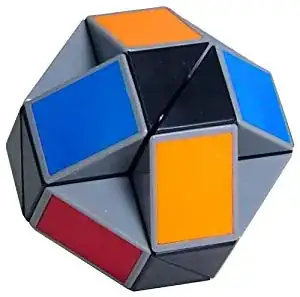
We denoted the square side of the wedge as $1u^2$ and thus the long rectangular side of the wedge is $\sqrt{2}u^2$ and a triangle is $\frac{1}{2}u^2$.
In the ball configuration, we counted 12 rectangle panels showing (blue, orange, and red in the above image) 6 "squares" (12 triangles) and 8 niches each made of 3 triangles giving:
- 12 + 24 = 36 triangles ($18u^2$)
- 12 rectangle panels ($12\sqrt{2}u^2$)
$18u^2 + 12\sqrt{2}u^2$ surface area, which is just under $35u^2$.
However, we found that there are configurations with smaller surface areas like:
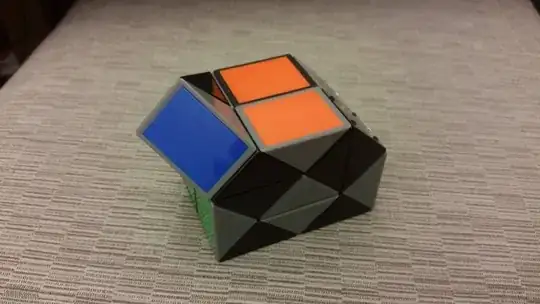
We calculated the surface area as just under $32u^2$ (12 rectangular panels, 2 squares and 26 triangles.)
The definition of surface we are using is any visible face - the area which would have to be painted if someone were to hold it and look all around it, no area would appear unpainted. (See the comments for extra clarification.)
In the ball shape (see first image) there is a 1x1x1 void in the center which is not counted as surface area as it is not visible. I'm not sure if that makes the problem much more difficult, however, I'd be interested to know of a solution in either case.
I calculate the surface area by counting up the number of visible rectangular panels, ($\sqrt{2}u^2$) triangles ($\frac{1}{2}u^2$) and the two square ends of the snake ($1u^2$ each.) By adding these units up I get the surface area.
So, for the ball we are excluding the $6u^2$ on the inside. Additionally, partial turns that expose the "inside" of the snake are not allowed (see below) as these are not valid configurations.
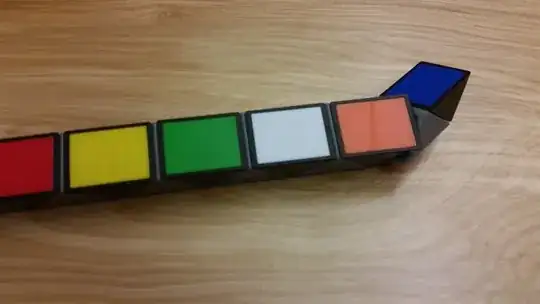 (Partial turn exposing inside grey face)
The ball shape had a lot of outcroppings which add up. We thought that another way of minimizing surface area is by maximizing touching faces. What configuration has the lowest visible surface area, and can it be derived or proved mathematically?
Or, can the configuration above be proven to exhibit the lowest surface area?
Or, can a computer program be written to iterate over (or in some way consider) all combinations (of which there can be no more than $4^{23}$ simply by observing each of the 23 twists can exist in 4 positions, although some positions are physically impossible as it overlaps itself) and find the solution?

Toying with it for some time, I am almost convinced that the OP shows the optimal solution. A proof will be difficult :-)
– Cuc Jun 19 '17 at 21:36