I'm trying to solve some problems in differential topology, and I came across the following: suppose $f:M\times [0,1]\rightarrow N$ is a homotopy, where $M$ is a compact manifold, such that $f_0$ and $f_1$ are $C^r$ functions, both transversal to a submanifold $K\subset N$, where $K$ is also compact; then there exists $W\subset M\times [0,1]$ a compact submanifold such that $\partial W=f^{-1}_0(K)\cup f_{1}^{-1}(K)$.
I know that one can assume that the homotopy is also a $C^r$-function (by Whitney Approximation Theorem) and, since both $f_0$ and $f_1$ are transversal to $K$, then $f^{-1}_0(K)$ and $f^{-1}_1(K)$ are submanifolds of $M$.
When we look at $M\times [0,1]$, the situation is the following:
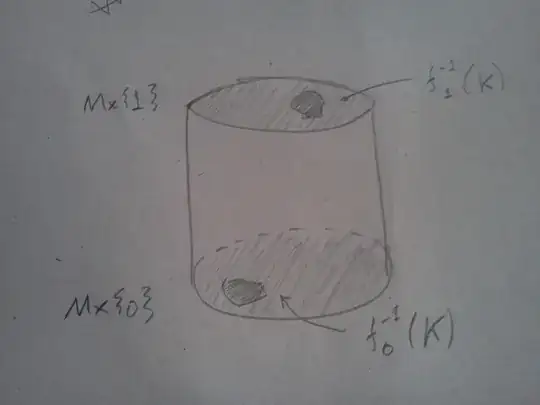 Besides it seems intuitively clear that we can "connect" $f^{-1}_0(K)$ to $f^{-1}_1(K)$, how this can be done formally?
Thank you

