6

This is an exercise in the book Partial Differential Equations (2nd edition) by Evans: enter image description here
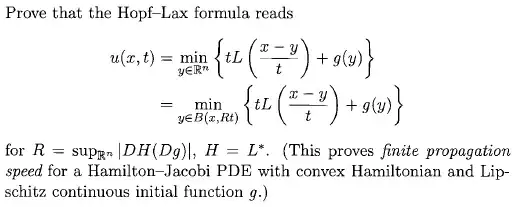
Here $L^*(q)=\max_{y\in {\Bbb R}^n}\{q\cdot y-L(y)\}$ and $L$ is assumed to be such that it is convex and satisfies $$ \lim_{|y|\to\infty}\frac{L(y)}{|y|}=+\infty. $$

I played around with the formula for a while but I don't make any progress. I don't see how one could possibly come up with "$DH(Dg)$". I vaguely feel that since $L$ and $H$ are connected to each other by the definition and the first minimum is achieved for some $y$, one might get $DH(Dg)$ by calculating the critical point. Also, a quick search on Google returns the following possibly useful result

enter image description here

Could anyone give me a hand to see how I shall go on?

EditPiAf
  • 21,328
  • Not sure why "a quick search on Google" was needed - the result you quoted is the previous problem in the textbook, which Evans tells you to use. –  Apr 19 '15 at 00:48
  • @pizza In the second edition of his book, the hint is deleted. –  Apr 19 '15 at 13:54

1 Answers1

5

If $y^*$ is a minimizer of the function $$y \mapsto tL\left(\frac{x-y}{t}\right)+g(y)$$ then the subdifferential of this function contains $0$. By the chain rule, this implies $$ 0\in -\partial L\left(\frac{x-y}{t}\right) + Dg(y) $$ Equivalently, $$ Dg \in \partial L\left(\frac{x-y}{t}\right) $$ by the previous exercise, which Evans suggests to use (the one you posted at the end of question) $$ \frac{x-y}{t} \in \partial H\left(Dg\right) $$ Thus, $$ |x-y|\le t \sup |\partial H\left(Dg\right)| $$ which was to be proved.