Hmm this appears pretty complicated. I hope there is a simpler solution.
Theorem. For any $n\ge3$ points on a 2D plane, we can always find 3 points $A,B,C$ such that $\angle ABC\le\frac{180°}n$. (OP's solution follows with $n=10$.)
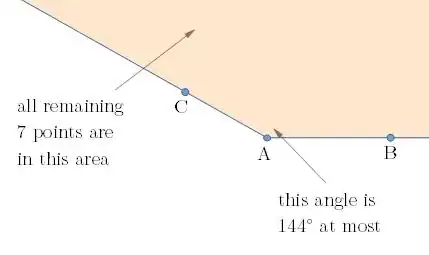
Proof. Again we take an edge of the convex hull and all points lie on the other side of this edge. Let's say points $A$ and $B$ are on this edge.
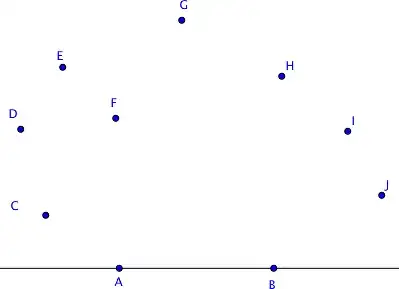
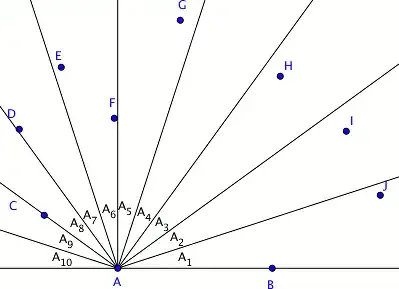
Partition the half-plane into $n$ regions about point $A$. Name each region $A_1,\dotsc,A_n$, where a point $X$ inside $A_i$ means $\frac{180°}n(i-1)<\angle XAB\le \frac{180°}n\cdot i$.
Do the same about point $B$. This will create $n$ other region $B_1,\dotsc,B_n$, where point $X$ in $B_j$ means $\frac{180°}n(j-1)<\angle XBA\le \frac{180°}n\cdot j$.
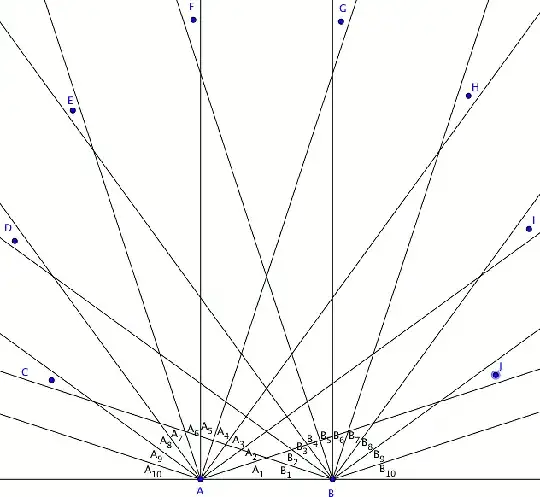
If two points $X,Y$ can be found in the same region $A_i$, then we also have $\angle XAY \le \frac{180°}n$. That means only one point can exist in each of the region $A_i$ (there are $n-2$ points and $n-1$ valid regions). Same for $B_j$.
$A_i$ and $B_j$ may overlap, though only when $i+j< n+2$ (a):
\begin{array}{c|ccccccc}
& A_2 & A_3 & A_4 & \cdots & A_{n-2} & A_{n-1} & A_n \\ \hline
B_2 & ✓ & ✓ & ✓ & \cdots & ✓ & \color{red}{✓} & ✗ \\
B_3 & ✓ & ✓ & ✓ & \cdots & \color{red}{✓} & ✗ & ✗ \\
B_4 & ✓ & ✓ & ✓ & \cdots & ✗ & ✗ & ✗ \\
\vdots & \vdots & \vdots & \vdots & ⋰ & \vdots & \vdots & \vdots \\
B_{n-2} & ✓ & \color{red}{✓} & ✗ & \cdots & ✗ & ✗ & ✗ \\
B_{n-1} & \color{red}{✓} & ✗ & ✗ & \cdots & ✗ & ✗ & ✗ \\
B_n & ✗ & ✗ & ✗ & \cdots & ✗ & ✗ & ✗ \\
\end{array}
we immediately see that the points can only exist in the overlapping regions $A_i B_{n+1-i}$, to ensure no two point occupy the same column ($A_i$) or same row ($B_j$).
So for any $X$ in $A_i B_{n+1-i}$, we have:
\begin{align}
\angle XAB &> \frac{180°}n(i-1) \\
\angle XBA &> \frac{180°}n(n-i) \\
\end{align}
For the triangle $\triangle ABX$, we need $\angle XAB + \angle XBA + \angle AXB = 180°$, thus
$$ \angle AXB < 180° - \frac{180°}n(i-1) - \frac{180°}n(n-i) = \frac{180°}n. $$
Note:
(a) if point $X$ exists in both $A_i$ and $B_j$ with $i+j\ge n+2$ then $$\angle XAB + \angle XBA > \frac{180°}n(i+j-2) \ge 180°,$$ which is impossible.