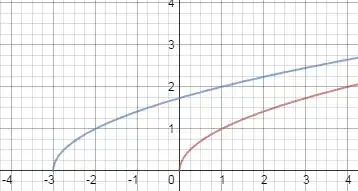
I have been having trouble understanding the translation of a graph. I understand the 'rule in the sense that the '$+$' shifts to the left and the '$-$' to the right when dealing with something like e.g. $f(x + 2) = f(x)$.
In the book I am using it has written that if $g(x) = f(x-c)$, where $c > 0$ then the value of $g$ at $x$ is the same as the value of $f$ at $x-c$.
So ...if $c = 2$ and my function for $g$ was $g(x) = x^2$ and I put in $x=3$ I'd get $9$. For $f(x-c)$ I don't quite understand this part. Am I wanting to put in the same $x$ (i.e. $x = 3$) which would give me $f(3-1) = f(1) = g(3) = 9$. When I do this it seems to work against how I thought it would go. To me this implies that in $g(x)$ when I input $3$ for $x$ I'd get a $y$ value of $9$. Then when I input $x=3$ in the function for '$f$' I'd end up with $f(1)$ provides me with $9$. It seems $g(1)$ is going back $2$ spaces to the left when compared to $f(3)$ in order to get the answer $9$ (based on $3-1 =2 $, from within the functions respective brackets)
Clearly I misunderstand something here.....