Remark. I somehow missed the fact that this is a duplicate question.
This is the MSE link
to the original computation, which did not include the PIE component.
The number of different isomers can be calculated by an application of
the Polya Enumeration Theorem (PET) to the vertex permutation group of
the regular icosahedron. We will not be concerned with the central
vertex as it is fixed by all rotations and only adds a factor of two
to the result. The general case that includes reflections can be
challenging and may require assistance from a computer algebra system
but rotations only are just simple enough that they can be done using
pen and paper and your imagination (it seems difficult to mentally
reflect an icosahedron through its center and factor the resulting
permutation).
We will now compute the cycle index $Z(Q)$ of the vertex permutation
group $Q$ of the regular icosahedron in order to apply PET. As this is
the dual of the regular dodecahedron and the dodecahedron is somewhat
simpler to work with we will use the dodecahedron and calculate the
face permutation group of the regular dodecahedron, which can be seen
at this Wikipedia entry.
We enumerate the permutations in this group. There is the identity,
which contributes $$a_1^{12}.$$ There are two rotations about an axis
passing through any one of ten pairs of opposite vertices, which
contributes $$10\times 2\times a_3^4.$$ There are four rotations about
an axis passing through the centers of any one of six pairs of
opposite faces, for a contribution of $$6\times 4\times a_1^2
a_5^2.$$ Finally there is a rotation about an axis passing through the
centers of any one of fifteen pairs of opposite edges, for a
contribution of $$15\times a_2^6.$$
This gives the following cycle index:
$$Z(Q)
= \frac{1}{60}
\left(a_1^{12} + 20a_3^4 + 24 a_1^2 a_5^2 + 15 a_2^6\right).$$
which in turn gives the following generating function for two colors / two types of atoms:
$${\frac { \left( 1+z \right) ^{12}}{60}}+1/4\,
\left( {z}^{2}+1 \right) ^{6}+2/5\, \left( 1+z
\right) ^{2} \left( {z}^{5}+1 \right) ^{2}
+1/3\, \left( {z}^{3}+1 \right) ^{4}$$
or alternatively
$${z}^{12}+{z}^{11}+3\,{z}^{10}+5\,{z}^{9}+12\,{z}^{8}+14\,{z}^{7}
\\+24\,{z}^{6}+14\,{z}^{5}+12\,{z}^{4}+5\,{z}^{3}+3\,{z}^{2}+z+1.$$
This is indexed by the number of instances of the one type of atom.
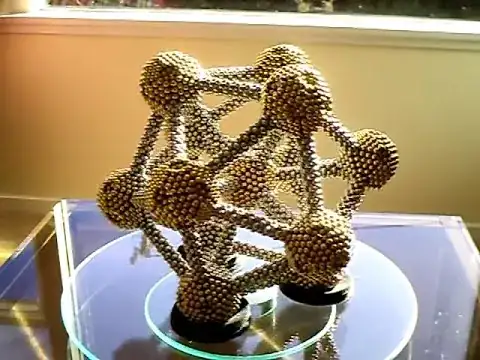
Answering the OPs question, if you put a silver atom in the center that leaves four silver, eight gold, and the generating function says that there are $12$ isomers. If you put a gold atom in the center that leaves five silver and seven gold and the generating function says there are $14$ isomers.
With $N$ different colors we obtain the sequence
$$1, 96, 9099, 280832, 4073375, 36292320, 230719293,
\\ 1145393152, 4707296613, 16666924000,\ldots$$
which points us to OEIS A000545
where the above calculation is confirmed.
Note that we can derive a formula for the case of $N$ colors
by using the fact that it is given by
$$Z(Q)(C_1+C_2+\cdots+C_N)_{C_1=1, C_2=1, \ldots C_N=1}.$$
This yields
$$a_N = \frac{1}{60}
\left(N^{12} + 44N^4 + 15 N^6\right).$$
The sequence $\{a_N\}$ counts colorings using at most $N$ colors and we
need to use the principle of inclusion-exclusion (PIE) to get the
number of colorings with exactly $M$ colors, call this sequence
$\{b_M\}.$
We have
$$b_M = \sum_{N=1}^M {M\choose N} (-1)^{M-N} a_N.$$
This gives the sequence
$$1, 94, 8814, 245008, 2759250, 15884004, 52701264, 106866144, \\
134719200, 103118400, 43908480, 7983360, 0, 0, 0, 0,\ldots$$
which is finite because there are only twelve vertices available for
coloring and hence no coloring with thirteen different colors, etc.
Observe that
$$\frac{12!}{60} = 7983360$$
which is because with twelve different colors all orbits have the same size, namely $60.$
This list at MSE Meta has many more Polya / Burnside computations by various users.