3

Since $\lim_{x \to 0}$$\sin x \over x$$=1$,here let $x=$$\pi\over n$ , then we have $\lim_{{\pi\over n} \to 0}$$\sin {\pi\over n} \over {\pi\over n}$$=1$ , which implies $\pi=$$\lim_{n \to\infty}$$\ n*sin {\pi\over n}$ Plot of the function $\ n*sin {\pi\over n}$ Here is the link of the animated graph of this method: Approximation of Pi

The idea is to evaluate $\pi$ by assigning a very large number to $n$, and then calculate the corresponding value of the function $f(n)=n*sin {\pi\over n}$ using a computer program: the bigger $n$ is, the closer to $\pi$ it will be.

So, here comes the question which makes me very confused: Am I cheating in this case by using the $\pi$ already existing in the function $f(n)=n*sin {\pi\over n}$ to generate the accurate value of $\pi$?

I'm not sure if I can do this. But the $\pi$ in the function actually acts as a notation of angle, which can be replaced with $180^\circ$, while the other $\pi$ here is a real number. They are different concepts So I guess it is not cheating.

  • 2
    It depends on how exactly you will be calculating the limit. So if have no value of $\pi$, how would you calculate the elements of $(a_n)$? – Andrei Rykhalski Feb 24 '15 at 17:47
  • 1
    $\lim_{x\to\infty} \frac{\sin x} {x}$ is $0$, not $1$. – Henrik supports the community Feb 24 '15 at 17:49
  • @Henrik i think that is a typo , it should be $n$ tending to infinity – avz2611 Feb 24 '15 at 17:50
  • oh, i'll correct it – Broken Pipe Feb 24 '15 at 17:53
  • I'd say it depends on if you can find a way of evaluating $\sin(\pi/n)$ or a subsequence thereof in an analytical, exact way or at least without necessarily knowing the exact value of $\pi$. – user159517 Feb 24 '15 at 17:57
  • 1
    @user159517 Yes, I think it's possible to get the exact value of $\sin{180^\circ \over 2^n}$ without using a computer. – Broken Pipe Feb 24 '15 at 18:04
  • I tried it in Maple which doesnt seem to be able to find a closed form for the sequence (except of course as $\sin(\pi/{2^n})$) which is a bad sign. – user159517 Feb 24 '15 at 18:07
  • I wonder if the question can be better tagged. – Broken Pipe Feb 24 '15 at 18:23
  • For example if you use power series to approximate $\sin(\pi /n)$, the formula you'd end up with is $\pi=\pi$. This has nothing to do with using the symbol $\pi$ instead of degrees, it's intrinsic to $\sin(x)$. – mathematician Feb 24 '15 at 18:42
  • Expanding on the comment by user159517, but with a positive result: There's a closed form not involving $\pi$ for $\mathrm{sin}(\pi/2^n)$, so you can in fact use the limit $\mathrm{lim}_{n\rightarrow\infty} 2^n \mathrm{sin}(\pi/2^n) = \pi$ to get an approximation for $\pi$ which does not circularly use its value. – aes Feb 26 '15 at 01:25
  • Note that $P = \lim_{n\to\infty} n\sin\left(\frac{P}{n}\right)$ holds for all $P$ so this method is not able to give us $\pi$ without knowing it beforehand. – Winther Feb 26 '15 at 01:46

2 Answers2

4

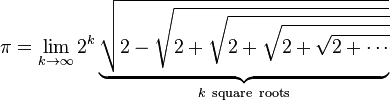
Since $\sin(\frac\pi{2^n})$ can be evaluated exactly (example), this isn't necessarily circular.

From Wikipedia:
enter image description here

The thing on the right is equal to $2^{k+1}\sin(\frac\pi{2^{k+1}})$, which is your equation with $n=2^{k+1}$.

  • You can use this to get $\pi$ up to six decimal-places accuracy (due to rounding errors) on a TI-84. First, press 0 and then ENTER. Then, type $\sqrt{2+\textrm{Ans}}$ and then ENTER ten times. Then, press $\sqrt{2-\textrm{Ans}}$ and ENTER, and finally press $\textrm{Ans}\times2^{11}$. – Akiva Weinberger Feb 26 '15 at 02:36
  • (Photo taken from here. It's in Related Formulas.) – Akiva Weinberger Feb 26 '15 at 02:41
0

Yes, this is cheating; your computer will surely be using the value of $\pi$ in the computation, which defeats the purpose - and this fact is somewhat unavoidable, given that $\sin(x)$ is likely computed by Taylor series - and plugging $\pi x$ into such a method certain requires knowing $\pi$ (as opposed to if $\sin$ was calculated geometrically, where $\pi$ might be a more natural unit - as has been referenced by comments, an interesting limit is the first equation in this question).

In spirit, if you had an equation of the form: $$\pi=f(\pi)$$ for some function $f$, then you could might be able to solve the above numerically. For instance, we could find $\pi$ by noting that $\pi=\sin(\pi)+\pi$ and, as the derivative of $\sin(x)+x$ is $0$ at $x=\pi$, we could perform a method called fixed-point iteration to find $\pi$ by choosing some starting point $x_1$ (for instance $3$) and setting $x_2=\sin(x_1)+x_1$ and so on. This converges to $\pi$, despite the definition looking initially circular.

However, we can prove the following fact: $$x=\lim_{n\rightarrow\infty}n\sin\left(\frac{x}n\right)$$ which means your equation works equally well for any $x$ that is not $\pi$ - so we cannot use it to figure out that value of $\pi$ as it does not uniquely specify it.

Milo Brandt
  • 61,938