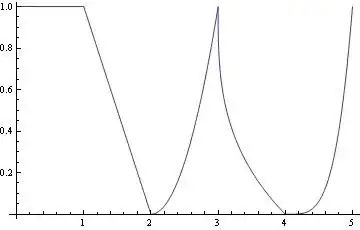
Let f be a non-negative continuous function on $[0,\infty)$.
If it's given that: $$\lim_{x \to \infty}\int_{x}^{x + 1}f(t)dt = 0$$
Does it follow that: $$(*) \ \lim_{x \to \infty}f(x) = 0 ?$$
Why or why not?
I (thought) I had solved this problem, but it was pointed out that my argument was flawed. To prove $(*)$, I reasoned as follows:
$f$ is continuous, so by MVT, there exists $C_x$ in $[x,x+1]$, such that:
$$\int_{x}^{x + 1}f(t)dt = f(C_x)\int_{x}^{x + 1}dt = f(C_x)$$
So it follows that:
$$\lim_{x \to \infty}f(x) = \lim_{x \to \infty}f(C_x) = \lim_{x \to \infty}\int_{x}^{x + 1}f(t)dt = 0 $$
What is missing in my work? Or where had I gone wrong?
In case I'm mistaken and $(*)$ doesn't hold, in general, please present a counter-example and explain to me where had I gone wrong.
Thanks a lot.