It is a well known fact that the map $f(x)=4x(1-x)$ is chaotic on $[0,1]$. By chaotic I mean the usual definition, i.e.:
a) the periodic points of $f$ are dense in $[0,1]$,
b) $f$ is topologically transitive,
c) $f$ exhibits sensitive dependence on initial conditions
One way to prove it is to show that the map: $$T(x)=\begin{cases} 2x, & \text{if }x\in[0,1/2) \\ 2-2x, & \text{if }x\in [1/2,1] \end{cases}$$ is chaotic, and then to show that there is a conjugacy between $f$ and $T$, which implies that $f$ is chaotic. According to Wikipedia for most values of $r>3.56995$ the function $f_r(x)=rx(1-x)$ is chaotic on a subset of $[0,1]$.
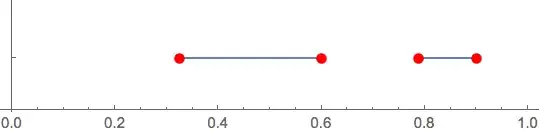
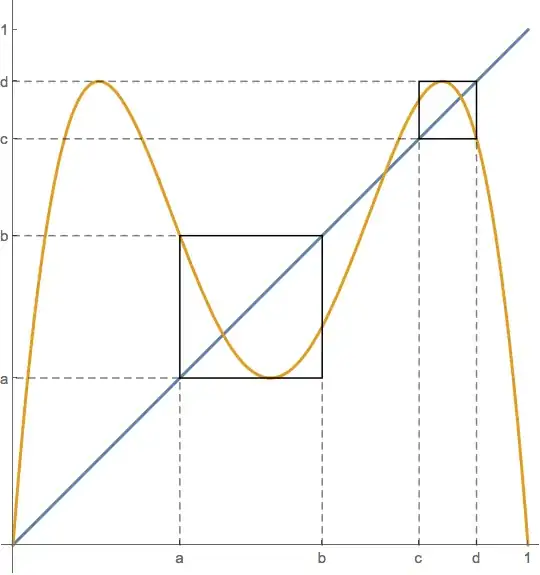
I am interested in proving that $f_{3.6}(x)=3.6x(1-x)$ is chaotic. By looking at the cobweb plot it seems that $f_{3.6}$ is chaotic on the interval $[0.324,0.9]$. I have tried to use a similar approach to the one described above to show that $f_{3.6}$ is chaotic, but I have not been able to find a conjugacy between $f_{3.6}$ and $T$. Does anybody know a way to show that $f_{3.6}$ is chaotic on $[0.324,0.9]$?