I'm trying to solve
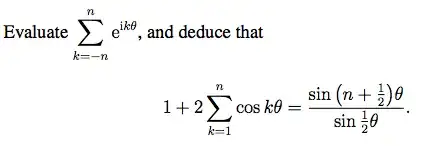
So far I've done the first part, evaluating the summation  ;
;
where a is just n. I'm not sure where to go from here or what it even means deduce the second summation. I understand that the summation of simply $$\sum\limits_{k=0}^n\cos(kx)$$ is derived from looking at the real part of $$\sum_{k=0}^n{\rm e}^{ikx} $$I'm guessing they want me to see how the second summation in the question is defined by 'playing around' with the original?


