When does a triangle's circumcenter to lie on its incircle? The isosceles right triangle is an example of such a triangle ...
Asked
Active
Viewed 1,204 times
0

-
3Yes: Consider the isosceles right triangle. The circumcenter is the midpoint of the hypotenuse; that's also the point where the incircle touches that side. – Blue Jan 17 '15 at 04:38
-
1@Zubin Mukerjee you can add a condition that the triangle is not isosceles then question may become interesting. – Satvik Mashkaria Jan 17 '15 at 04:53
2 Answers
6
Yes: Consider the isosceles right triangle. The circumcenter is the midpoint of the hypotenuse; that's also the point where the incircle touches that side.
Moreover, consider making the vertex angle of that triangle smaller and smaller (while remaining isosceles). The circumcenter moves to the interior of the incircle until ---when the triangle becomes equilateral--- it coincides with the incenter. For a sufficiently-small vertex angle, the circumcenter will be diametrically opposite the incircle's point of tangency with the base.
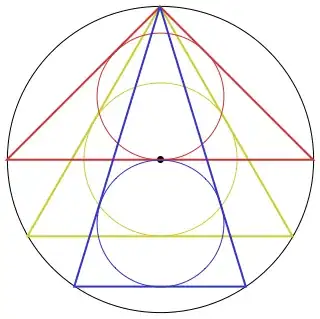
More generally, we can reference the formula for the distance from circumcenter ($K$) to incenter ($J$): $$|\overline{JK}|^2 = R (R - 2 r)$$ where $R$ and $r$ are, respectively, the circumradius and inradius. For $K$ to lie on the incircle, $|\overline{JK}| = r$, so that $$R^2 - 2 R r = r^2 \qquad(\star)$$ Given that $$r = 4 R \sin\frac{A}{2}\sin\frac{B}{2}\sin\frac{C}{2}$$ $(\star)$ is equivalent to $$1 - 8 \sin\frac{A}{2}\sin\frac{B}{2}\sin\frac{C}{2} - 16 \sin^2\frac{A}{2}\sin^2\frac{B}{2}\sin^2\frac{C}{2} = 0$$ which becomes $$\sin\frac{A}{2}\sin\frac{B}{2}\sin\frac{C}{2} = \frac{1}{4}\left(\sqrt{2}-1\right) \qquad (\star\star)$$ (We discard the solution $-(\sqrt{2}+1)/4$, since all the sines are necessarily positive.) We can also write $(\star\star)$ as $$\cos A + \cos B + \cos C = \sqrt{2}$$ (whereby the isosceles right triangle solution is evident); the Law of Cosines, and a bit of clean-up, then provides this form of the relation: $$(-a+b+c)(a-b+c)(a+b-c) = 2 a b c \left(\;\sqrt{2}-1\;\right)$$

Blue
- 83,939
-
2Incidentally, the "sufficiently-small" vertex angle I mentioned is about $34.0625^\circ$. – Blue Jan 17 '15 at 05:27
-
2
-
1I thought that vertex angle was $\approx34°03'45''$ :-). The apparent $1/16$ in the fractional part is a misdirection; it is not a rational-degree angle. – Oscar Lanzi Jun 05 '24 at 13:08
0
Try to prove that the ratio between tha greatest and smaller side of triangle is less than 2
