This is a problem from Discrete Mathematics and its Applications
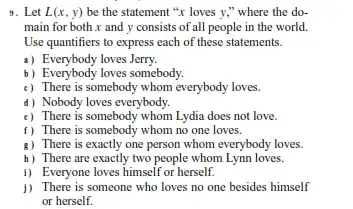
My question is on 9g.
Here is my work so far 
I am struggling with the exactly one person part. The one person whom everybody loves is pretty straight forward ( ∃ x∀y(L(y,x)). I am trying to apply the method that Alan gave in How to express exact quantifier in this situation? from my other question. From what I have, if I know that x is a possibility(one, exists), I have to iterate over all the rest of the domain to ensure that there are no other possibilities(check against x) That's what I tried doing with the conjunction. However, this doesn't work because in my diagram, A is the exact one person whom everybody loves. I also showed that C loves C. Once q and w take up C and C (go through all the values in the domain) w, which is C, is not A, which means the whole expression is false because the implication is false but the expression shouldn't be false(A is the only one in the diagram whom everybody loves. C loving C should not have an effect) Is there any way else I can restructure the nested quantifier so i can still iterate through and see if there are any others that everybody loves?


