6

I got a homework and I've trying to do this problem about 2 days, but I "lost my fight". So I turn to you. I have to prove that $$\int _0^\infty \frac{\sin (x)}{x} \, dx = \frac{\pi}{2}.$$ I can't use complex numbers, double integral, laplace transforms.

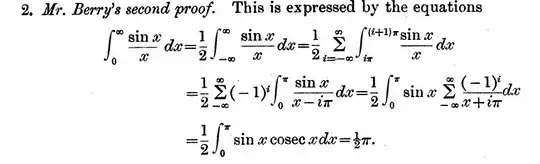
I found Mr. Berry's proof, which is looks good, but I don't understand any steps so I need some explanation. Proof on the picture. Thank you!

enter image description here

Zarrev
  • 63
  • 1
    At which point do you start having problems ? – Claude Leibovici Jan 10 '15 at 08:31
  • 1
    I dont understand the second line on the picture. What did he do? Integral has changed and the fraction denominator, it get a (-1)^i, but how? And the penultimate sum equal 1/sin(x), but why? (sry I cant use latex form on the page) – Zarrev Jan 10 '15 at 08:51
  • 2
    I think because he changed the integration bounds from $[i\pi,(i+1)\pi]$ to $[0,\pi]$ by the change of variables $x=y+i\pi$. I agree that it would have been better to change the name of the variable. The last summation is the development of $\csc(x)$. Please, tell me if this helps. Cheers. – Claude Leibovici Jan 10 '15 at 08:56
  • I'm so sorry, but I found a mistake in the equation, I've repaired it. Your help is good, but I still don't understand how get it. – Zarrev Jan 10 '15 at 09:14
  • You have a very answer from Ron Gordon. Cheers :-) – Claude Leibovici Jan 10 '15 at 09:16
  • The use of $i$ as an index here by "Mr. Berry" (who is he, BTW?) is a bit confusing. – user1551 Jan 10 '15 at 09:18
  • I don't know who is he :D BTW, sb can give a link to a proof for it (which don't use complex things)? :D And thank you Claude Leibovici :) – Zarrev Jan 10 '15 at 09:43
  • 1
    https://math.stackexchange.com/questions/5248/evaluating-the-integral-int-0-infty-frac-sin-x-x-dx-frac-pi-2?noredirect=1&lq=1 – Guy Fsone Jan 02 '18 at 08:50

2 Answers2

5

Note that

$$\underbrace{\int_{i \pi}^{(i+1) \pi} dx \frac{\sin{x}}{x}}_{x=u+i \pi} = \int_0^{\pi} du \frac{\sin{(u+i \pi)}}{u+i \pi} = (-1)^i \int_0^{\pi} du \frac{\sin{u}}{u+i \pi}$$

Then

$$\sum_{i=-\infty}^{\infty} \int_{i \pi}^{(i+1) \pi} dx \frac{\sin{x}}{x} = \sum_{i=-\infty}^{\infty} (-1)^i \int_0^{\pi} du \frac{\sin{u}}{u+i \pi} = \sum_{i=-\infty}^{\infty} (-1)^i \int_0^{\pi} du \frac{\sin{u}}{u-i \pi}$$

We may reverse the order of summation and integration, so that the integral is equal to

$$\frac12 \int_0^{\pi} du \, \sin{u} \sum_{i=-\infty}^{\infty} \frac{(-1)^i}{u-i \pi} $$

This last sum is $\csc{u}$; one may show this using the Residue Theorem.

Ron Gordon
  • 141,538
2

Since you cannot use complex numbers, double integrals, or Laplace transforms, here is a method that comes to mind. After showing that the improper integral exists, let $A = \int_0^\infty \frac{\sin x}{x}\, dx$. Then $$A = \lim_{n\to \infty} \int_0^{(2n+1)\frac{\pi}{2}} \frac{\sin x}{x}\, dx = \lim_{n\to \infty} \int_0^\pi \frac{\sin \frac{(2n+1)}{2}x}{x}\, dx = \lim_{n\to \infty} \int_0^\pi f(x)g_n(x)\, dx,$$

where $f(x) = \frac{\sin x/2}{x/2}$ and $g_n(x) = \frac{\sin (2n+1)x/2}{2\sin x/2}$. Since $$g_n(x) = \frac{1}{2} + \sum_{k = 1}^n \cos kx$$ for $0 < x < \pi$, we have $$\int_0^\pi g_n(x)\, dx = \frac{\pi}{2}.$$ Therefore

$$\int_0^\pi f(x)g_n(x)\, dx = \frac{\pi}{2} + \int_0^\pi h(x)\sin \frac{(2n+1)x}{2}\, dx,$$

where $h(x) = (f(x) - 1)/(2\sin x/2)$. Not only is $h$ continuous on $(0,\pi)$, but $h$ also has a right-hand limit at $0$. Indeed, $$\lim_{x \to 0^+} h(x) = \lim_{x\to 0^+} \frac{f(x) - 1}{x} \lim_{x\to 0^+} \frac{x/2}{\sin x/2} = \lim_{x\to 0^+} \frac{f(x) - 1}{x} = \lim_{x\to 0^+} \frac{2\sin \frac{x}{2} - x}{x^2},$$ and

$$\lim_{x\to 0^+} \frac{2\sin \frac{x}{2} - x}{x^2} = \lim_{x\to 0^+} \frac{O(x^3)}{x^2} = \lim_{x\to 0^+} O(x) = 0.$$ Thus $h(x)$ is piecewise continuous on $(0,\pi)$. Hence, by the Riemann-Lebesgue lemma, $\lim_{n\to \infty} \int_0^\pi h(x)\sin \frac{(2n+1)x}{2}\, dx = 0$. Now we deduce $$\lim_{n\to \infty} \int_0^\pi f(x)g_n(x)\, dx = \frac{\pi}{2},$$ in other words, $A = \frac{\pi}{2}$.
kobe
  • 43,217
  • Thank you so much, but I don't know what is O(x^3). Can you tell me? – Zarrev Jan 10 '15 at 13:29
  • 1
    It's big-O notation. If you're uncomfortable with it, you can use L'hospital's rule to find $\lim_{x\to 0^+} (2\sin(x/2) - x)/x^2$. – kobe Jan 10 '15 at 13:44