Another way to look at how the separation decreases with time would be as follows.
Assumptions:
- The initial length of the triangle is $a$.
- All particles move with constant speed $v$.
Let at a certain instant of time $t$, the side length of the triangle is $x(t)$.
The image represents the position of the three particles at any instant of time $t$ and its subsequent position after a time $\Delta t$.
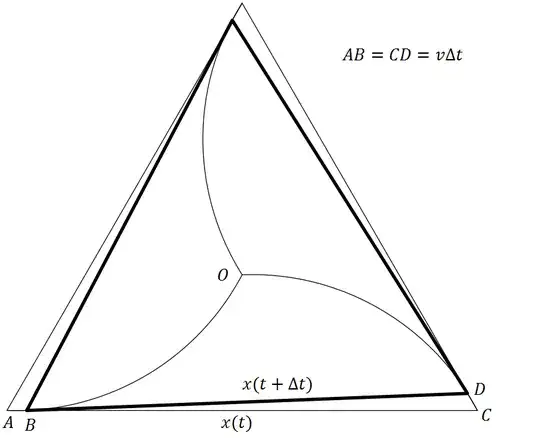
Do note that the angle $\angle BCD$ is always $60^0$.
Applying the cosine rule to the $\Delta BCD$, we have
$$ \cos \frac{\pi}{3}=\frac{1}{2}=\frac{[x(t)-v\Delta t]^2 + [v\Delta t]^2 -[x(t+\Delta t)]^2}{2[x(t)-v\Delta t][v\Delta t]}$$
$$ \implies [x(t)-v\Delta t][v\Delta t]= [x(t)]^2 + 2[v\Delta t]^2 -2vx(t)\Delta t -[x(t+\Delta t)]^2 $$
$$\implies vx(t)\Delta t -[v\Delta t]^2 = [x(t)]^2 + 2[v\Delta t]^2 -2vx(t)\Delta t -[x(t+\Delta t)]^2$$
$$\implies [x(t+\Delta t)]^2 -[x(t)]^2=3[v\Delta t]^2 -3vx(t)\Delta t $$
Let $\big [x(t)]^2=A(t)$. The above equation becomes
$$\implies A(t+\Delta t) -A(t) = 3[v\Delta t]^2 -3v\sqrt{A(t)}\Delta t $$
$$\implies \frac{A(t+\Delta t) -A(t)}{\Delta t} = 3v^2 \Delta t - 3v\sqrt{A(t)}$$
Taking the limit $\Delta t \rightarrow 0$, the LHS becomes a derivative, and the first term of the RHS becomes zero.
$$\implies\frac{dA(t)}{dt}=-3v\sqrt{A(t)} $$
$$ \implies \frac{dA(t)}{\sqrt{A(t)}}=-3vdt$$
The above equation needs to be integrated within suitable limits to evaluate the change in length of the triangle with time.
At time $t=0$, length of side of triangle is $a$. At time $t$, the length of the side of the triangle is $x(t)$. The limits of integration in the LHS is from $a^2$ to $[x(t)]^2$.
$$\large \implies \int_{a^2}^{[x(t)]^2}\frac{dA(t)}{\sqrt{A(t)}}=\int_{0}^{t}-3vdt$$
$$\large \implies 2[|x(t)|-a]=-3vt$$
This equation describes the change in length of the side of the triangle with time.
To find out when the three particles will meet, we put $x(t=t_0)=0$ where $t=t_0$ is the time at which the three particles meet.
And thus, $\large t_0= \frac{2a}{3v}$


