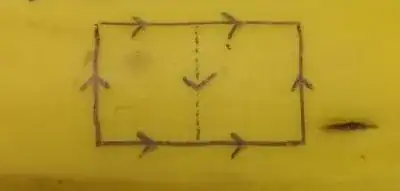
Most topologists would be happy just drawing the diagram you've drawn (though the topologists I know prefer to draw on apples), but if you want to do it explicitly then you can as well.
As you know, the torus $S^1\times S^1$ is homeomorphic to $[0,1]\times [0,1]/\equiv$, where $\equiv$ identifies the edges of the square by $(x,0)\equiv(x,1)$ and $(0,y)\equiv(1,y)$. We also define the Klein bottle to be $K=[0,1]\times [0,1]/\sim$, where $\sim$ identifies the edges of the square by $(x,0)\sim(x,1)$ and $(0,y)\sim(1,1-y)$.
For the torus, we have an explicit continuous surjection
$$
\pi:[0,1]\times[0,1]\to S^1\times S^1: (x,y)\mapsto\left(e^{i\pi x},e^{i\pi y}\right)
$$
using the standard identification of $S^1$ with the unit circle in the complex plane (more a notational convenience than anything else). Note that we now have:
$$
(x_1,y_1)\equiv(x_2,y_2)\Longleftrightarrow \pi(x_1,y_1)=\pi(x_2,y_2)
$$
In other words, $\pi$ induces a well-defined homeomorphism $([0,1]\times[0,1]/\equiv)\to S^1\times S^1$.
The next step is to interpret your diagram as a map $[0,1]^2\to[0,1]^2$. This map is then going to induce the two-sheeted covering we want. Explicitly, we have:
$$
\phi:[0,1]\times[0,1]\to[0,1]\times[0,1]: (x,y)\mapsto
\begin{cases}
(2x,y) &\mbox{if } x\le\frac12 \\
(2x-1,1-y) & \mbox{if } x\ge\frac12.
\end{cases}
$$
Composing this map $\phi$ with the projection $\pi_\sim:[0,1]\times[0,1]\to K$, we get a map $\pi_\sim\circ\phi : [0,1]\times[0,1] \to K$.
We claim that this map $\pi_\sim\circ\phi$ induces a two-to-one covering map
$$\psi : S^1 \times S^1 \,\,\, = \,\,\, [0,1]\times[0,1]/\equiv \,\,\,\to\,\,\,[0,1] \times [0,1] / \sim \,\,\,= \,\,\,K
$$
Proving that $\psi$ is two-to-one means checking
$$
|(\psi^{-1}(\{q\})/\equiv)|=2
$$
for each $q \in K$. And to prove that $\psi$ is a covering map it suffices to check that $\psi$ is a local homeomorphism at $p \in S^1 \times S^1$ (ordinarily this is not enough for checking that something is a covering map, but it suffices when the domain and range are compact manifolds). So one has to check something for the points in $[0,1] \times [0,1]$ that form the equivalence class of the relation $\equiv$ corresponding to $p$: the four corner points; or a pair of opposite side points; or an interior point. Namely one must find neighborhoods of those points which, when fitted together under $\equiv$, form an open neighborhood of $p$ that maps homeomorphically onto an open neighborhood of $q=\psi(p)$. Checking these things is the real content of the proof, and I'll leave them as exercises. It's basically what your diagram is telling you.
Now we have a double-cover by $[0,1]\times[0,1]/\equiv$ of $K$. We already remarked that there is a homeomorphism between $S^1\times S^1$ and $[0,1]\times[0,1]/\equiv$; putting these together gives us a double cover of $K$ by $S^1\times S^1$.
I should stress - there's very little content in any of this, and it really is just a way of making your diagram 'rigorous' in some sense. It's good to work thorugh a few examples like this one explicitly, but you'd be bananas to try and be completely rigorous all the time in topology.