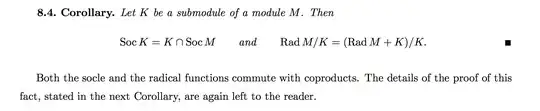
in these notes i am reading i am told that the socle of $K$ (where $K \subset M$ , and $M$ is a module) is = $K \cap$ Soc $ M$
But why is this? i see the intuition but cannot formalize a proof
any help would be great thanks
in these notes i am reading i am told that the socle of $K$ (where $K \subset M$ , and $M$ is a module) is = $K \cap$ Soc $ M$
But why is this? i see the intuition but cannot formalize a proof
any help would be great thanks


There are two ways to see this.
First, one characterization of the socle of a module $N$ is that it is the sum of the simple submodules of $N$. The simple submodules of $K$ are exactly the simple submodules of $M$ that lie in $K$.
Second, using the theorem you stated in the comments let $f\colon K \to M$ be the inclusion map. Then that theorem gives $\mathrm{soc} \ K \subseteq \mathrm{soc} \ M$ and clearly it's in $K$ so $\mathrm{soc} \ K \subseteq K \cap \mathrm{soc} \ M$. But $K \cap \mathrm{soc} \ M$ is semisimple and a submodule of $K$ so $K \cap \mathrm{soc} \ M \subseteq \mathrm{soc} \ K$. Hence they are equal.
