11

I have been asked to either prove or disprove a sort of converse to the well know "Nine Lemma" (Also sometimes called the $3 \times 3$ Lemma I believe)

The basic concept of the Nine Lemma is that if we have a commutative diagram of three rows and three columns with all columns exact, the middle row exact, and the first or third row exact, then we get the remaining row is exact.

I am to prove/disprove now that if we have the first and the last row exact (and all columns still exact), that we get the middle row is exact.

Is this just a matter of a diagram chase, or is it more involved (or even false)?

I believe that if I can show that the middle row is a chain complex (with all but the elements forming the middle row of the $3$ $\times$ $3$ diagram being $0$), then the result will follow.

Vladhagen
  • 5,048
  • I suggest you to prove that nine lemma first by writing what you are actually using rather than what is actually given... To be precise, i was asked to prove five lemma given that 4 columns (not the middle one) out of five are isomorphisms but when i proved it i came to know that "bijection" is not necessary and injective (in one column) and surjective (in another column) would be sufficient to prove this... So, in case of nine lemma also something like that would work... Before guessing anything i suggest you to prove nine lemma and see what are all the details that you have not used.. –  Nov 06 '14 at 05:07
  • The Wikipedia article should be edited because there is no reference to a homological algebra text yet. – Martin Brandenburg Nov 06 '14 at 07:20

2 Answers2

11

Yes, if the middle row is a complex, then it will be exact. This is mentioned at the nlab. It seems to be a consequence of Bergman's salamander lemma. A direct proof is also possible:
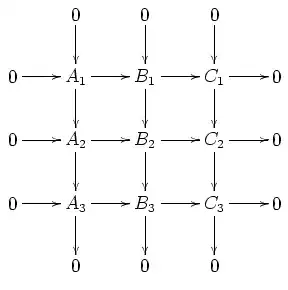
enter image description here

Let the columns be exact and the first and third row be exact, and assume that $A_2 \to C_2$ is zero. We prove that $0 \to A_2 \to B_2 \to C_2 \to 0$ is exact. (I suggest the reader to move the mouse over the diagram while following the proof.)

1) $A_2 \to B_2$ is monic: If $a_2 \in A_2$ maps to $0 \in B_2$, it also maps to $0 \in B_3$. Since $A_3 \to B_3$ is monic, the image in $A_3$ will also be $0$. Hence, there is a preimage $a_1 \in A_1$ of $a_2 \in A_2$. Look at its image $b_1 \in B_1$. Since it maps to $0 \in B_2$ and $B_1 \to B_2$ is monic, it follows $b_1=0$. Since $A_1 \to B_1$ is monic, it follows $a_1=0$, hence $a_2=0$. $\square$

2) $B_2 \to C_2$ is epic: This follows from 1) (generalized to abelian categories as usual) by duality. A diagram chase is also possible, but a little bit longer. $\square$

3) $\ker(B_2 \to C_2) = \mathrm{im}(A_2 \to B_2)$: We have $\supseteq$ by assumption that $A_2 \to C_2$ is zero. Conversely, let $b_2 \in \ker(B_2 \to C_2)$. Consider the image $b_3 \in B_3$. It maps to $0 \in C_3$, hence has a preimage $a_3 \in A_3$. Choose a preimage $a_2 \in A_2$ and look at its image $b'_2 \in B_2$. Then $b_2-b'_2$ maps to $0 \in B_3$, hence we find a preimage $b_1 \in B_1$. Notice that $b_2-b'_2$ maps to $0 \in C_2$ (in fact, $b'_2$ does since $A_2 \to C_2$ is zero). It follows that $b_1$ maps to $0 \in C_1$, hence it has a preimage $a_1 \in A_1$. Let $a'_2 \in A_2$ be its image. It maps to $b_2-b'_2 \in B_2$, so that $a'_2+a_2$ maps to $(b_2-b'_2)+b'_2=b_2$. $\square$

Without the assumption that $A_2 \to C_2$ is zero, we cannot conclude that the middle row is exact. Even in the case that each column is split exact. So let us assume $A_2=A_1 \oplus A_3$, $B_2=B_1 \oplus B_3$, $C_2 = C_1 \oplus C_3$ and that the columns are the canonical ones. Then $A_2 \to B_2$ may be written as a matrix $\begin{pmatrix} A_1 \to B_1 & A_3 \to B_1 \\ A_1 \to B_3 & A_3 \to B_3 \end{pmatrix}$ and similarly $B_2 \to C_2$ can be written as a matrix $\begin{pmatrix} B_1 \to C_1 & B_3 \to C_1 \\ B_1 \to C_3 & B_3 \to C_3 \end{pmatrix}$. Even though the product of the two upper (lower) diagonal entries is zero, the product of the matrices doesn't have to be zero. There are mixed terms such as $A_1 \to B_3 \to C_1$, and it should be easy to write down specific examples, say of vector spaces.

Finally, let me mention that diagram lemmas "should" be really seen as statements about complexes (or double complexes), not about commutative diagrams. Therefore, it is not "bad" that the "middle nine-lemma" "only" works for double complexes.

1

As Martin Brandenburg mentions, there is a proof using Bergman's salamander lemma (and corollaries thereof).

Consider a double complex of the following form:

enter image description here

Assume that the first and the third row are exact. Using the notation from Bergman's paper On diagram-chasing in double complexes, we then have the following chain of isomorphisms: $$A_2-\cong {^\Box A_2}\cong A_1{_{\Box}}\cong {^\Box 0}\cong 0.$$ The first isomorphism exists by the first case of Corollary 2.2. in Bergman's paper since the third row of our double complex is exact. The next two isomorphisms follow from Corollary 2.1. of Bergman's paper since the first column is exact. The last isomomorphism exists by definition of the receptor.

Similiarly, we obtain the following chain of isomorphisms: $$C_2-\cong {C_2{_{\Box}}}\cong {^\Box}C_3\cong C_3 -\cong 0.$$ The first isomorphism exists by the third case of Corollary 2.2. since the first row is exact. The next isomomorphism follows from Corollary 2.1. since the third column is exact. The penultimate isomorphism exists by the fourth case of Corollary 2.2. since the second column is exact.

Lastly, the salamander lemma gives an exact sequence: $$A_1{_\Box}\rightarrow A_2 -\rightarrow A_2{_\Box}\rightarrow {^\Box}B_2\rightarrow B_2-\rightarrow {^\Box}B_3.$$

Now, we have the following chain of isomorphisms $${^\Box}B_2\cong B_1{_\Box}\cong B_1-\cong 0.$$ The first exists by Corollary 2.1. since the second column is exact. The second follows from the second case of Corollary 2.2. since the third column is exact. Additionally, we have ${^\Box}B_3\cong B_3-\cong 0$ by Corollary 2.2 since the first row is exact.

From the exactness of the salamander sequence it follows that $B_2-\cong 0.$ This shows that the middle row is exact.


If ones does not require the middle row to be a chain complex, then the statement becomes false as this example by Jeremy Rickard shows.