To be honest, I'm pretty awful at mathematics however, when up till 6AM I do like to do random things throughout the night to keep me occupied. Tonight, I began playing with the Fibonacci sequence in the Python programming language. I understand that the Fibonacci sequence is just adding the previous two numbers together to produce your next value so I defined a function to spit out the sequence up to the 200th number like so,
def fib(n):
    a, b = 0, 1
    i=1
    while i < 200:
        print("ITERATION: " + str(i))
        a, b = b, a + b
        print(a)
        i += 1
print(fib(1))
What I found interesting is a pattern I came across when adding up the total amount of numbers before the sequence added the next digit. (see picture A.)
PICTURE A:
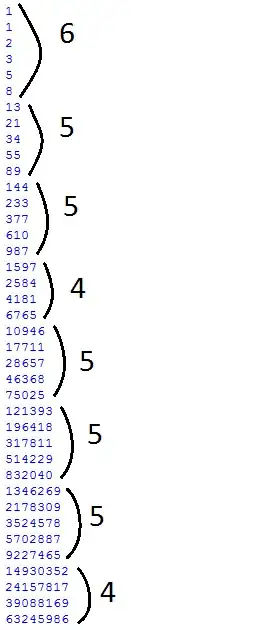
from there, I added up the number "sets" and the pattern emerged.(see picture B.)
PICTURE B:
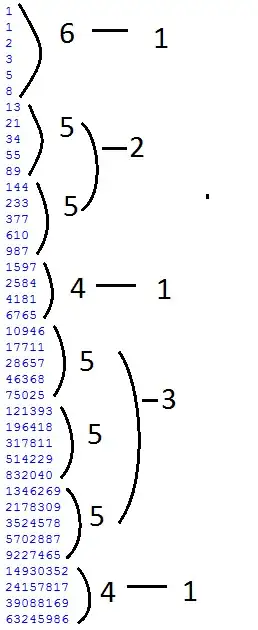
This pattern continued, I went up to the 22nd "set" of numbers and the whole pattern was like so:
1 2 1 3 1 4 1 5 1 2 1 4 1 4 1 3 1 4 1 3 1 4
I found it interesting that the numbers added a digit sequentially by either 4 or mainly 5 integers and how the overall pattern that emerged out of the "sets" appeared to become less stable after the 8th set which was ironically 5;
1 2 1 3 1 4 1 5
forgive me if this seems obvious or silly, but like I said, I'm pretty bad at math. Can anyone explain why this pattern emerges and a little bit more in depth on what the fibonacci sequence can be used for?


