My problem is to find all integer solutions to an ILP. As an example, I'm using an ILP with two variables, but I may have more than two variables. I describe the method I currently use to solve this problem near the end, but I'm interested in knowing if there is a proper and efficient algorithm or method for solving this kind of problem.
There is no objective function, but the constraints for this ILP are
$$ \begin{equation} 0 \leq -2x -y \leq 8 \\ 0 \leq 1-x+3y \leq 5 \\ 0 \leq 2+x-y \leq 2 \\ x,y \in \mathbb{Z} \end{equation} $$
Since this ILP has two variables, I can visually inspect the solution region by graphing the lines formed by the constraints, which are
$$ \begin{align} y &\leq -2x \\ y &\geq -2x-8 \\ y &\geq \frac{1}{3}x - \frac{1}{3} \\ y &\leq \frac{1}{3}x + \frac{4}{3} \\ y &\leq x + 2 \\ y &\geq x \end{align} $$
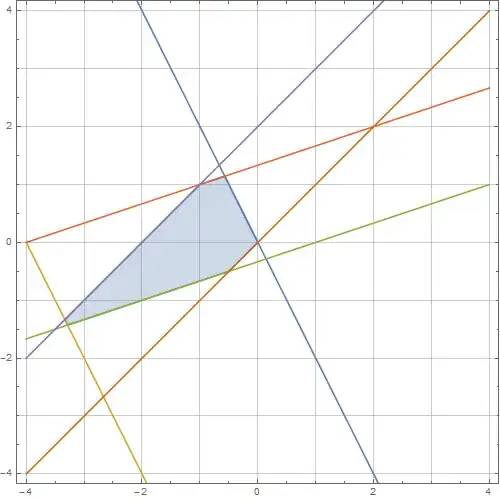
By inspection, there are 6 integer solutions for $(x, y)$: $\{ (0,0), (-1,1), (-1,0), (-2,0), (-2,-1), (-3,-1) \}$.
However, my current method is to use linear programming with non-negativity relaxed and integers from branch-and-cut. I've tried using a set of four objective functions: minimize $x$, maximize $x$, minimize $y$, and maximize $y$. These give a smaller search area as
$$ \begin{equation} -3 \leq x \leq 0 \\ -1 \leq y \leq 1 \end{equation} $$
I then iterate over all valid integer tuples in that smaller area and filter it for tuples that satisfy the original constraints. The tuples that remain are all valid integer solutions.


