24

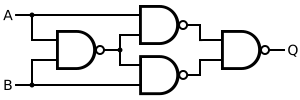
xor gate, now I need to construct this gate using only 4 nand gate

a b out
0 0 0
0 1 1
1 0 1
1 1 0

the xor = (a and not b) or (not a and b), which is \begin{split}\overline{A}{B}+{A}\overline{B}\end{split}

I know the answer but how to get the gate diagram from the formula?

xor gate

EDIT

I mean intuitively, to me, I should get this one if I do it step by step followed by the definition xor = (a and not b) or (not a and b).

\begin{split}\overline{\overline{\overline{A}{B}}\cdot\overline{{A}\overline{B}}}\end{split}

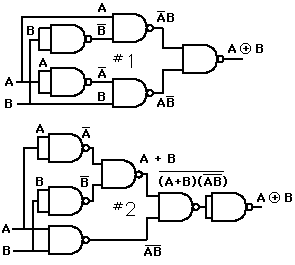
and xor will be constructed with 5 nand gates (first #1 image below)

xor gate 2

my question is more like: imagine the first person in history figure out this formula, how can he or she (the thinking process) get the 4 nand soltuion from this formula, step by step.

\begin{split}\overline{A}{B}+{A}\overline{B}\end{split}

Timeless
  • 805
  • 1
  • 9
  • 16

7 Answers7

20

From that formula? It can be done. But it's easier to start with this one: (using a different notation here)

a ^ b = ~(a & b) & (a | b)

Ok, now what? Eventually we should derive ~(~(~(a & b) & a) & ~(~(a & b) & b)) (which looks like it has 5 NANDs, but just like the circuit diagram it has a sub-expression which is used twice).

So make something that looks like ~(a & b) & a (and the same thing but with a b at the end) and hope that it'll stick around: (and distributes over or)

(~(a & b) & a) | (~(a & b) & b)

Pretty close now, just apply DeMorgan to turn that middle or into an and:

~(~(~(a & b) & a) & ~(~(a & b) & b))

And that's it.

user555045
  • 2,148
  • 14
  • 15
10

I think you are asking for this proof:

A^B = (!A)B + A(!B)
    = !!((!A)B) + !!(A(!B))
    = !(!!A + !B) + !(!A + !!B)
    = !(A + !B) + !(!A + B)
    = !((A + !B)(!A + B))
    = !(A(!A) + AB + (!A)(!B) + B(!B))
    = !(AB + (!A)(!B))
    = !(AB)(!(!A)(!B))
    = !(AB)(!!A + !!B)
    = !(AB)(A+B)
    = !(AB)A + !(AB)B
    = !!(!(AB)A + !(AB)B)
    = !((!(!(AB)A))(!(!(AB)B)))

Although apparently there are 5 NANDs used in the resultant equation, but the duplicate !(AB) will be used only once when you are designing its circuit.

Muntasir
  • 216
  • 3
  • 6
6

Since you already have the diagram answer, easily awailable from wikipedia by typing you question title in Google, as a .png diagram identical to yours, it should be easy for you to find the formula by extracting it from that diagram. Given the definition NAND as $\text{NAND}(A,B)=\overline{AB}\;$:

  • The leftmost gate gives $C=\overline{AB}$;

  • The top gate gives $D_1=\overline{AC}$;

  • The top gate gives $D_2=\overline{BC}$, as the NAND is commutatve like the AND;

  • The rightmost gate gives $E=\overline{D_1D_2}$.

Putting it all together we first note that

$C=\overline{AB}=\overline A+\overline B$

$\begin{align} \overline{D_1}&=AC\\ &=A(\overline A+\overline B)\\ &=A\overline A+A\overline B\\ &=0+A\overline B\\ &=A\overline B\\ \end{align}$

Similarly: $\overline{D_2}=B\overline A$

Thus
$\begin{align} E&=\overline{D_1D_2}\\ &=\overline{D_1}+\overline{D_2}\\ &=A\overline B + B\overline A \end{align}$

Which is precisely the definition of XOR. You may just reverse all this if you want to start from your initial data, rather than just check the answer.

Finding the answer with no prior knowledge

This is intended to answer the explicit request, added as an edit to the question, for a way of finding the solution from scratch. Given that the question is about a thought process, I am giving all details.

I would try to rely on the constraints of the problem (only 4 NAND gates) and on its symmetry between $A$ and $B$ which may be preserved in the solution.

One thing I know (assuming information flows from left to right as in the question diagrams) is that there must be a rightmost NAND gate that produces the desired answer $\text{XOR}(A,B)=A\overline B + B\overline A\;$.

So we can try to guess what kind of input to this gate would produce the desired output.

We know that $\text{NAND}(X,Y)=\overline{XY}= \overline X+\overline Y\;$

Unifying this last formula with the result we have to get, we obtain:

  • $\overline X=A\overline B\;$, thus $X=\overline{A\overline B}=\overline A+B\;$.

  • and symetrically $Y=\overline{\overline A B}=A+\overline B\;$.

Note that this is only the simplest possibility. There are other pairs of inputs that would give the desired result, because we are not unifying in a free algebra, since NAND has equational properties. But we try that for a start.

The problem is now whether we can obtain both $X$ and $Y$ from $A$ and $B$ with 3 NAND gates.

We could try to repeat the unification procedure (I did), but this will naturally lead us to using four more gates, hence to a 5 gates solution.

Assuming we are on the right track, we need two NAND gates to produce $X$ and $Y$. So that leaves us with only one gate to produce a formula $Z$ that combined with $A$ or $B$ will provide the input for these two intermediate gates.

Given that we have to provide symetrically for $X$ and $Y$, we can expect that $Z$ should be symmetric in $A$ and $B$. Hence this leftmost NAND gate should take both $A$ and $B$ as input.

This first NAND gate, with $A$ and $B$ as input, produces as output:

$Z=\text{NAND}(A,B)=\overline{AB}= \overline A+\overline B\;$

Now, we have to check whether combining $Z$ with itself, $A$, $B$, 0, or 1 through a NAND gate can produce $X$, and also $Y$.

We know that combining a value with itself, 0 or 1 through a NAND gate is either the identity function or the negation. So the only remaining candidates are $A$ and $B$.

It is easy to check that

$\begin{align} \text{NAND}(Z,A)&=\overline{ZA}\\ &=\overline{\overline{AB}\;A}\\ &=\overline{(\overline A+\overline B)\;A}\\ &=\overline{\overline AA+\overline BA}\\ &=\overline{0+\overline BA}\\ &=\overline{\overline BA}\\ &=\overline{A\overline B}\\ &=X \end{align}$

Similarly $\text{NAND}(Z,B)=Y$

Hence we can compose these four gates to get the desired result, i.e., the XOR function.

babou
  • 19,645
  • 43
  • 77
0

I take the input $(0,0)$ as an example.

For $\text{XOR}$, the desired output is 0. However, $\text{NAND}(0,0) = 1$.

  • Because the only way to get a 0 using $\text{NAND}$ is (at the last layer) $\text{NAND}(1,1) = 0$, you should first produce two 1's.

    • According to $\text{NAND}(0,1) = 1$ or $\text{NAND}(1,0) = 1$, you produce a 1 using one $\text{NAND}(0,0)$ at the first layer and feed it, along with one input 0, into a second layer $\text{NAND}$.

Only four $\text{NAND}$s are involved. But it is only correct for the input $(0,0)$ so far. So you need to check other inputs $(0,1), (1,0),$ and $(1,1)$ against the solution and find that it just works. Lucky.

hengxin
  • 9,671
  • 3
  • 37
  • 75
0

I tried my best to give the answer using formula as asked.Hope you appreciate it.
Z=AB'+A'B
Z=AA'+AB'+BB'+A'B --->BB'=AA'=0
Z=A(A'+B')+B(B'+A')
Z=A(AB)'+B(AB)' --> Hint
so now (AB)' can get through 1st NAND gate,then in 2nd and third NAND gate the output of 1st NAND gate pass through with one of the input as A and B.After this we need one more complement so use fourth NAND gate.
NAND(1st)=(AB)'=A'+B'
NAND(2nd)=(A(AB)')'=(A(A'+B'))'=(AB')'=A'+B
NAND(3rd)=(B(AB)')'=(B(A'+B'))'=(A'B)'=A+B'
NAND(4th)=[(A'+B)(A+B')]' =[A'B'+AB]'=(A+B)(A'+B')=AB'+A'B

Happy!

0

The formula: XOR = (a and not b) or (not a and b).

Thats' not what you want, you want a formula that is a NAND. Remember that not (a or b) = not a and not b, and therefore (a or b) = not (not a and not b). Therefore

(a and not b) or (not a and b) =

not (not (a and not b) and not (not a and b)) =

not ((not a or b) and (a or not b)) =

NAND (not a or b, a or not b).

So we used one NAND gate, and have to calculate (not a or b) and (a or not b) using three NANDs. We turn each expression into a NAND:

not a or b = not (a and not b) = NAND (a, not b)

a or not b = not (not a and b) = NAND (not a, b)

Now we observe that (x and y) = x and (not x or y): If x is false then both sides are false. If x is true then (not x or y) = (false or y) = y. This is true for NAND just as it's true for AND. Therefore

NAND (a, not b) = NAND (a, not a or not b) = NAND (a, NAND (a, b))

NAND (b, not a) = NAND (b, not b or not a) = NAND (b, NAND (a, b)).

So we first find mid = NAND (a, b), left = NAND (a, mid) and right = NAND (b, mid), finally XOR = NAND (left, right).

gnasher729
  • 32,238
  • 36
  • 56
-2

*From left to right--D1,D2,D3,D4 ** D1=(A.B)' OR(A'+B')

suppose

(A.B)'=C

D2=(A.C)'=A'+C'

D3=(B.C)'=B'+C' then

D4=(D2.D3)'

D4=((A.C)'.(B.C)')'

D4=(A.C)''+(B.C)''

D4=(A.C)+(B.C)

D4=A.(A'+B')+B.(A'+B')

D4=AB'+BA' {A.A'=B.B'=0}**

Bivash
  • 1