3

Studying for my finals and stuck on the following question:

Prove or disprove: Given an undirected and connected graph $G=(V,E)$ and three different vertices $u,v,w\in V$ then there exists some number $x$ so in any run of BFS from vertex $w$, the distance from $u$ to $v$ in BFS tree is always $x$.

I think it's not true but could not think about a good example to disprove it.

vesii
  • 223
  • 1
  • 7

2 Answers2

3

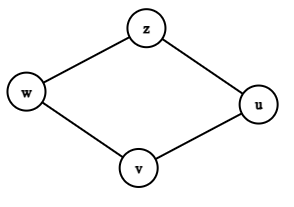
The statement is false. Take a look at the following graph:

enter image description here

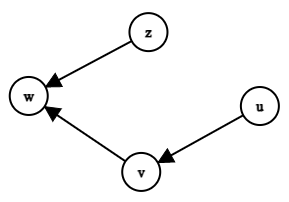
In one BFS run, you will get the following tree:

enter image description here

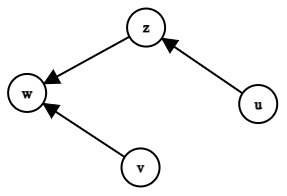
That has a distance of $1$ between $u$ and $v$, while in a different run, you could get another tree:

enter image description here

Which has a distance of $3$ between $u$ and $v$

nir shahar
  • 11,753
  • 3
  • 17
  • 35
0

Because you run BFS from $w$, The BFS produce a shortest path tree $\mathcal{T}$ that contain shortest path from $w$ to other vertices. On the other hand the claim say that: any tree $\mathcal{T}$ that produced by BFS, the distance between $u,v$ is $x$, clearly it's not true, because the BFS guarantee the distance between $w$ and $\forall v\in V\setminus w$ that by multiple running BFS from $w$ not changed, but the distance between any two other vertices can be changed. BFS can't guarantee that distance between any two other vertices $u,v\in \{V\setminus w\}$ remain as the same previous run of BFS. Look at the counter-example nir shahar.

ErroR
  • 1,954
  • 6
  • 22