So I got curious as to how fast things actually are. Apparently you can use $ openssl speed to see how fast certain operations
are. I am not sure, however, as to how this translates to actual
performance issues when connecting to an SSH server.
As a part of the Diffie-Hellman key exchange, the SSH server computes a
certain hash and then signs it with its private host key. The client then computes the same hash and verifies the server signature. So it's useful to look at how slow both of these operations are. The signing operation is perhaps more important
as servers tend to have much more SSH connections than clients.
The signing/verifying operation will typically involve another hashing operation; it is going to be a part of the host key verification algorithm. E.g. ssh-rsa is going to use sha1
and ecdsa-sha2-nistp521 is going to use sha512. I am not sure if the numbers below include hashing times. In either case, it
seems that for data > 16 bytes sha256 and sha512 perform comparably.
I tested this on three devices:
Thinkpad X220, Intel Core i5-2520M
                              sign      verify      sign/s verify/s
  rsa 2048 bits               0.001350s 0.000048s    740.8  20913.2
  rsa 3072 bits               0.006107s 0.000094s    163.7  10639.3
  rsa 4096 bits               0.010134s 0.000158s     98.7   6316.4
  rsa 7680 bits               0.089906s 0.000525s     11.1   1903.0
  rsa 15360 bits              0.468636s 0.002004s      2.1    499.0
  dsa 2048 bits               0.000600s 0.000519s   1667.5   1927.0
  256 bits ecdsa (nistp256)   0.0000s   0.0001s    23594.7   7348.1
  384 bits ecdsa (nistp384)   0.0016s   0.0011s      620.4    890.8
  521 bits ecdsa (nistp521)   0.0005s   0.0009s     1866.4   1080.1
  253 bits EdDSA (Ed25519)    0.0001s   0.0002s    15737.2   6078.1
Xiaomi Mi A2, Qualcomm SDM660 Snapdragon 660
                              sign      verify      sign/s verify/s
  rsa 2048 bits               0.004257s 0.000111s    234.9   9030.1
  rsa 3072 bits               0.012975s 0.000243s     77.1   4116.7
  rsa 4096 bits               0.029138s 0.000425s     34.3   2353.9
  rsa 7680 bits               0.220952s 0.001460s      4.5    684.9
  rsa 15360 bits              1.362500s 0.005801s      0.7    172.4
  dsa 2048 bits               0.001530s 0.001434s    653.8    697.3
  256 bits ecdsa (nistp256)   0.0001s   0.0003s    12472.4   3907.9
  384 bits ecdsa (nistp384)   0.0032s   0.0025s      311.4    396.6
  521 bits ecdsa (nistp521)   0.0081s   0.0062s      123.1    161.9
  253 bits EdDSA (Ed25519)    0.0002s   0.0004s     6284.5   2412.9
Raspberry Pi 3 Model B Rev 1.2, Cortex-A53
                              sign      verify      sign/s verify/s
  rsa 2048 bits               0.011919s 0.000268s     83.9   3735.0
  rsa 3072 bits               0.032787s 0.000550s     30.5   1819.5
  rsa 4096 bits               0.069583s 0.000934s     14.4   1070.1
  rsa 7680 bits               0.381111s 0.003097s      2.6    322.9
  rsa 15360 bits              2.725000s 0.012002s      0.4     83.3
  dsa 2048 bits               0.003586s 0.003021s    278.9    331.0
  256 bits ecdsa (nistp256)   0.0004s   0.0013s     2249.3    743.5
  384 bits ecdsa (nistp384)   0.0181s   0.0127s       55.1     78.5
  521 bits ecdsa (nistp521)   0.0421s   0.0287s       23.7     34.8
  253 bits EdDSA (Ed25519)    0.0005s   0.0012s     2156.7    800.2
Here are the charts, linear and logarithmic.
Y axis is sign/s (solid, circles) and verify/s (dotted, triangles).
Blue is the X220, Orange is Xiaomi, and Red is Raspberry Pi.
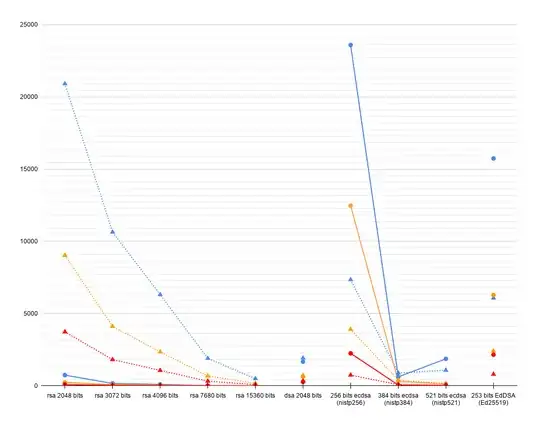
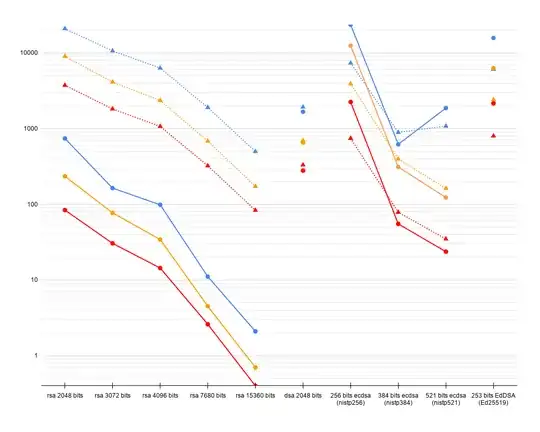
My take away here is that ECDSA nistp256 is much faster at signing than other ECDSA keys. On Raspberry pi, using nistp384 and 521
leads to a maximum of 55.1 or 23.7 signing operations per second—these look like bad defaults to me.
Ed25519 is somewhat slower than ECDSA, especially at signing, but not
by much.
Also, surprisingly, nistp521 performs better than nistp384 on Intel CPU.


