First of all, coin tossing represents a uniform random generator. Therefore, the selections are assumed to be uniform.
In order to create a share for a pixel, as you mentioned, a pixel split into two subpixels. A share for
- a white pixel can be $[(B|W),(B|W)]$ or $[(W|B),(W|B)]$
- a black pixel can be $[(B|W),(W|B)]$ or $[(W|B),(B|W)]$, where in $[(x,y)]$, $x$ represents the color of left pixel and $y$ represents the color of right pixel.
or, one can see from the image;
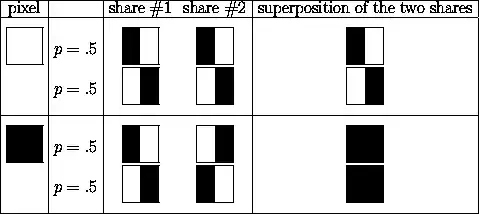
The superposition is putting the images on top of each other. White shares construct a half white and half black square and black shares construct a black square. When the selection is random, the shares are indistinguishable from being white or black.
How a share is constructed
For each pixel, toss a coin to select a row. For example, assuming that when the toss result is Tail, we select the first rows;
- for white pixels, select $[(B|W),(B|W)]$ and
- for black pixels, select $[(B|W),(W|B)]$.
Similarly, for Head result, we select the second rows.
- for white pixels, select $[(W|B),(W|B)]$ and
- for black pixels, select $[(W|B),(B|W)]$.
The confusion
If we toss a coin for the second share (instead of selecting the share together), then for example; for a white pixel after a Tail (select first row $(B|W)$), we may select the second row with a Head then the white pixel will be shared as $(B|W)$ and $(W|B)$. In superposition, however, this constructs a black pixel $(B,B)$. Therefore, they must be selected together.
Share 1 and share 2 are random in group-wise.


