"Impossible" might be appropriate. And "Not really a cryptography issue." Summing up Artjom's and Geoffroy's comments, nothing can stop you pointing a camera at the screen. Or perhaps taking a screen grab. There is the notion of an Analogue Hole, which means that ultimately if you can see it, you can record it.
But that's not really necessary. Virtually all mainstream content transmission protocols have been cracked directly via interception software or accessing a master key. You can easily record directly from the BBC, PornHub and YouTube as simple examples. These services have huge incentive to prevent unauthorised copying and can't, so it's unlikely a school can succeed where major global players can't. This all becomes much easier on Linux powered devices where you have total control over the kernel. Linux also comes by default with the ability to record anything playing on the sound card, so audio protection is non existent on that platform. And text can be spoken by a screen reader, which can then be recorded via the sound card feature above. Then speech recognition $ \rightarrow $ text and so on and on.
Clearly you can release encrypted content, then either repost the plain text or the key to allow users to decrypt. But then you've lost all control of the data. It's out. Re-encrypting will just create a copy of the files you already had before decryption. The decrypted content may have been copied off machine. USB stick perhaps. The whole of the political European Union wants content to be able to be deleted for ever, but they haven't achieved it yet. Perhaps General Data Protection Regulation might work, but I doubt it. And a server restore can bring it all back, and this has happened as you hear it in the news occasionally.
Another comment provides us with a fine example of irony - Google's attempt at self destructing emails. I'm assuming that this is exactly the kind of copy protection that you're looking for. The irony is found in the mere existence of the following screen grab of such a test email featuring a clear expiry date. Assume it expired yesterday:-
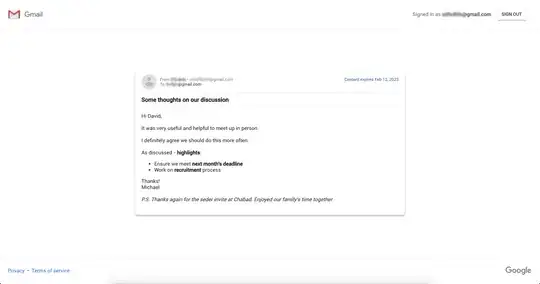
So what? Not only has it been screen grabbed and made immutable, I've just reposted it here. So the irony is further exacerbated in that whilst the email might disappear off the Gmail system in a puff of smoke, Googlebot has already indexed this answer and made it available on the Google search engine! And as the email text is a nice clear modern machine font, OCR techniques allow for it to be extracted automatically from image format to text. This is a perfect measure of the size of the Analogue Hole and how even a billion dollar company cannot fill it in.
There's my answer here to "Can a device prove the identity of its own code?" which really asks if a voting machine can be hacked, even with specialist hardware protection. You're asking almost the same question, regarding a computer displaying some content. Yes it can be.


