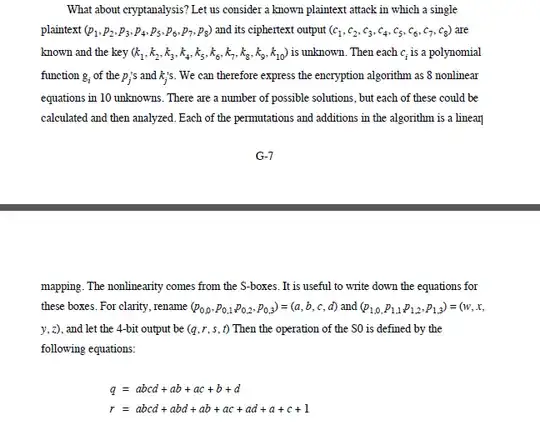
The question is actually about Simplified DES (rather than Simple DES as stated), which is an extremely simplified mock-up of Single DES.
From reading the definition of S-DES in the reference used in the question, we get that:
The S-boxes operate as follows. The first and fourth input bits are treated as a 2-bit number that specify a row of the S-box, and the second and third input bits specify a column of the Sbox. The entry in that row and column, in base 2, is the 2-bit output.
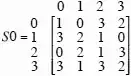
Now let $a b c d$ be the input bits, $q r$ the output bits, use big-endian convention, and reformat that table as:
abcd qr     abcd qr    abcd qr    abcd qr
0000 01     0010 00    0100 11    0110 10
0001 11     0011 10    0101 01    0111 00
1000 00     1010 10    1100 01    1110 11
1001 11     1011 01    1101 11    1111 10
In order to verify the equations $q=abcd\oplus ab\oplus ac\oplus b\oplus d$ and $r=abcd\oplus abd\oplus ab\oplus ac\oplus ad\oplus a\oplus c\oplus 1$, just compute what $q$ and $r$ they give for each of the $2^4$ combinations of input, and compare that to the reformatted table; this is left as an exercise to the reader.
There is no systematic practical method to derive the most compact equation for a sizable bit table, and in the case of DES S-boxes this has been the subject of intense research. One systematic method leading to the most compact representation of an arbitrary boolean function as OR-of-AND-terms is known as Karnaugh map, but here the equations are wanted as XOR-of-AND-terms, and I know no analogous method. With 4 entries, finding the shortest equation (by some metric) that match would be tractable by brute force with a computer.
Still, here is how one of the equation could have been derived by hand. First we rewrite the table with the arguments in Gray order
a | 0000000011111111
b | 0000111111110000
c | 0011110000111100
d | 0110011001100110
--|-----------------
q | 0110100101111010
r | 1100110001011110
By comparing the line for $d$ with the line for $q$, it is striking that a bit flip of $d$ cause a flip in $q$, except when $a=b=c=1$; in other words, $q'=q\oplus d\oplus abcd$ is independent of $d$. We have reduced the problem to finding an equation for $q'$, with table
a | 00001111
b | 00111100
c | 01100110
--|---------
q'| 00110110
and some trial and error is enough to find $q'=ab\oplus ac\oplus b$, from which $q=abcd\oplus ab\oplus ac\oplus b\oplus d$ follows.