An ASN.1-encoded SSH private key contains the following integers in order:
- The public modulus $n$ and exponent $e$;
- The private exponent $d$;
- The prime factors $p$ and $q$ of $n$;
- The "reduced" private exponents $d_p=d\bmod(p-1)$ and $d_q=d\bmod(q-1)$;
- The "CRT coefficient" $q_{\text{inv}}=q^{-1}\bmod p$.
The observation that the value of $d$ in such a key may be irrelevant is due to the following: To speed up exponentiation modulo $n$ by a factor of about $4$, the Chinese Remainder Theorem can be utilized to compute the result modulo $p$ and $q$ separately and subsequently combine them to obtain the "real" result modulo $n$. With this optimization, the values of $n$, $e$ and $d$ are not required, hence are ignored by typical implementations whenever $p$, $q$, $d_p$, $d_q$ and $q_{\text{inv}}$ are available*. This is why changing some characters in the middle of the key need not necessarily destroy it, depending on which of the components you change.
*) at least for OpenSSH, they do not have to be present: setting $p=q=1$ and $d_p=d_q=q_{\text{inv}}=0$ makes the implementation use $n$ and $d$.
To visualize the arrangement of the individual components, I created the following graphic from a typical 4096-bit RSA private key file:
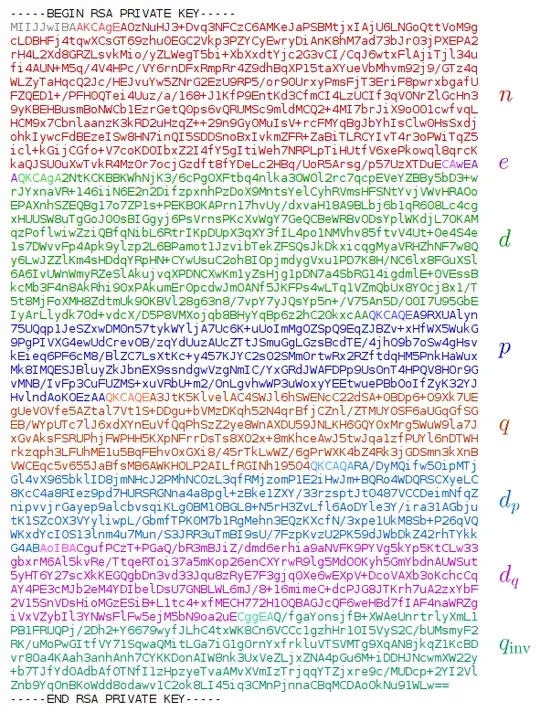
The grey part right in the beginning is ASN.1 header data (encoding the fact that a sequence is about to follow, etc), followed by the integers forming the key as described above. The ASN.1 header data associated to each component (mostly a length field) is colored slightly brighter than the data representing the integer itself. Note that the pictured subdivision is not 100% accurate as one Base64 character encodes roughly $3/4$ raw bytes, hence some boundaries should actually run strictly within a single character.


