I am building an open source hardware system that will be used to control things over the internet. The system consists of a Base Station and Modules which use wireless communication at 2.4GHz to exchange data.
Now I have come to the point where I need to protect the transmitted RF data against re-transmission and decryption. I also need to protect the system so that nobody can pose as a Base Station and send RF packets to some Module and for example turn on my lights or unlock the door.
Details about data that needs to be protected:
- Message is always 27 bytes long (this can be reduced to 20 bytes to leave room for proper MAC)
- Format of message (protocol) is known to public
- Message contents are sometimes known to public because it is usually a simple command such as "1" for turn-on command, and "0" for turn-off command. Other future Modules might contain data that should be kept secret from a potential eavesdropper
- Messages are transmitted rarely, there is no constant RF activity
Since this project is implemented on microcontrollers with limited amount of RAM (some 4kB for the entire thing) and FLASH memory for program (usually 32kB) there is not much room for state-of-the-art encryption algorithms and hash generation functions for MAC. There is also a limitation of data that is being transferred to 29 bytes in each packet. Data should not be split to multiple packets and re-assembled on the receiving side, so 29 bytes is all we have to work with.
These are the specifications of my current implementation:
- Messages are encrypted using ARC4
- Key for ARC4 is 27+1 bytes long
- Key is used for maximum of 256 transmissions or for 30 minutes of RF no-activity (whichever comes first). After that new key is generated inside the Module, encrypted and sent to Base Station so it can decrypt further data
- Key (27 bytes) is appended with 1 byte (SYNC) which is incremented after each encryption solving vulnerability of re-transmissions. After rollover this byte starts from 0 again (0-255). In the end this makes the key for ARC4 28 bytes long and different for each transmission
Encryption process
27 bytes of unencrypted data message is first padded with SYNC byte (the last byte of final ARC4 key), then this is padded with CRC-8 checksum calculated over the previous 28 bytes. These resulting 29 bytes are encrypted using current ARC4 key (27 bytes and the SYNC counter (1 byte)).
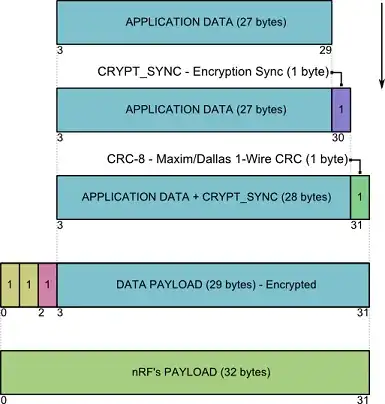
The CRC-8 checksum in combination with the SYNC byte is used as a MAC on the decrypting side. The packet is decrypted using current KEY+SYNC and if the SYNC byte in the decrypted packet is the same as the one expected and used during the decryption, and if the CRC-8 is calculated over the entire decrypted package as the one received - all is good.
Questions
- I think this is not a very smart way to implement MAC. Is there something else that I could implement here that would take at most 9 bytes of my unencrypted data space? I could reduce the application data space from 27 to 20 bytes to make space for improved MAC.
- How safe is this current implementation of the system because I am worried that someone might inject their own RF packets that will be decrypted by Modules and matched the SYNC & CRC-8. Is there any way to analyze this?
I hope I didn't give too much irrelevant information in this post, this is my first time to implement some kind of encryption, and first post on SE.
UPDATE
I have decided to abandon this design as it is not safe. Thanks to poncho for suggesting the alternative. I have found CMAC AES implementation in AVR411 document which also targets the same hardware I am currently using. You can find this document by simply searching for AVR411 on Google.


