3

This question relates to bit flip attacks on OTP encrypted messages.

Lets say I've got a list of numbers from 0 to 2^24-1

I want to re-order the list so it has the following property:

If you start at a random (unknown) position and go forward 1 step, I want it to be as hard as possible to guess how the the value will change. Assuming the re-ordered list is known. The list is circular.

Edit: By changes I mean "which bits in the value will flip". To put it another way:

  1. Attacker knows value from list AFTER OTP is applied (they don't know the actual value)
  2. Attacker does something which they know will cause the list position to step forward 1.
  3. Attacker wants to guess what the new value will be AFTER OTP.

Examples:

  • For a simple ordered sequence 1,2,3,4... It's quite easy. If you go forward one step in the sequence, 50% of the time this will cause only the LSB to toggle. Chance of correct guess: 1/2

  • I tried a few completely random sequences and found the most common changes occurred 9-10 times. Chance of correct guess: 10/2^24.

  • 1/2^24 would be considered "perfect". Since that's the base chance of guessing without knowing anything.

So my question is. How would I go about choosing the order to maximize the difficulty of this guess.

Edit2: I will try to describe the problem using the notation from the comments.

  • Start with a list of all possible values for a 24 bit number, in order. 0,1,2,3, etc. We will call this list U.

  • We will re-order this list in some way, generating list V.

  • An index in the list is chosen at random. We will call this i.

  • An attacker has access to V, but not i

  • The attacker must guess the value Vi⊕V(i+1modn)

  • The goal is to modify the list in such a way as to maximize the difficulty of this guess.

Some thoughts: To achieve 1/2^24, each difference would have to appear exactly once. I'm not sure that's even possible.

Drew
  • 151
  • 7

1 Answers1

2

Let $U=\{v(0),v(1),\ldots,v(2^n-1)\}$ where $v(k)$ is the binary vector representing the integer $n,$ and each $v(i) \in \{0,1\}^n,$ which we can take as $GF(2)^n$ for convenience.

Almost Perfect Nonlinear functions.

A function $f:\{0,1\}^n\rightarrow \{0,1\}^m$ is APN if the multiset $$\{f(x)\oplus f(x\oplus a): x \in \{0,1\}^n\},$$ has half the possible vectors in $\{0,1\}^n$ occur twice (hence another half are missing). By symmetry if $f(x)=f(x\oplus a)\oplus f(x)$ then $x'=x\oplus a$ is also a solution of the equation so we always get 2 solutions in characteristic 2 (i.e., binary arithmetic) and this is the best possible, perfect distribution of differences is impossible in binary. That means the difference with the next value is equidistributed on half the possible values, which is quite good, since you choose the point i at random and this holds for all $i$.

Here we wish to have $n=m.$ Unfortunately, we must have $n$ odd for an APN permutation to exist. For example, the map $x\mapsto x^{2^n-2}$ which is used in AES Sbox for $n=8$ is APN for any $n$ which is odd.

Therefore, if you were ready to use $n=23$ or $n=25$ you'd be done and get the APN property.

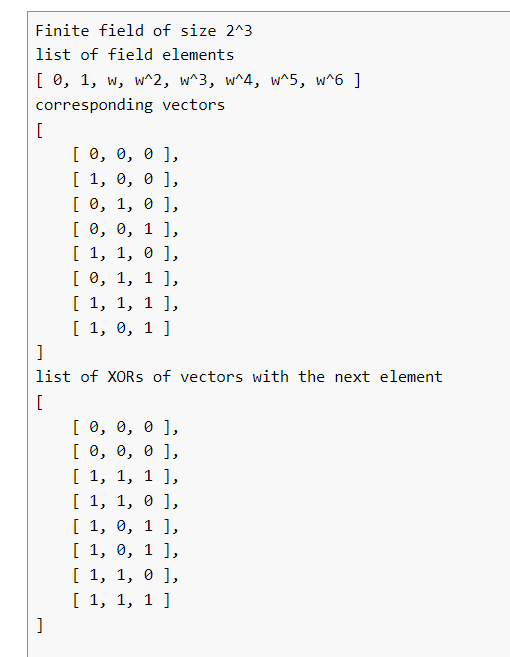
I demonstrate this with the magma script below for $n=3$. You can run it at http://magma.maths.usyd.edu.au/calc/ I know SageMath and pari/gp can also do the same but magma is what I am familiar with. See here for more.

Since $x^7=1$ for all $x$ in $GF(2^3)$ (multiplicative group has order 7 and thus all elements have order dividing 7) the map usually shown as the inverse map for nonzero elements is actually $x\mapsto x^6.$

K:=GF(2); F:=ext<K|3>; F;

"list of field elements";

[u: u in F];

"corresponding vectors";

[Eltseq(u): u in F];

"list of XORs of vectors with the next element";

[Eltseq(u+u^6): u in F];

"permutation you want";

[Eltseq(u^6): u in F];

Output is below with probability of correctly guessing the next element being $1/2^{n-1}.$

enter image description here

Oops, here is the permutation you want listed:

[ [ 0, 0, 0 ], [ 1, 0, 0 ], [ 1, 0, 1 ], [ 1, 1, 1 ], [ 0, 1, 1 ], [ 1, 1, 0 ], [ 0, 0, 1 ], [ 0, 1, 0 ] ]

References: Alex Pott has a nice set of slides here with definition but is focused on finding non-power APN permutations, i.e., not of the form $x\mapsto x^d$ which are very rare. Claude Carlet has a whole Chapter on related topics see here.

kodlu
  • 25,146
  • 2
  • 30
  • 63