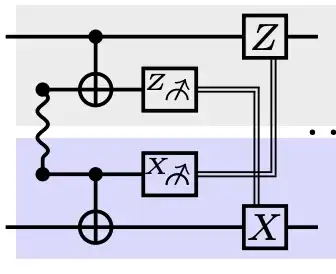
Let's consider a state $\psi_{00}|00\rangle+\psi_{01}|01\rangle+\psi_{10}|10\rangle+\psi_{11}|11\rangle$ and apply the procedure above, from Fig. 2 of the paper. First, we put a Bell pair between the two qubits:
\begin{align}
&\psi_{00}\left(|0000\rangle +|0110\rangle\right)\\
+&\psi_{01}\left(|0001\rangle +|0111\rangle\right)\\
+&\psi_{10}\left(|1000\rangle +|1110\rangle\right)\\
+&\psi_{11}\left(|1001\rangle +|1111\rangle\right)
\end{align}
Then we perform the CNOT gates:
\begin{align}
&\psi_{00}\left(|0000\rangle +|0111\rangle\right)\\
+&\psi_{01}\left(|0001\rangle +|0110\rangle\right)\\
+&\psi_{10}\left(|1100\rangle +|1011\rangle\right)\\
+&\psi_{11}\left(|1101\rangle +|1010\rangle\right)
\end{align}
Now we need to measure the second qubit in the $Z$ basis, the third qubit in the $X$ basis. I'll assume we measure the second qubit to be in $Z=-1$ and the third qubit in $X=+1$, and leave the other cases as an exercise.
After performing the $Z$-measurement, the state is:
\begin{align}
&\psi_{00}\left(|0111\rangle\right)\\
+&\psi_{01}\left(|0110\rangle\right)\\
+&\psi_{10}\left(|1100\rangle\right)\\
+&\psi_{11}\left(|1101\rangle\rangle\right)
\end{align}
After performing the $X$-measurement, the state is:
\begin{align}
&\psi_{00}\left(|01+1\rangle\right)\\
+&\psi_{01}\left(|01+0\rangle\right)\\
+&\psi_{10}\left(|11+0\rangle\right)\\
+&\psi_{11}\left(|11+1\rangle\rangle\right)
\end{align}
If we remove the irrelevant middle-two qubits, since they are unentangled with the first and fourth qubit, this is the same as
\begin{align}
&\psi_{00}\left(|01\rangle\right)\\
+&\psi_{01}\left(|00\rangle\right)\\
+&\psi_{10}\left(|10\rangle\right)\\
+&\psi_{11}\left(|11\rangle\rangle\right)
\end{align}
Now we just need to apply the correction operator. This is just an $X$ operator on the last qubit. This gives
\begin{align}
&\psi_{00}\left(|00\rangle\right)\\
+&\psi_{01}\left(|01\rangle\right)\\
+&\psi_{10}\left(|11\rangle\right)\\
+&\psi_{11}\left(|10\rangle\rangle\right)
\end{align}
which is exactly the action of a CNOT gate.
I'll add that if you wanted to derive this procedure, it can be helpful to ask yourself the question: What are the logical operators of the input state $(Z_1,X_1,Z_4,X_4)$, what are the stabilizers of the input state $(X_2X_3, Z_2Z_3)$, and how do the stabilizers and logical operators transform after each operation (exercise)? You'll find that the logical operators transform as $Z_1\rightarrow Z_1$, $X_1\rightarrow X_1X_4$, $Z_4\rightarrow Z_1Z_4$, $X_4\rightarrow X_4$, just as they should for a CNOT gate between qubits $1$ and $4$. In particular, measuring qubits $2$ and $3$ does not measure any logical information on qubits $1$ or $4$. This might make the construction feel more intuitive.


