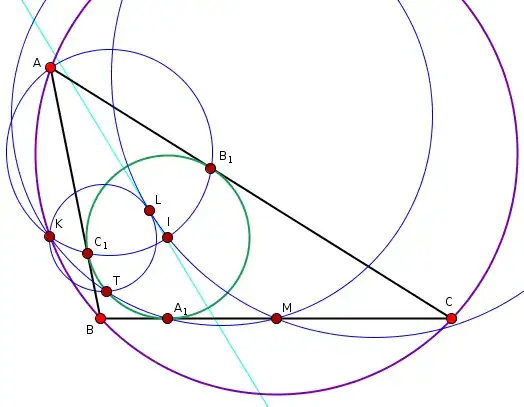
Without loss of generality you can choose a coorinate system in such a way that $\omega$ is the unit circle and $A_1=(1,0)$. Then you can use a rational parametrization of the circle to describe $B_1$ and $C_1$ in terms of two parameters $b,c\in\mathbb R$, ending up with these coordinates:
\begin{align*}
I &= \begin{pmatrix}
0\\
0
\end{pmatrix}
&
A_1 &= \begin{pmatrix}
1\\
0
\end{pmatrix}
\\
B_1 &= \frac1{b^{2} + 1}\begin{pmatrix}
b^{2} - 1\\
2 b
\end{pmatrix}
&
C_1 &= \frac1{c^{2} + 1}\begin{pmatrix}
c^{2} - 1\\
2 c
\end{pmatrix}
\end{align*}
From there on, you can do a brute force coordinate computation, yielding these intermediate points:
\begin{align*}
A &= \frac1{b c + 1}\begin{pmatrix}
b c - 1\\
b + c
\end{pmatrix}
\\
B &= \frac1{c}\begin{pmatrix}
c\\
1
\end{pmatrix}
\\
C &= \frac1{b}\begin{pmatrix}
b\\
1
\end{pmatrix}
\\
M &= \frac1{2 b c}\begin{pmatrix}
2 b c\\
b + c
\end{pmatrix}
\\
L &= \frac1{b^{2} c^{2} + b^{2} + c^{2} + 1}\begin{pmatrix}
b^{2} c^{2} - 1\\
b^{2} c + b c^{2} + b + c
\end{pmatrix}
\\
K &= \frac1{b^{2} c^{2} + b^{2} + 4 b c + c^{2} + 1}\begin{pmatrix}
b^{2} c^{2} + b^{2} + 2 b c + c^{2} - 1\\
2 b + 2 c
\end{pmatrix}
\\
T &= {\scriptsize\frac1{16 b^{4} c^{4} + 9 b^{4} c^{2} + 18 b^{3} c^{3} + 9
b^{2} c^{4} + b^{4} + 6 b^{3} c + 10 b^{2} c^{2} + 6 b c^{3} + c^{4} +
b^{2} + 2 b c + c^{2}}}\cdot\\
&\phantom={\scriptsize\begin{pmatrix}
16 b^{4} c^{4} + 7 b^{4} c^{2} + 14 b^{3} c^{3} + 7 b^{2} c^{4} + b^{4}
+ 2 b^{3} c + 2 b^{2} c^{2} + 2 b c^{3} + c^{4} - b^{2} - 2 b c -
c^{2}\\
8 b^{4} c^{3} + 8 b^{3} c^{4} + 2 b^{4} c + 14 b^{3} c^{2} + 14 b^{2}
c^{3} + 2 b c^{4} + 2 b^{3} + 6 b^{2} c + 6 b c^{2} + 2 c^{3}
\end{pmatrix}}
\end{align*}
I'd like to paste equations for the circles as well, but I still have to work out how to format them since they are pretty big.
The circles $KLT$ and $LIM$ then have a common tangent:
\begin{align*}{\scriptsize
\bigl((b + c) \cdot (2 b^{4} c^{4} - 3 b^{4} c^{2} + 4 b^{3} c^{3} - 3 b^{2}
c^{4} - b^{4} - 8 b^{2} c^{2} - c^{4} - b^{2} - 4 b c - c^{2})\bigr)x}
\\
{\scriptsize+
\bigl(5 b^{5} c^{3} + 2 b^{4} c^{4} + 5 b^{3} c^{5} + b^{5} c + b^{4} c^{2} +
16 b^{3} c^{3} + b^{2} c^{4} + b c^{5} - b^{4} + 3 b^{3} c + 3 b c^{3}
- c^{4} - b^{2} - 2 b c - c^{2}\bigr)y}
\\
{\scriptsize= 2\cdot c \cdot b \cdot (b + c) \cdot (b c + 1)^{3}}
\end{align*}


s the name of the task. Im not the author. – santoni7 Oct 04 '14 at 07:27