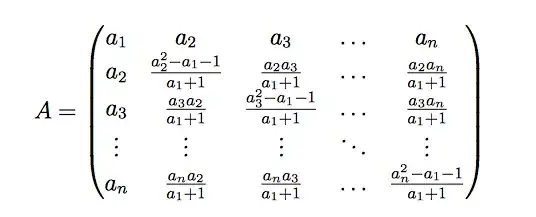
Equivalently, does every unit vector in $\mathbb{Q}^n$ belong to some orthonormal basis for $\mathbb{Q}^n$?
This is clearly true for $\mathbb{Q}^2$, and for $\mathbb{Q}^3$ it seems to be true for every vector I check. For example,
$\displaystyle\frac{1}{3}\!\begin{bmatrix}1 \\ 2 \\ 2\end{bmatrix}$ is the first column of $\displaystyle\frac{1}{3}\!\begin{bmatrix}1 & 2 & 2 \\ 2 & 1 & -2 \\ 2 & -2 & 1\end{bmatrix}$
$\displaystyle\frac{1}{7}\!\begin{bmatrix}2 \\ 3 \\ 6\end{bmatrix}$ is the first column of $\displaystyle\frac{1}{7}\!\begin{bmatrix}2 & 3 & 6 \\ 3 & -6 & 2 \\ 6 & 2 & -3\end{bmatrix}$
$\displaystyle\frac{1}{9}\!\begin{bmatrix}7 \\ 4 \\ 4\end{bmatrix}$ is the first column of $\displaystyle\frac{1}{9}\!\begin{bmatrix}7 & 4 & 4 \\ 4 & 1 & -8 \\ 4 & -8 & 1\end{bmatrix}$
Here's an example in $\mathbb{Q}^4$:
- $\displaystyle\frac{1}{2}\!\begin{bmatrix}1 \\ 1 \\ 1 \\ 1\end{bmatrix}$ is the first column of $\displaystyle\frac{1}{2}\!\begin{bmatrix}1 & 1 & 1 & 1 \\ 1 & 1 & -1 & -1 \\ 1 & -1 & 1 & -1 \\ 1 & -1 & -1 & 1\end{bmatrix}$
Actually, all of the matrices in these examples are symmetric. This wouldn't be true if you permuted the entries of the vectors, but you could manage to make them some column of a symmetric orthogonal matrix. So we have the additional question:
Is every unit vector in $\mathbb{Q}^n$ a column of some rational symmetric orthogonal matrix?