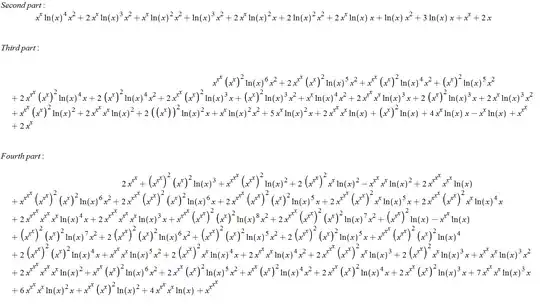
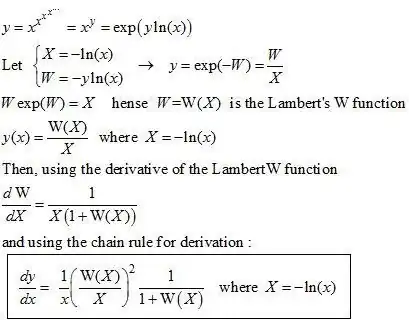
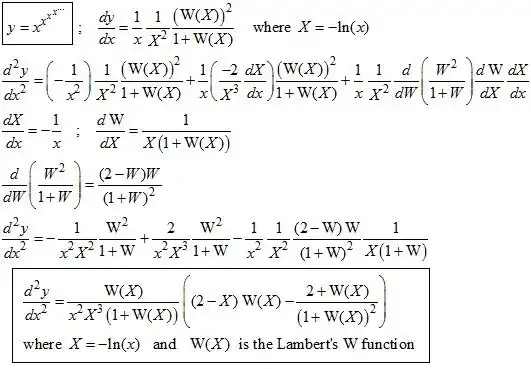
Note: This answer ended up much longer than I intended (supposed to be a "hint"). However, it was too fun to not investigate further, hence the large amount of edits :)
Hint: The derivative of $x\uparrow\uparrow n$ can be expressed in terms of the following recurrence relation
$$\frac{d}{dx}\left(x\uparrow\uparrow n\right)=x\uparrow\uparrow n \left(\frac{x\uparrow\uparrow (n-1)}{x}+\log x\frac{d}{dx}\left(x\uparrow\uparrow (n-1)\right)\right)$$
You can use this relation to find a closed form solution
Edit 1: It turns out the closed form is quite horrid so I'll save you the bother and write it out here. You can verify it with mathematical induction if you ever get the time.
$$\frac{d}{dx}\left(x\uparrow\uparrow n\right)=\left[\sum _{i=0}^{n-3} x^{-1+\sum _{k=1}^{i+2} x\uparrow\uparrow(n-k)}\log ^i(x) \right]+\left(\log ^{n-2}(x)+\log ^{n-1}(x)\right) x^{\sum _{k=1}^{n-1} x\uparrow\uparrow k}$$
Edit 2: I had some time on my hands so here is a proof of the above recurrence relation:
\begin{align*}\frac{d}{dx}\left(x\uparrow\uparrow n\right)
&=\frac{d}{dx}\left(x^{x\uparrow\uparrow (n-1)}\right)\\
&=\frac{d}{dx}\left(e^{x\uparrow\uparrow (n-1)\cdot\log x}\right)\\
&=e^{x\uparrow\uparrow (n-1)\cdot\log x}\left(\frac{x\uparrow\uparrow (n-1)}{x}+\log x\cdot\frac{d}{dx}\left(x\uparrow\uparrow (n-1)\right)\right)\\
&=x\uparrow\uparrow n\left(\frac{x\uparrow\uparrow (n-1)}{x}+\log x\cdot\frac{d}{dx}\left(x\uparrow\uparrow (n-1)\right)\right)\end{align*}
Edit 3: After playing around with the formula a little, it turned out that the closed form wasn't so bad after all. The odd looking $\log$'s don't have to awkwardly stand apart from the sum if we work with the convention that $x\uparrow\uparrow0=1$ and $x\uparrow\uparrow-1=0$. By modifying the equation accordingly we get the following much tidier formula:
$$\frac{d}{dx}\left(x\uparrow\uparrow n\right)=f(n)=\frac{1}{x}\sum _{i=1}^n x^{\sum _{k=n-1-i}^{n-1} x\uparrow\uparrow k}\cdot\log ^{i-1}(x)$$
With this "new" formula we can now in fact more easily verify that $\frac{d}{dx}\left(x\uparrow\uparrow n\right)$ is indeed equal to $f(n)$. To do this we simply checking that $f(n)$ satisfies the recurrence relation for $\frac{d}{dx}\left(x\uparrow\uparrow n\right)$ and that it works for n=1.
Proof:
(1) If $n=1$ we have
\begin{align*}f(1)&=\frac{1}{x}\sum _{i=1}^1 x^{\sum _{k=-i}^{0} x\uparrow\uparrow k}\cdot\log ^{i-1}x \\
&=\frac{1}{x}\left(x^{\sum _{k=-1}^{0} x\uparrow\uparrow k}\cdot\log ^{1-1}x\right) \\
&=\frac{1}{x}\cdot x^{(x\uparrow\uparrow -1)+(x\uparrow\uparrow 0)} \\
&=\frac{1}{x}\cdot x^{0+1}=1=\frac{d}{dx}x=\frac{d}{dx}\left(x\uparrow\uparrow 1\right)\end{align*}
Therefore $\frac{d}{dx}\left(x\uparrow\uparrow n\right)=f(n)$ holds for $n=1$.
(2) Now we want to check that $f$ satisfies the recurrence relation:
\begin{align*}f(n+1)&=\frac1x \left(\sum _{j=1}^{n+1} x^{\sum _{k=n-j}^{n} x\uparrow\uparrow k}\cdot\log ^{j-1}(x)\right)\\
&=\frac1x \left(\sum _{i=0}^n x^{\sum _{k=n-1-i}^{n} x\uparrow\uparrow k}\cdot\log ^{i}(x)\right) \hspace{5mm} \{\text{reindexing such that }i=j-1\} \\
&=\frac1x \left(x^{\sum _{k=n-1}^{n} x\uparrow\uparrow k}+\left(\sum _{i=1}^n x^{\sum _{k=n-1-i}^{n} x\uparrow\uparrow k}\cdot\log ^{i}(x)\right)\right) \\
&=\frac1x \left(x^{x\uparrow\uparrow (n-1)+x\uparrow\uparrow n}+x^{x\uparrow\uparrow n}\left(\sum _{i=1}^n x^{\sum _{k=n-1-i}^{n-1} x\uparrow\uparrow k}\cdot\log ^{i}(x)\right)\right) \\
&=\frac1x \left((x\uparrow\uparrow n)\cdot (x\uparrow\uparrow (n+1))+x\uparrow\uparrow (n+1)\left(\sum _{i=1}^n x^{\sum _{k=n-1-i}^{n-1} x\uparrow\uparrow k}\cdot\log ^{i}(x)\right)\right) \\
&=\frac{x\uparrow\uparrow (n+1)}{x} \left(x\uparrow\uparrow n+\sum _{i=1}^n x^{\sum _{k=n-1-i}^{n-1} x\uparrow\uparrow k}\cdot\log ^{i}(x)\right)\\
&=x\uparrow\uparrow (n+1) \left(\frac{x\uparrow\uparrow n}{x}+\frac1x\sum _{i=1}^n x^{\sum _{k=n-1-i}^{n-1} x\uparrow\uparrow k}\cdot\log ^{i}(x)\right) \\
&=x\uparrow\uparrow (n+1) \left(\frac{x\uparrow\uparrow n}{x}+\log x\left(\frac1x\sum _{i=1}^n x^{\sum _{k=n-1-i}^{n-1} x\uparrow\uparrow k}\cdot\log ^{i-1}(x)\right)\right)\\
&=x\uparrow\uparrow (n+1) \left(\frac{x\uparrow\uparrow n}{x}+\log x\cdot f(n)\right) \blacksquare\end{align*}
Final edit: upon request by the OP I'll demonstrate how to calculate the second derivative too. I will use the defintion of $f(n)$ that I used above.
\begin{align*}
\frac{d^2}{dx^2}\left(x\uparrow\uparrow n\right)&=\frac{d}{dx}\left(\sum _{i=1}^n x^{-1+\sum _{k=n-1-i}^{n-1} x\uparrow\uparrow k}\cdot\log ^{i-1}(x)\right)\\
&=\sum _{i=1}^n \frac{d}{dx}\left(x^{-1+\sum _{k=n-1-i}^{n-1} x\uparrow\uparrow k}\cdot\log ^{i-1}(x)\right)\\
&=\sum _{i=1}^n \left((i-1)\cdot x^{-2+\sum _{k=n-1-i}^{n-1} x\uparrow\uparrow k}\cdot\log ^{i-2}(x)+\color{red}{\frac{d}{dx}\left(x^{-1+\sum _{k=n-1-i}^{n-1} x\uparrow\uparrow k}\right)}\color{black}{ \cdot\log ^{i-1}(x)}\right)
\end{align*}
Now,
\begin{align*}
\color{red}{\frac{d}{dx}\left(x^{-1+\sum _{k=n-1-i}^{n-1} x\uparrow\uparrow k}\right)}&=\frac{d}{dx}\left(e^{\left(-1+\sum _{k=n-1-i}^{n-1} x\uparrow\uparrow k\right)\log x}\right)\\
&=\frac{x^{\sum _{k=n-1-i}^{n-1} x\uparrow\uparrow k}}{x}\left(\frac{-1+\sum _{k=n-1-i}^{n-1} x\uparrow\uparrow k}{x}+\log x\left(\sum _{k=n-1-i}^{n-1} f(k)\right)\right)
\end{align*}
Substitute for the red parts and you are done.