27

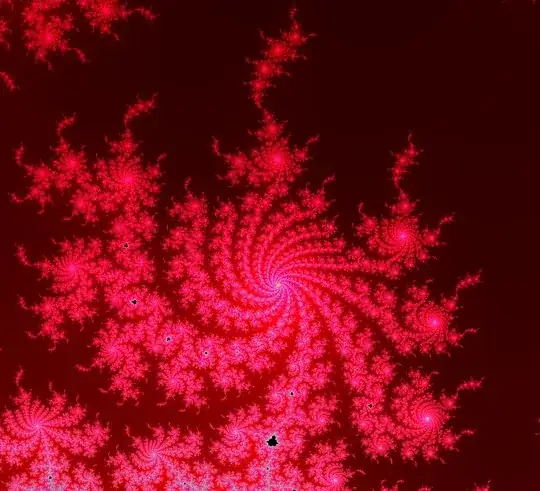
I have written a simple program in C to generate Mandelbrot set. Wherever I zoom in, it seems to me that I see prime numbers, most often 11, 17, 19. For example the object on the attached image has 11 branches.

Is there some deeper explanation, or have I just been misled by some kind of numerology?

Mandelbrot

Mark McClure
  • 31,496
  • 7
    That is a really beautiful image! Could you post your program and some images on a web page? – Stephen Montgomery-Smith Dec 14 '13 at 20:35
  • 8
    You should also see 9's, and 15's, as well. On the left side of the main cardioid, you will see all odd numbers, starting with 3 on the top bulb, then going counterclockwise, you'll see bulbs numbered 5, 7, 9, 11, 13 .... – Sheldon L Dec 14 '13 at 23:55
  • 1
    @SheldonL In other words, the numerology is of the 'all odd numbers are prime' variety? – Steven Stadnicki Jan 08 '14 at 05:11

3 Answers3

9

First off, I don't think it's the case that spirals with a prime number of arms appear any more or less frequently than spirals with a composite number of arms. The fact is that, for every $n$, there are infinitely many spirals with $n$ arms. Here's a spiral with 12 arms:

enter image description here


What truly is amazing and connects the number of arms in a spiral to certain types of numbers is that the distribution of the bulbs on any component of the Mandelbrot set can be determined using Farey fractions. This is beautifully described in this paper by Bob Devaney.

Consider, for example, the following image of the Mandelbrot set:

enter image description here

The fractions $1/2$, $1/3$, and $2/5$ label disk-like bulbs hanging off the main cardioid of the Mandelbrot set. Those fractions give us a lot of information about the structure of the set near there. In particular, the denominator of each fraction tells us how many arms spiral in off of decorations nearby. Given two such disk-like bulbs labeled by fractions $a/b$ and $c/d$, the largest bulb between them should have label $(a+c)/(b+d)$. That is exactly how the $2/5$ bulb arises between the $1/2$ bulb and the $1/3$ bulb. Similarly, there is a $3/8$ bulb between the $2/5$ bulb and the $1/3$ bulb; if you zoom in near there, you're sure to find spirals with 8 arms.


If all this is right, we might be able to use it to help us find where your image lies in the Mandelbrot set. In fact, I was able to come up with the following image:

enter image description here

This image does not lie immediately off of the main cardioid. To find it, I had to use the portion that's boxed in the figure. Near a $c$ parameter in the Mandelbrot set, it tends to "look like" the Julia set with that $c$ parameter. I happen to know that we can generates pictures like the one in the box by choosing a $c$ value near the yellow dot in the picture of the Mandelbrot set above. Zooming in near there and finding a period $11$ bulb, I was able to find your picture.

Mark McClure
  • 31,496
4

Apparently fractals are related to partition numbers, and Ramanujan found a way to relate some prime numbers to partition numbers (5, 7, 11), according to the following articles:

http://www.wired.com/wiredscience/2011/01/partition-numbers-fractals/

http://www.aimath.org/news/partition/

I see your primes are higher, but who knows, maybe you will find these ties in higher partition numbers or different fractals.

CAGT
  • 829
  • 1
  • 7
  • 17
  • 1
    The results of Ono et al have nothing to do with complex dynamics or the Mandelbrot set, which is mentioned the Wired article simply because it's often mentioned in popular accounts of fractals. – Mark McClure Oct 18 '16 at 23:43
0

Numerology is correct in my book.

For example, 11, 13, 17, 19 become 101, 103, 107 and 109.

This can b used to predict primes regularly though I am yet to solve why certain primes do not repeat. My thought is moving through 0, going up through tens, hundreds etc has an effect.

For example, a random prime 839 using numerology can b:

8039 - PRIME 8129 - not 8219 - PRIME 8309 - not

Just using 0:

80039 - PRIME 80309 - PRIME 83009 - PRIME 800039 - not 800309 - not 803009 - not 830009 - not 8000039 - not 8000309 - PRIME 8003009 - not 8030009 - not ETC 80030000009 - PRIME

Whilst I don’t fully understand the effect 0 has and though it definitely has one is obviously the reason primes appear more randomly and further apart, (I expect it has something to do with the number 60 and the Fibonacci sequence hence your spirals) the sequence without the 0 can b seen here:

If we look at just three digits

929 - PRIME 839 - PRIME 749 - not 659 - PRIME 569 - PRIME 479 - PRIME 389 - PRIME 299 - not

Then:

1019 - PRIME 1109 - PRIME

Does this make sense with your formula? When I imagined how the sequence must look I thought like a tree but your spirals make more sense.
  • This doesn't seem to be an answer to the OP's question about the Mandelbrot set. – PM 2Ring Oct 01 '24 at 03:52
  • “Is there some deeper explanation, or have I just been misled by some form of numerology” is in the question. Please forgive my lack of technical maths with an open mind, the pattern I have explained above is true and with a varying degree of accuracy I can predict prime numbers occurring using this methodology. Would the pattern above have anything to do with the Mandlebrot set and if not, why do you think such an obvious pattern which is seen in all prime numbers has such a high number of primes? – Francis Oct 01 '24 at 18:34
  • I actually have the sequence here and if you graph it you will b interested. 299 389 479 569 659 749 839 929 1019 1109. Basically it’s a straight line. The number I have chosen are for their numerological value, each set adds up to the same and shifts up a ten for every hundred down. If you divide those numbers by 5, the numbers which end in 9.8 aren’t prime, perhaps this series continues but it is above my technical ability. In answer to ur original question, Mandelbrot no x=why yes. – Francis Oct 01 '24 at 19:01
  • Your sequence 299, 389, 479, 569, etc is an arithmetic progression. See https://en.wikipedia.org/wiki/Primes_in_arithmetic_progression & https://en.wikipedia.org/wiki/Dirichlet%27s_theorem_on_arithmetic_progressions There are numerous questions about primes in arithmetic progressions on this site. – PM 2Ring Oct 01 '24 at 19:55
  • 1
    Thank you very much for explaining this. I really appreciate it. – Francis Oct 01 '24 at 22:58