1

Consider a discrete, one-dimensional, space made of $N$ squares. At the extremes of this space (so in position $1$ and $N$ respectively) two random walkers are placed, at time $t=0$ (time is discrete). At each new time $t'=t+1$ they have probability $1/3$ of staying still, moving left, or moving right. If they try to escape the space between $1$ and $N$ they simply stay still, nothing happens, so a kind of reflective barrier is in place. What is the shape of the discrete probability distribution of the walkers' first encounter? It will be a normalized vector of dimension equal to $N$ of course.

Also consider this: The walkers move at the same time, so if the walkers end up in adjacent squares they could pass over one another in the next move; this should not be possible: any compenetration is considered an encounter, and the square of encounter is randomly chosen between the two previous occupied squares.

Noumeno
  • 423
  • 1
    This is the text of your HW. What have you done ? – Jean Marie Feb 10 '25 at 21:16
  • @JeanMarie It's not an homework question. I am just interested in discrete dynamics, and this question came to me naturally today – Noumeno Feb 10 '25 at 21:18
  • 1
    All right, it is not a HW. It remains the question "What have you done ?" Have you for example attempted to write a program simulating the "game" ? – Jean Marie Feb 10 '25 at 21:20
  • 1
    An important point : please confirm that you are looking for the probability $p_k$ of having first encounter in box number $k$. Because there is another kind of probability : $p_k$ = probability that $k$ "time units" have elapsed before this first encounter. – Jean Marie Feb 10 '25 at 21:25
  • @JeanMarie I am trying to simulate it, but I would like an analytic solution. I have tried to search for the dynamic of a single 'solitary' walkers first, but even this is hard, and also it is not trivial to use P_k(t) for a single walker in the box to obtain my probability of interest. Also, yes, I am interested in the probability of having the first encounter in square k, I don't care about the time. – Noumeno Feb 10 '25 at 21:40
  • 1
    Random Walkers is a good name for a rock band. – Will Jagy Feb 10 '25 at 21:50
  • 3
    If it helps, this is equivalent to a single random walker on an $N\times N$ checkerboard, starting at $(1,N)$, and ending when reaching either $(k,k)$ or $(k+1,k)$ for some $k\in\Bbb N$. – Greg Martin Feb 10 '25 at 23:10
  • I wouldn't be surprized that the good approach for a modelization is by using Markov chains. – Jean Marie Feb 10 '25 at 23:11
  • @Greg Martin It has taken me some minutes before I understand what you mean : you are perfectly right. Indeed, it is equivalent to consider the (half)grid of all positions $(W_1,W_2)$ with transitions from a point of the grid to one of the eight neigbours with probability $1/3^2 = 1/9$ (and a probability $1/9$ to remain in the same place), until the diagonal is reached (with initial position in (1,N) of course) – Jean Marie Feb 10 '25 at 23:27

3 Answers3

6

By scaling everything by $1/N$, we can compute the limiting density of the first encounter location. We can get it in closed form, but only in terms of elliptic functions. Namely, the limiting density over $t \in [0, 1]$ is $$ g(t) = \frac{4K(-1)}{\pi}\sqrt{\frac{\varphi(t)^{2} - \varphi(t)^{-2}}{2i}}, $$ where $K$ is the complete elliptical function and $\varphi$ is defined by $$ \varphi(t) = \operatorname{sn}(K(-1)(1 + (i-1)t), -1), $$ where $\operatorname{sn}$ is the Jacobi elliptic sine function.

These special functions are complicated, but standard enough to be implemented in common special function libraries. So for instance, we can implement this in R easily enough:

library(elliptic)

n_grid <- 1000 t_grid <- seq(0, 1, length.out = n_grid) z_grid <- 1 + (-1 + 1i) * t_grid

phi <- sn(K.fun(-1) * z_grid, -1) dmu <- K.fun(-1) * 4/pi * sqrt((phi^2 - phi^(-2))/(2i))

Plot of limiting density of Brownian crossing time

The complete proof is involved, the ideas are as follows:

  1. As per Greg Martin's observation, this problem is equivalent to finding the distribution of the first location that a random walker on an $N \times N$ grid crosses the diagonal $\{(k, k) : k\in 1, \dotsc, N\}$

  2. By reflecting the sample paths along the axes, the above problem can further be translated to finding the first location that a random walker starting at $(0, 0)$ first leaves the diamond $\{(x, y) : |x| + |y| < N\}$ (this is not an exact correspondence because the reflection is not so easy, but the discrepancy disappears in the limit)

  3. Taking the limit as $N \rightarrow \infty$, this becomes the problem of finding the point at which a 2-d Brownian motion leaves the diamond $V = \{(x, y) : |x| + |y| \leq 1\}$ - a classical result is that this is the harmonic measure for the unit diamond.

  4. This harmonic measure $\mu$ is constructed from the Riemann map from the unit disc $D$ to the unit diamond. That is, if $f \colon D \rightarrow V$ is a conformal map with $f(0) = 0$, the density of the measure is $$ \frac{\mathrm{d}\mu(w)}{\mathrm{dw}} = \frac{1}{2\pi i}\frac{\psi'(w)}{\psi(w)}, $$ where $\psi = f^{-1}$.

  5. Since $V$ is a polygon, the conformal map $f$ is a Schwarz-Christoffel map. The unit diamond has a particularly nice such map, allowing us to write its derivative explicitly as $$ f'(z) = \frac{1}{K(-1)(1 - z^4)^{1/2}}, $$ with its antiderivative being defined in terms of the elliptic integral of the first kind $F$ according to $f(z) = F(z; -1)/K(-1)$. The inverse of these functions is defined in terms of Jacobi elliptic functions, rendering $$ \psi(w) = f^{-1}(w) = \operatorname{sn}(K(-1)w, -1). $$

    But now we can write \begin{align*} \frac{\mathrm{d}\mu(w)}{\mathrm{d}w} &= \frac{1}{2\pi i}\frac{\psi'(w)}{\psi(w)} \\ &= \frac{1}{2\pi i}\frac{1}{\psi(w)f'(\psi(w))} \\ &= \frac{K(-1)}{2\pi i} \sqrt{\psi(w)^{-2} - \psi(w)^2} \end{align*}

  6. We transfer back from the diamond to the unit interval by making the transformation $$ w = 1 + (i-1) t, \quad \varphi(t) = \psi(w) $$ mapping the interval to one edge of the diamond. This transformation picks up a factor of $(i-1)$, as we multiply by $4$ to account for the fact that the Brownian motion can escape through any of the four edges, so the final form of the density is \begin{align*} g(t) &= 4(i-1) \cdot \frac{\mathrm{d}\mu(w)}{\mathrm{d}w} \\ &= \frac{2(i-1)K(-1)}{\pi} \sqrt{\varphi(t)^{-2} - \varphi(t)^2} \\ &= \frac{4K(-1)}{\pi}\sqrt{\frac{\varphi(t)^{2} - \varphi(t)^{-2}}{2i}}, \end{align*} where the terms in the final square root are real and non-negative.

3

I have written and run a simulation program giving a stable trend displayed on the graphical representation below for the case $N=30$ ; it remains to find a theoretical approach...

enter image description here

with the following (Matlab) program (a remark : Matlab's indices begin at $1$):

    clear all;close all;
    N=30;C=zeros(1,N); % table of counts
    ns=1000000; % number of simulations
    C=zeros(1,N);
    for k=1:ns
       W1=1;W2=N; % initial positions of Walkers
       while W2>W1
          W1=W1+floor(3*rand-1); % adding -1,0,1 with equiprobability
          W1=max(1,W1); % "barrier effect"
          W2=W2+floor(3*rand-1); % similar comments for W2              if W1<W2
          W2=min(N,W2);
       end;
       x=W2; % W1 or W2 are chosen with equal prob.
       if rand<0.5
           x=W1;
       end;
       C(x)=C(x)+1;
    end;
    u=C/ns;
    fprintf([repmat(' %1.5f ',1,numel(u)) '\n'],u) 
    bar(u)
Henry
  • 169,616
Jean Marie
  • 88,997
  • That looks as if is it almost a parabola. It is not, even allowing for simulation noise, but not far away. – Henry Feb 11 '25 at 01:52
  • @Henry I don't think so : the "branches" look a little too linear for being approximated by a parabola. – Jean Marie Feb 11 '25 at 06:58
  • 2
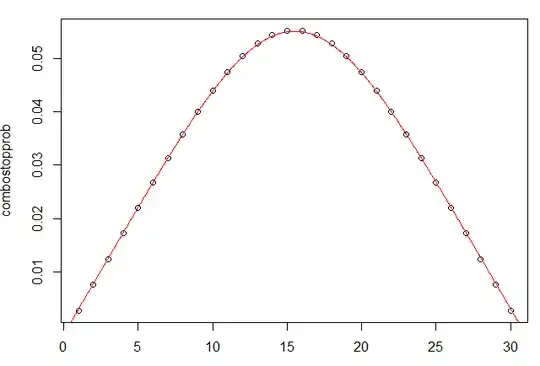
    The probabilities for finishing at $1,2,\ldots,15$ can be calculated as $0.002772733$, $0.007675049$, $0.012473265$, $0.017251971$, $0.022004215$, $0.026704038$, $0.031310570$, $0.035766768$, $0.039998749$, $0.043916832$, $0.047418931$, $0.050396660$, $0.052744012$, $0.054367815$, $0.055198392$ and the same downwards for finishing at $16,\ldots,30$, with an expected $403.0262$ steps to finish. – Henry Feb 11 '25 at 11:45
  • As stated by other comments, this is a Markov Chain on half an $N\times N$ matrix, so it is easier enough to set this up and run it until the probability of having stopped is $1$ up to the precision of calculations. If the question was open, I would post my code. – Henry Feb 11 '25 at 13:40
  • 1
    It is a pity that so many questions are closed too early... If you want, you can post this code at the bottom of my answer (and say it's yours). – Jean Marie Feb 11 '25 at 14:15
  • This curve seems to fit the data: https://www.desmos.com/calculator/4n7swhwarm (not perfectly, but better than a parabola). – ploosu2 Feb 11 '25 at 16:00
  • @ploosu2 Indeed, with this shifted generalized gaussian, we have a very good agreement. – Jean Marie Feb 11 '25 at 18:34
  • I have changed a little the Matlab program : in this way the obtained distribution is perfectly symmetric and the results obtained for this simulation ; $0.00767 0.01238, 0.01716, 0.02202, 0.02643, 0.03138, 0.03585...$ etc. very close to those of Henry. – Jean Marie Feb 11 '25 at 23:06
  • @Henry You have seen that the question has been re-opened. You can now give an answer of your own :) – Jean Marie Feb 11 '25 at 23:11
  • 1
    @JeanMarie - I have - thank you for letting me use your answer space temporally. – Henry Feb 12 '25 at 01:18
3

This R code finds the probabilities by iterating the Markov Chain, using Greg Martin's comment "this is equivalent to a single random walker on an $N×N$ checkerboard, starting at $(1,N)$, and ending when reaching either $(k,k)$ or $(k+1,k)$ for some $k∈\mathbb N$." The first line uses the same $N=30$ as Jean Marie, though this can be changed.

N <- 30
filter <- outer(1:N,1:N, "<")
positionprob <- matrix(0,nrow=N,ncol=N)
positionprob[1,N] <- 1
probfinished <- 0
t <- 0
while (sum(positionprob * filter) > 1e-20){ 
  t <- t+1
  filteredprob <- positionprob * filter
  augmented <- rbind(filteredprob[1,], filteredprob, filteredprob[N,])
  augmented <- cbind(augmented[,1], augmented, augmented[,N])
  positionprob <- (augmented[-c(1,2),-c(1,2)] + 
     augmented[-c(1,N+2),-c(1,2)] + augmented[-c(N+1,N+2),-c(1,2)] +
     augmented[-c(1,2),-c(1,N+2)] + augmented[-c(1,N+2),-c(1,N+2)] + 
     augmented[-c(N+1,N+2),-c(1,N+2)] + augmented[-c(1,2),-c(N+1,N+2)] +   
     augmented[-c(1,N+2),-c(N+1,N+2)] + augmented[-c(N+1,N+2),-c(N+1,N+2)] 
     ) / 9 + positionprob - filteredprob 
  probfinished[t] <- sum(positionprob - positionprob * filter)
  }

ondiagonal <- positionprob[cbind(1:N, 1:N)] pastdiagonal <- positionprob[cbind(2:N, 1:(N-1))] combostopprob <- ondiagonal + (c(0,pastdiagonal) + c(pastdiagonal,0)) / 2 plot(combostopprob) combostopprob

[1] 0.002772733 0.007675049 0.012473265 0.017251971 0.022004215 0.026704038

[7] 0.031310570 0.035766768 0.039998749 0.043916832 0.047418931 0.050396660

#[13] 0.052744012 0.054367815 0.055198392 0.055198392 0.054367815 0.052744012 #[19] 0.050396660 0.047418931 0.043916832 0.039998749 0.035766768 0.031310570 #[25] 0.026704038 0.022004215 0.017251971 0.012473265 0.007675049 0.002772733

sum(combostopprob) # should be 1

1

Jean Marie's simulation is very close to this.

This also gives the expected time.

sum(diff(c(0,probfinished[-t])) * 1:(t-1)) # expected time
# 403.0262
sum(1-c(0,probfinished)) # alternative
# 403.0262

The same code can equally well be used for larger $N$ - it just takes longer - or smaller $N$. Playing with that, there seems to be a limiting distribution after suitable rescaling as $N$ increases. I might guess it could be related to the distribution of the location of the first passage of a 2D Wiener process starting from the centre of a square boundary. Somebody asked that question on Reddit getting a general reply pointing at harmonic measure and another pointing at stochastic processes and boundary value problems.

Added: Damian Pavlyshyn's answer has since done that analysis. His limiting curve (with suitable rescaling) shown in red below fits these values in black very well, using

plot(combostopprob)
lines(t_grid*(N+1/3)+1/3, Re(dmu)/(N+1/3), col="red") 
probability and curve

Henry
  • 169,616