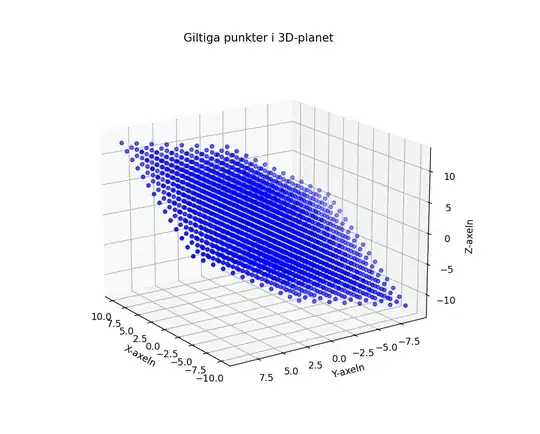
Added sanity checking section at the end of my answer.
$E_1:-7 \le x + y - z \le 7$
$E_2:-11 \le y + z - x \le 11$
$E_3:-13 \le x + z - y \le 13$
Let $~n~$ be a variable which denotes $~(x + y + z).~$
Let $~f(n)~$ denote the enumeration of all satisfying ordered triplets $~(x,y,z),~$ as a function of $~n.~$
Then, the desired enumeration is
$$\sum_{n = -\infty}^{+\infty} f(n).$$
So, the problem is reduced to determining the viable range for $~n,~$ and then finding the closed form formula for $~f(n).$
From the constraints:
$E_4: ~x + y + z = n.$
$E_5: ~-7 \leq n-2z \leq 7 \implies $
$-7 \leq 2z - n \leq 7 \implies $
$n - 7 \leq 2z \leq n + 7.$
$E_6:~$ similarly
$~n - 11 \leq 2x \leq n + 11.$
$E_7:~$ similarly
$~n - 13 \leq 2y \leq n + 13.$
Adding $~E_5, ~E_6, ~$ and $~E_7,~$ gives
$$3n - 31 \leq 2(x + y + z) = 2n \leq 3n + 31 \implies $$
$$n - 31 \leq 0 \leq n + 31.$$
Therefore, you must have that
$$-31 \leq n \leq 31.$$
Stars and Bars theory may now be used to obtain the closed form formula for $~f(n).~$ For Stars and Bars theory, see
this article and
this article.
To ease the syntax, I am going to let $~n_{xl}, ~n_{xu}, n_{yl}, ~n_{yu}, n_{zl}, ~n_{zu}~$ denote the respective lower and upper bounds on $~x,y,~$ and $~z.$
Then:
$\displaystyle n_{xl} = \left\lceil \frac{n - 11}{2} ~\right\rceil, ~~n_{xu} = \left\lfloor \frac{n + 11}{2} ~\right\rfloor.$
$\displaystyle n_{yl} = \left\lceil \frac{n - 13}{2} ~\right\rceil, ~~n_{yu} = \left\lfloor \frac{n + 13}{2} ~\right\rfloor.$
$\displaystyle n_{zl} = \left\lceil \frac{n - 7}{2} ~\right\rceil, ~~n_{zu} = \left\lfloor \frac{n + 7}{2} ~\right\rfloor.$
Then, $~f(n)~$ equals the enumeration of the number of solutions to
$x + y + z = n.$
$x,y,z \in \Bbb{Z}.~$
The lower bounds for $~x,y,~$ and $~z~$ are $~n_{xl}, ~n_{yl}, ~n_{zl}~$ respectively.
The upper bounds for $~x,y,~$ and $~z~$ are $~n_{xu}, ~n_{yu}, ~n_{zu}~$ respectively.
I am going to use this answer
as a model for how to attack this problem.
The first step is to adjust the lower and upper bounds for each variable so that the lower bounds are $~0.~$
This changes the enumeration to
$~x + y + z = n - ( ~n_{xl} + n_{yl} + n_{zl} ~).$
$~x,y,z \in \Bbb{Z_{\geq 0}}.$
The upper bounds on $~x,y,z~$ are respectively $~( ~n_{xu} - n_{xl} ~), ~( ~n_{yu} - n_{yl} ~), ~( ~n_{zu} - n_{zl} ~).$
Note
To ease the expression of the formula for $~f(n),~$ I will adopt the convention that when $~a < b,~$ that the expression $~\displaystyle \binom{a}{b}~$ will equal $~0.~$
Here, I am going to break the problem into two cases: $~n~$ is even or $~n~$ is odd.
$\underline{\text{Case 1:} ~n ~\text{is even}}$
Assume that $~n = 2k.$
$$n_{xl}, ~n_{xu}, ~n_{yl}, ~n_{yu}, ~n_{zl}, ~n_{zu} \\
= \left[k - 5\right], ~\left[k + 5\right], ~\left[k - 6\right], ~\left[k +6\right],\\
\left[k - 3\right], ~\left[k + 3\right]
~~\text{respectively}.$$
- $x + y + z = 14 - k.$
- $x,y,z \in \Bbb{Z_{\geq 0}}.$
- $x \leq 10, ~y \leq 12, ~z \leq 6.$
So, when $~n~$ is even, you must have that
$$~0 \leq 14 - \frac{n}{2} \leq 28 \implies -28 \leq n \leq 28.$$
Within this range for $~n,~$ with $~k = \dfrac{n}{2},~$ you have that
$$f(n) = \binom{16 - k}{2} \\
- \left[ ~\binom{5 - k}{2} + \binom{3 - k}{2} + \binom{9 - k}{2} ~\right] \\
+ \left[ ~\binom{-8 - k}{2} + \binom{-2 - k}{2} + \binom{-4 - k}{2} ~\right] \\
- \binom{-15 - k}{2}.$$
So, let $~A~$ denote the set
$$A = \{~n \in \Bbb{Z} ~: ~n ~\text{even}, ~-28 \leq n \leq 28 ~\}.$$
Then, the Case 1 partial sum is
$$\sum_{n \in A} f(n).$$
$\underline{\text{Case 2:} ~n ~\text{is odd}}$
Assume that $~n = 2k + 1.$
$$n_{xl}, ~n_{xu}, ~n_{yl}, ~n_{yu}, ~n_{zl}, ~n_{zu} \\
= \left[k - 5\right], ~\left[k + 6\right], ~\left[k - 6\right], ~\left[k +7\right],\\
\left[k - 3\right], ~\left[k + 4\right]
~~\text{respectively}.$$
- $x + y + z = 15 - k.$
- $x,y,z \in \Bbb{Z_{\geq 0}}.$
- $x \leq 11, ~y \leq 13, ~z \leq 7.$
So, when $~n~$ is odd, with $~k = \dfrac{n - 1}{2},~$ you must have that
$$~0 \leq 15 - \frac{n - 1}{2} \leq 31 \implies -31 \leq n \leq 31.$$
Within this range for $~n,~$ you have that
$$f(n) = \binom{17 - k}{2} \\
- \left[ ~\binom{5 - k}{2} + \binom{3 - k}{2} + \binom{9 - k}{2} ~\right] \\
+ \left[ ~\binom{-9 - k}{2} + \binom{-3 - k}{2} + \binom{-5 - k}{2} ~\right] \\
- \binom{-17 - k}{2}.$$
So, let $~B~$ denote the set
$$B = \{~n \in \Bbb{Z} ~: ~n ~\text{odd}, ~-31 \leq n \leq 31 ~\}.$$
Then, the Case 2 partial sum is
$$\sum_{n \in B} f(n).$$
$\underline{\text{Sanity Checking}}$
Although the Case 1 and Case 2 formulas can be manually applied with scratch paper, it is very tedious to do so.
I wrote a computer program to perform the Case 1 and Case 2 computations, with $~n~$ in the specified Case 1 and Case 2 ranges.
Remembering the convention that $~a < b \implies \displaystyle \binom{a}{b} = 0,~$ the computer program's final computation, $~2345,~$ agrees with the original poster's official solution.