2

I saw this article

https://www.scientificamerican.com/article/2-high-school-students-prove-pythagorean-theorem-heres-what-that-means/

That 2 students prove Pythagorean theorem with "trigonometry"

My daughter asks me about it.

So i wonder. I know many proofs of Pythagorean theorem.

https://www.youtube.com/watch?v=28Pgi_tXamM

Here is a sample.

The article makes this absurd comments

At an American Mathematical Society meeting, high school students presented a proof of the Pythagorean theorem that used trigonometry—an approach that some once considered impossible

What is so impossible?

What makes their very complicated proof more valid than many other Pythagoras proofs? What's the catch?

Also there is this statement that proof of pythagorean theorem is impossible. How the hell it's impossible? I saw many proofs already.

If verified, Johnson and Jackson’s proof would contradict mathematician and educator Elisha Loomis, who stated in his 1927 book The Pythagorean Proposition that no trigonometric proof of the Pythagorean theorem could be correct. Their work joins a handful of other trigonometric proofs that were added to the mathematical archives over the years. Each sidestepped “circular logic” to prove the pivotal theorem. So what exactly is a trigonometric proof of the Pythagorean theorem, and why was Loomis so closed off to the idea?

No trigonometric proof of the Pythagorean theorem could be correct? What the hell is trigonometric proof? We have many proofs just fine. Trigonometry simply use it.

user4951
  • 1,798

2 Answers2

3

Compiling and (over?-)expanding my comments to @RobinSparrow's answer ...


Loomis' maxim "Trigonometry is because the Pythagorean Theorem is" is succinct and catchy ... and wrong. :)

(Well, it's correct from a certain point of view. We'll get to that.)

I prefer: "Trigonometry is because similarity is."

After all, the identity $\sin x/\cos x=\tan x$ is nothing more than an algebraic consequence of the SOHCAHTOA definitions. The same is true for any result derived via mere ratio-chasing through a diagram ... for instance, the Angle-Sum and -Difference identities (via my trigonography site):
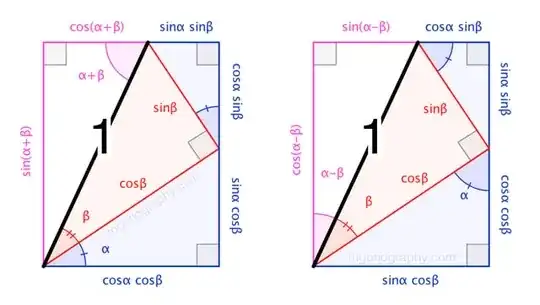
angle-sum and -difference trigonographs

$$\begin{align} \sin(\alpha\pm\beta) &= \,\sin\alpha\cos\beta\pm\cos\alpha\sin\beta \tag1\\ \cos(\alpha\pm\beta) &= \cos\alpha\cos\beta\mp\,\sin\alpha\sin\beta \tag2 \end{align}$$

These are certainly "fundamental formulae", yet they are not "based upon the truth of the Pythagorean Theorem", despite Loomis' blanket declaration that "all [of them] are".

Perhaps to Loomis, ratio-chasing amounts to elementary geometry —a kind of pre-trigonometry— while trigonometry-proper only comes into its own upon the introduction of the Unit Circle, which brings with it an inherent dependence upon Pythagoras, which in turn justifies his maxim. That's a not-unreasonable stance, but the qualification needs to be clearly articulated to avoid confusion among those (myself and many? most? almost-all? others) with a more-inclusive view —especially non-experts (eg, journalists) who may lack an awareness of the distinction between, say, Right-Triangle trig and Unit Circle trig— or else we'll keep getting questions like this one. ;)

Regarding the Johnson-Jackson proof, and others whose trigonometric components are of the ratio-chasing variety, the upshot is this:

The oft-overlooked nuance in Loomis' oft-cited rejection of "trigonometric" proofs of Pythagoras is that Loomis' rejection does not apply to ratio-chasing arguments, simply because Loomis' particular conception of "trigonometric" does not apply to ratio-chasing arguments.

So, people need to stop dismissing any Pythagorean proof that happens to feature a sine or cosine as automatically circular "because Elisha Loomis said so". He didn't.

As I've commented elsewhere, Calcea Johnson and Ne’Kiya Jackson deserve applause for their cleverness. However, inflated claims that these precocious high-schoolers somehow "accomplished the impossible" only do them a disservice.


Granted, as I repeat myself from this answer, caution is advised when considering such things, as it's all-to-easy to inadvertently invoke a Pythagorean identity. Indeed, in the 1940 edition of The Pythagorean Proposition (PDF link via ed.gov) (p 244), Loomis follows-up the passage highlighted in @RobinSparrow's answer by calling-out such an error in Jan Versluys' previous compilation of proofs:

Therefore the so-styled Trigonometric Proof, given by J. Versluys, in his Book, Zes en Negentig Bewijzen, 1914 (a collection of 96 proofs), p. 94, proof 95, is not a proof since it employs the formula $\sin^2A+\cos^2A=1$.

Versluys #95 (shown in a screenshot in this answer on History of Science and Math SE) amounts to substituting $\alpha+\beta=90^\circ$ into $(1)$ ...

$$\sin^2\alpha+\cos^2\alpha=\sin\alpha\cos\beta+\cos\alpha\sin\beta=\sin(\alpha+\beta)=\sin90^\circ=1$$

... which seems all well and good, except that that final, innocuous-looking equality is subtly dependent upon the Pythagorean Theorem (say, by way of the Unit Circle). Observe that if we grant ourselves a $1$ from the get-go, we can avoid this pitfall and arrive a what amounts to the standard high-school proof by ratio-chasing:
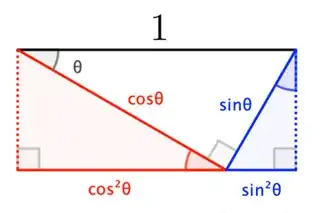
Pythagoras by standard ratio-chase

$$1 = \cos^2\theta+\sin^2\theta$$

(Note that this serves as the $\alpha+\beta=90^\circ$ limiting case of the Angle-Sum trigonograph above.)

Versluys may be suggesting something (ahem) similar by writing:

If one arranges this proof in such a way that one avoids the trigonometric relations, by including the proof of the first formula, then one arrives at the proof by means of proportionality of the sides of triangles having equal angles.

I'll stop typing now. :)

Blue
  • 83,939
1

"why is a trig proof impossible"?

This assertion is a reporter's version of Elisha Loomis' position. Loomis was an accomplished mathematician who, nearly 100 years ago, published a collection of 300+ proofs of the Pythagorean Theorem ranging from geometric constructs to magic squares. The book is in the public domain and can be found on Google Books. Because I don’t see it in the other posts linked by Blue above, and so that we can stop relying on hearsay, here is precisely what Loomis has to say on the subject:

enter image description here

As context, Loomis was not shy about this position, it was one of five main points he wanted to make about the Theorem per his Foreward:

enter image description here

RobinSparrow
  • 3,669
  • Loomis' maxim "Trigonometry is* because the Pythagorean Theorem is"* is succinct and catchy ... and wrong. :) I submit: "Trigonometry is because similarity is." ... The identity $\sin x/\cos x=\tan x$ is nothing more than an algebraic consequence of the SOHCAHTOA definitions; likewise for any result derived via mere ratio-chasing ... eg, the Angle-Sum and -Difference identities. Such "fundamental formulae" are not "based upon the truth of [PT]", despite Loomis' blanket declaration that "all [of them] are". (cont'd) – Blue Nov 02 '24 at 20:08
  • 1
    (cont'ing) Perhaps Loomis considers ratio-chasing too elementary to be "fundamental" to trigonometry-proper; that's a not-unreasonable stance, I suppose, but the qualification needs to be clearly articulated to avoid confusion among those (myself and many? most? almost-all? others) with a more-inclusive view. The upshot is this: The oft-overlooked nuance in Loomis' oft-cited rejection of "trigonometric" proofs is that Loomis' rejection does not apply to ratio-chasing arguments, simply because Loomis' restricted conception of "trigonometric" does not apply to ratio-chasing arguments. – Blue Nov 02 '24 at 20:08
  • BTW: Loomis' The Pythagorean Proposition is also available from the US Department of Education here (PDF link via ed.gov) – Blue Nov 02 '24 at 20:11
  • Interestingly, in the 1940 edition of The Pythagorean Proposition (PDF link via ed.gov), Loomis follows-up the passage highlighted above by writing (p 244) "Therefore the so-styled Trigonometric Proof, given by J. Versluys, in his Book, Zes en Negentig Bewijzen, 1914 (a collection of 96 proofs), p. 94, proof 95, is not a proof since it employs the formula $\sin^2A+\cos^2A=1$." ... I can't seem to find Versluys #95 online, so I don't know quite how to take this review (or the fact that it does not appear in subsequent editions). – Blue Nov 02 '24 at 21:25
  • 1
    @Blue: your answers elsewhere and comments here are illuminating. I wish we could chat with Loomis to get his more complete views. I think I agree with you in that he does appear to lump ratio chasing into the algebraic group of proofs (fine), but my own understanding of trig is of the basic sort and I’m not really qualified to come down on his stance or this proof. – RobinSparrow Nov 03 '24 at 03:21