An old challenge problem I saw asked to prove that $\sqrt{2 \sqrt{3 \sqrt{4 \ldots}}} < 3$. A simple calculation shows the actual value seems to be around $2.8$, which is pretty close to $3$ but leaves a gap. Can someone find $C < 3$ and prove $\sqrt{2 \sqrt{3 \sqrt{4 \ldots}}} < C$?
Asked
Active
Viewed 930 times
10

-
1See this: http://math.stackexchange.com/questions/356977/what-is-the-value-of-this-repeated-square-root-sqrt1-sqrt2-sqrt-3-sqrt4/357012#357012 – Ron Gordon Sep 19 '13 at 17:10
-
@RonGordon, great link. After posting the answer I was trying to put the exact value of the series which is given at your link. – Arash Sep 19 '13 at 17:14
-
This (https://oeis.org/A259235) and its square root (https://oeis.org/A112302) can be found on OEIS. – Akiva Weinberger May 17 '24 at 04:08
6 Answers
9
See my solution to a similar question, in which I show how to prove it by "Stronger Induction".
It tells you to prove by induction of $k \rightarrow k-1$ that
Fix $n\geq 2$. For all values of $2\leq k \leq n$, $\sqrt{ k \sqrt{(k+1) \sqrt{\ldots \sqrt{n} } } } < k+1 .$
Hence, applying this for $k=3$, we can show that
$$ \sqrt{3 \sqrt{4 \sqrt{5 \ldots}}} \leq 4.$$
Thus, we can improve our bound to
$$ \sqrt{ 2 \times 4 } = \sqrt{8} \approx 2.82. $$
Starting with higher values of $k$ gives us a better bound. For example, with $k=4$, we get
$$ \sqrt{2 \times \sqrt{3 \times 5 } } \approx 2.78.$$
$k=5$ gives $2.769$. This seems pretty decent for very little work. You can improve on this as much as you want, but I'd stop here.


Calvin Lin
- 77,541
-
the Stronger Induction article is interesting indeed. Just a small typo in worked out example #1, last line. It should read: $ \dfrac{1}{n(n+1)} > \dfrac{1}{(n+1)^2}$. The sign over there is the other way round. – Parth Thakkar Sep 19 '13 at 18:49
-
1
-
It seems like if you only prove strict inequality when you fix $n$, then you might get equality when you take the limit $n \to \infty$. However that's a minor point; if we have a constant $C$ that gives weak inequality then we can just add an arbitrarily small constant to get strict inequality. Interestingly, I think that your sequence of upper bounds converges to the actual value of the expression. So this is about the best set of upper bounds one could hope for. – user2566092 Sep 19 '13 at 18:51
-
@user2566092 Indeed, made $\leq$. It also shows you that the initial terms are really important (which easily follows by the exponent). Having control over them greatly improves the bound. In the subsequent terms, we are using $2^{\frac{1}{2}}$, $3^\frac{1}{4} $, etc explicitly. – Calvin Lin Sep 19 '13 at 18:54
7
Take a logarithm from the both sides and use $\log n\leq n-5$ for $n\geq 7$ and we have: $$ \log C= \log \sqrt{2 \sqrt{3 \sqrt{4 \ldots}}} = \frac{\log 2}{2}+\frac{\log 3}{2^2}+\frac{\log 4}{2^3}+\frac{\log 5}{2^4}+...\\ \leq \frac{\log 2}{2}+...+\frac{\log 6}{2^5}+\frac{2}{2^6}+\frac{3}{2^7}+...\\ \leq 0.92 +\frac{1}{16}\sum_{i=1}^{\infty} \frac{i}{2^i}=1.045 $$ which gives $C<2.8434$.

Arash
- 11,307
-
2
-
-
1This looks almost right, except that $\log 3 > 1$, but not by much. So I think that if that is corrected for, a valid $C$ will be found which is hopefully still less than $3$. Currently my computer calculation shows that $C$ should be greater than $2.76$. – user2566092 Sep 19 '13 at 17:59
-
1To 50 digits: 2.7612068419574980332304546465801311048761259807153 (using Pari/GP up to 300 terms of the $\log C$-formula) – Gottfried Helms Sep 19 '13 at 18:08
-
Well, it shows that I should not write the answer in a rush. I corrected everything again. The upper bound seems nice by the way. – Arash Sep 19 '13 at 18:38
-
1$\sum_{i=1}^{+\infty}\frac{i}{2^i}=2$, so the actual proof gives only $C<\exp\left(\frac{3}{2}+\frac{1}{40}\right)=4.59514\ldots$. – Jack D'Aurizio Sep 19 '13 at 19:25
-
@Andrew: ok, in fact $\sum_{i=1}^{+\infty}\frac{i}{2^i}>\frac{1}{2}+\frac{2}{4}=1.$ – Jack D'Aurizio Sep 19 '13 at 19:48
-
-
I'm highly amused that this got more up votes than mine, while showing a much weaker result than what OP stated. Note that even by weakening $ \frac{\log 2} { 2} $ to $\frac{1}{2}$, you increase your value by $ e^{\frac{1-\log 2 } {2} } $, and $ 2.75 * e^{\frac{1-\log 2 } {2} } > 3$. So the very first approximation brings you out of the tight 3 bound already. You need to use a much tighter bound that is off by less than $ \log (3/2.75) = 0.087$. – Calvin Lin Sep 19 '13 at 20:33
-
The current mistake is that you went from $\frac{\log 3}{2^2}$ to $\frac{0.1}{2^2}$ From your previous statement, I'm guessing that you want $ \frac{1.1}{2^2}$, which would thus increase your estimate by a ratio of $e^\frac{1}{4}\approx 1.28$. – Calvin Lin Sep 19 '13 at 20:41
-
7
There is an interesting formula hiding in this product which we now try to reveal. We seek to evaluate $$ S = \log P = 2 \times \sum_{n\ge 1} \frac{\log n}{2^n}.$$ The sum term is harmonic and may be evaluated by inverting its Mellin transform.
Recall the harmonic sum identity $$\mathfrak{M}\left(\sum_{k\ge 1} \lambda_k g(\mu_k x);s\right) = \left(\sum_{k\ge 1} \frac{\lambda_k}{\mu_k^s} \right) g^*(s)$$ where $g^*(s)$ is the Mellin transform of $g(x).$
In the present case we have $$\lambda_k = 1, \quad \mu_k = k \quad \text{and} \quad g(x) = \frac{\log x}{2^x}.$$ We need the Mellin transform $g^*(s)$ of $g(x)$ which is $$\int_0^\infty \frac{\log x}{2^x} x^{s-1} dx.$$ Observe that $$\int_0^\infty 2^{-x} x^{s-1} dx = \frac{1}{(\log 2)^s} \Gamma(s)$$ by a straightforward substitution that turns the integral into a gamma function integral. This implies that $$g^*(s) = \left(\frac{1}{(\log 2)^s} \Gamma(s)\right)' = - \frac{\log\log 2}{(\log 2)^s} \Gamma(s) + \frac{1}{(\log 2)^s} \Gamma'(s).$$
It follows that the Mellin transform $Q(s)$ of the harmonic sum $S(x)$ is given by $$Q(s) = \left(-\frac{\log\log 2}{(\log 2)^s} \Gamma(s) + \frac{1}{(\log 2)^s} \Gamma'(s)\right) \zeta(s).$$ The Mellin inversion integral here is $$\frac{1}{2\pi i} \int_{3/2-i\infty}^{3/2+i\infty} Q(s)/x^s ds$$ which we evaluate by shifting it to the left for an expansion about zero.
We have $$\operatorname{Res}(Q(s)/x^s; s=1) = -\frac{1}{x}\frac{\log\log2+\gamma}{\log 2}.$$ From the remaining residues we get the contribution $$\sum_{q\ge 0} \operatorname{Res}(Q(s)/x^s; s=-q) = -\sum_{q\ge 0} x^q \frac{(-1)^q}{q!} (\log 2)^q \left(\zeta'(-q) - \zeta(-q)\log x\right),$$ where we have used the fact that the poles of the gamma function at $s=-q$ are simple with residue $(-1)^q/q!.$
Finally to find $S(1) = S/2$ we put $x=1$ to obtain the convergent expansion $$S(1) = - \frac{\log\log2+\gamma}{\log 2} - \sum_{q\ge 0} \frac{(-1)^q}{q!} (\log 2)^q \zeta'(-q).$$ The conclusion is that $$P = \exp\left(-2\frac{\log\log2+\gamma}{\log 2} - 2\sum_{q\ge 0} \frac{(-1)^q}{q!} (\log 2)^q \zeta'(-q)\right)$$ which is approximately $$2.761206841957498033230454646580131104876125980715304850.$$ If the goal is to find approximations to $P$ it suffices to take the initial terms of the above series. For example, taking the first five terms we get five accurate digits for $P,$ taking seven terms we get seven digits and so on, the exact formula for the number of good digits is of course more complicated.

Marko Riedel
- 64,728
-
What does $\zeta'(-q)$ look like asymptotically? Does it go to zero exponentially? – Akiva Weinberger May 17 '24 at 04:04
-
This (https://oeis.org/A259235), its square root (https://oeis.org/A112302), and the logarithm of the latter (https://oeis.org/A114124) can be found on OEIS. If you have an OEIS account (and I recommend getting one), I figure it's worth adding your formula to these entries. – Akiva Weinberger May 17 '24 at 04:08
3
Put $K=\log C$. The problem is then to found a tight upper bound for: $$ K = \sum_{n=1}^{+\infty}\frac{\log(1+n)}{2^n}. $$ Note that: $$ K/2=K-K/2 = \sum_{n=1}^{+\infty}\frac{\log\left(1+\frac{1}{n}\right)}{2^n}. $$ By writing $K/4$ as $K/2-K/4$ just like above, we get: $$\frac{K}{4}=\frac{\log 2}{2}-\sum_{n=1}^{+\infty}\frac{\log\left(1+\frac{1}{n(n+2)}\right)}{2^{n+1}},$$ equivalent to: $$(\heartsuit)\quad K = \log 3 -\sum_{n=1}^{+\infty}\frac{\log\left(1+\frac{1}{(n+1)(n+3)}\right)}{2^n} = \log 3 +\sum_{n=1}^{+\infty}\frac{\log\left(1-\frac{1}{(n+2)^2}\right)}{2^n}.$$ Now using the Bernoulli inequality we have: $$\log 3-\sum_{n=1}^{+\infty}\frac{1}{(n+1)(n+3)2^n}\leq K \leq \log 3-\sum_{n=1}^{+\infty}\frac{1}{(n+2)^2 2^n}, $$ that gives: $$ 1 < 3\log 2 + \log 3 -\frac{13}{6} \leq K \leq \log 3+\frac{1}{12}\left(27-4\pi^2+24\log^2 2\right), $$ so $K$ is between $1.0113\ldots$ and $1.0196$, and $C$ is between $2.7494\ldots$ and $2.7722\ldots$.
The next step of the acceleration process leads us to: $$ K = 3\log 2-\log 3+\sum_{n=1}^{+\infty}\frac{\log\left(1+\frac{5+2n}{(n+1)(n+3)^3}\right)}{2^n},$$ that converges faster but is way less appealing than $(\heartsuit)$.

Jack D'Aurizio
- 361,689
-
+1 Interesting lower bounds. I think that these comments should be included in your answer. – Calvin Lin Sep 19 '13 at 20:36
-
@Calvin Lin: Upper and lower bounds deriving from the standard series acceleration technique included, thank you. – Jack D'Aurizio Sep 19 '13 at 21:16
0
Iif $a(n)=\sqrt{ 2\sqrt {3\sqrt {4...\sqrt{n}}}}$, $$a(n)^{2}= 2\sqrt {3\sqrt {4...\sqrt{n}}} \tag{1}$$ $$\dfrac{1}{2^{2}}.a(n)^{2}= 3\sqrt {4...\sqrt{n}} \tag{2}$$ $$\dfrac{1}{3^{2}}.\dfrac{1}{2^{2^{2}}}.a(n)^{2^{2}}= 4\sqrt{...\sqrt{n}} \tag{3}$$ $$\vdots$$ $$\prod_{i=0}^{n-2}\Big(\dfrac{1}{(n-i)^{2^{i}}}\Big).a(n)^{2^{n-1}}=1 \tag{n}$$ Then $$a(n)=(\prod _{i=0}^{n-2}{(n-i)^{2^{i}})}^{\dfrac{1}{2^{n-1}}} \tag{1}$$ and $$a(n+1)=(\prod _{i=0}^{n-1}{(n+1-i)^{2^{i}})}^{\dfrac{1}{2^{n}}} \tag{2}$$ From $(1)$ and $2$, $$\frac{a(n+1)}{a(n)}=(n+1)^{\frac{1}{2^{n}}}$$
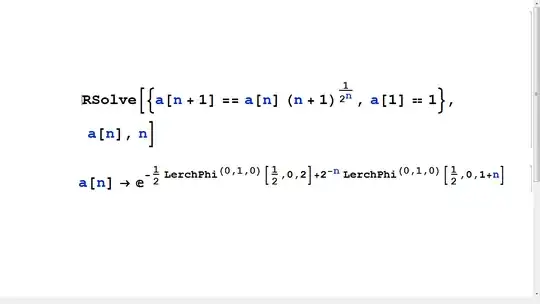 Mathematica could not find the limit sequence for $n\longrightarrow \infty$.

Jamal Farokhi
- 775
- 4
- 14
-
1I slightly improved formatting using
\tag{1}, etc for labels. I do hope you pass number theory, but this isn't a part of the answer. – Jul 04 '15 at 23:34
0
Reusing my answer on Quora and showing how it can be used to improve bounds
Write the expression as
$$\displaystyle 2\sqrt[2]{\frac{3}{2}}\sqrt[4]{\frac{4}{3}}\sqrt[8]{\frac{5}{4}}\sqrt[16]{\frac{6}{5}}...$$
$$\displaystyle \prod\limits_{n=1}^{+\infty} \left ( 1 + \frac{1}{n} \right )^{\frac{1}{2^{n-1}}}$$
$$\displaystyle \prod\limits_{n=1}^{+\infty} \left ( 1 + \frac{1}{n} \right )^{\frac{n}{n2^{n-1}}} < 2\prod\limits_{n=2}^{+\infty} e^{\frac{1}{n2^{n-1}}}$$
Now $$\displaystyle \prod\limits_{n=1}^{+\infty} e^{\frac{1}{n2^{n-1}}}=4$$ because $$\displaystyle \sum\limits_{n=1}^{+\infty} \frac{1}{n2^{n-1}}=\log(4)$$
$$\displaystyle 2\prod\limits_{n=2}^{+\infty} e^{\frac{1}{n2^{n-1}}}=2\frac{4}{e}<3$$
The expression can be used to get more convergents, simply take first few terms and set the rest to the exponent.
$$\frac{8\sqrt[4]{3}}{e^{\frac{4}{3}}}\approx 2.77$$
$$4\frac{2^\frac{3}{4}\sqrt[4]{3}\sqrt[8]{5}}{e^{\frac{131}{96}}} \approx 2.766$$ already