6

I want to compute the asymptotic expansion of

$$ \sum_{k=1}^n\sqrt{1+t\sin(2\pi k/n)} $$

when $n\to\infty$ and parameter $0<t<1$.

I tried to use $f(x/n)$ in the Euler–Maclaurin formula, with $f(x)=\sqrt{1+t\sin(2\pi x)}$ as

$$ \sum_{k=1}^nf\Bigl(\frac kn\Bigr)-n\int_0^1f(x)dx=\sum_{k=1}^p\frac{B_k}{k!}\frac{f^{(k-1)}(1)-f^{(k-1)}(0)}{n^{k-1}}+R_p $$

However, for my specific $f(x)$, $f^{(k)}(1)=f^{(k)}(0)$ for all $k$, so all terms in the sum on the right vanishes and I get no information. I think this means that the remainder vanishes faster than any polynomial, presumable exponentially.


Update

I tried to directly evaluate the sum using either series expansion in $t$ or Fourier series. I found both methods yields that the sum is strictly equal to the integral $\int_0^1f(x)dx$ (which evaluates to elliptic integrals, but it does not matter). Numerically, this is not true. I did not find any apparent mistakes, as the sum over $k$ is finite and can always commute with limit.

I sketch the approach using series expansion. For $t<1$,

$$ f(x)=\sum_{r=0}^\infty\binom{1/2}rt^r(\sin x)^r $$

Summation over $k$ yields

$$ \color{gray}{\sum_{k=1}^n(\sin(2\pi k/n))^r=\begin{cases} 0 & r\ \mathrm{odd}\\ \frac n{2^r}\binom{r}{r/2} & r\ \mathrm{even}\\ \end{cases}} $$

Edit: The gray formula above is not correct. (Do not blindly believe in Mathematica) The correct one is $$ \sum_{k=1}^n(\sin(2\pi k/n))^{2r}=\frac n{4^r}\sum_{s\in\mathbb Z,|s|\le 2r/n}\binom{2r}{r+ns/2} $$ The further conclusion below is thus false, so is deleted. This is not directly related to the question anyway.


Question: How can I calculate the asymptotic expansion, at least to the first order?

I would appreciate any help or suggestions.

Covariant
  • 739
  • Did you tried the Abel summation formula? Maybe it can be useful, in this case. Anyway, I would expect terms that depend, in some way, on complete elliptic integrals of the second kind. – Marco Cantarini Oct 14 '24 at 13:16
  • Some checks with WA. It seems that the rough formula (above) gives the correct order of magnitude - https://www.wolframalpha.com/input?i=6%5Cint_0%5E1+%5Csqrt%7B1+%2B+0.5%5Csin+%282%5Cpi+x%29%7Ddx and https://www.wolframalpha.com/input?i=%5Csum_%7Bk%3D1%7D%5E%7B6%7D%5Csqrt%7B1%2B0.5%5Csin%282%5Cpi+k%2F6%29%7D and https://www.wolframalpha.com/input?i=e%5E%7B-6%5Cln%282%2B%5Csqrt3%29%7D – Svyatoslav Oct 14 '24 at 18:45
  • Also https://www.wolframalpha.com/input?i=6%5Cint_0%5E1+%5Csqrt%7B1+%2B+0.7%5Csin+%282%5Cpi+x%29%7Ddx and https://www.wolframalpha.com/input?i=%5Csum_%7Bk%3D1%7D%5E%7B6%7D%5Csqrt%7B1%2B0.7%5Csin%282%5Cpi+k%2F6%29%7D and https://www.wolframalpha.com/input?i=e%5E%7B-6%5Cln%281%2F0.7%2B%5Csqrt%7B1%2F0.49-1%7D%29%7D – Svyatoslav Oct 14 '24 at 18:46
  • 1
    Notice that $$\sum_{r=0}^\infty \frac1{4^r}\binom{2r}{r}\binom{1/2}{2r}t^{2r}=, _2F_1\left(-\frac{1}{4},\frac{1}{4};1;t^2\right)$$ – Claude Leibovici Oct 15 '24 at 05:06
  • @ClaudeLeibovici I know that the sum is hypergeometric (and can be reduced to a complete elliptic integral). The exact form does not matter anyway. – Covariant Oct 15 '24 at 06:03
  • @RiverLi The summation is a finite sum for fixed $n$. Of course it can commute with integrals or series. – Covariant Oct 16 '24 at 06:56
  • @Svyatoslav Thank you for you remark. I was actually aware of my mistake, but have no time to edit. Now I correct that part. – Covariant Oct 16 '24 at 16:02
  • Have you tried using the exact expression for $R_p$ as a starting point for estimating it? – Greg Martin Oct 16 '24 at 16:37
  • Right now I cannot get asymptotis of your sum, but I can explained in details what is happening - using similar example $$\sum_{k=0}^n (-1)^n\sqrt{1+t\sin\frac{2\pi k}n}$$ This case is easier to investigate, and I got its asymptotics. I was right about the method of evaluation and general view of the additional asymptotic term, but I looks a bit complicated and has additional factors. Checked numerically - it works perfectly. So, if you are interested, I will post it. Please, let me know. – Svyatoslav Oct 16 '24 at 18:11
  • 2
    $$\sum_{k=1}^n\sqrt{1+t\sin\frac{2\pi k}n}-n\int_0^1\sqrt{1+t\sin(2\pi x)},dx\sim-,\frac{\cos\frac{3\pi n}2}{\sqrt{\pi n}}\left(\frac{1+\sqrt{1-t^2}}t\right)^{-n}(1-t^2)^\frac14$$ It seems that WA (free option) confirms. Could you please check, using more serious source? Thank you. – Svyatoslav Oct 16 '24 at 20:06
  • @Gary, could you prove or disprove the asymptotics above? I got it by very unjustified means and not sure whether it works... I believe there sould be a regular approach. Many thanks in advance! – Svyatoslav Oct 16 '24 at 20:37
  • Comments have been moved to chat; please do not continue the discussion here. Before posting a comment below this one, please review the purposes of comments. Comments that do not request clarification or suggest improvements usually belong as an answer, on [meta], or in [chat]. Comments continuing discussion may be removed. – Shaun Oct 16 '24 at 21:27
  • 1
    When the function is periodic the Riemann sums approximate the integral with exponentially decreasing error term and the EM formula doesn't work. See this https://math.stackexchange.com/q/3490868/72031 (specially discussion in comments). – Paramanand Singh Oct 25 '24 at 04:01
  • Just in case to the discussion. The straightforward solution https://math.stackexchange.com/questions/4951182/sum-of-sum-i-0n-1-frac1a-sin2-fracij-pin/4951680#4951680 gives for any $a>0$ $$\sum_{k=0}^{n-1}\frac1{a+\sin^2\frac{\pi k}n}=\frac n{\sqrt{a(1+a)}}\frac{\big(1+2a+2\sqrt{a(1+a)},\big)^n+1}{\big(1+2a+2\sqrt{a(1+a)},\big)^n-1}\overset {,a=\frac18}{\Rightarrow}\frac{8n}{3}\frac{2^n+1}{2^n-1}$$ – Svyatoslav Oct 25 '24 at 06:11

1 Answers1

9

Very interesting problem indeed! It is late at night, so I apologise in advance for any typo :)

Let' consider (just to note that we start summation from $k=0$) $$S=\sum_{k=0}^n\left(1+t\sin\frac{2\pi k}n\right)^{-\alpha}$$ where we chose for a while $0<\alpha<1$

In a standart way, switching to complex integration $$2\pi iS=\pi t^{-\alpha}\oint_C\cot\pi z\left(\frac1t+\sin\frac{2\pi z}n\right)^{-\alpha}dz=\pi t^{-\alpha}\oint_C\cot\pi z\left(\cosh\frac{2\pi s_0}n+\sin\frac{2\pi z}n\right)^{-\alpha}dz$$ where $\,s_0=\frac{n}{2\pi}\operatorname{arch}\frac1t=\frac{n}{2\pi}\ln\left(\frac1t+\sqrt{\frac1{t^2}-1}\right)$, and the contour $C$ embraces the points $z=0,1,2,...n,\,$ . As we have two branch points $z=\frac{3n}4\pm is_0$, we deform the contour and integrate along the following way (adding two cuts and keeping the integrand an analytical function)
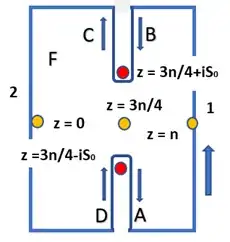
contour

Integrals along the paths 1 and 2 cancel each other; at $z\to\pm i\infty$ the integrand declines exponentially, so the integral along the horizontal paths tend to zero, and we are left with the integrals along the paths A,B,C,D (and, of course, the half-residues at the points $z=0, n$)

Hence, $$2\pi iS=2\pi i+I_A+I_B+I_C+I_D$$ Appointing the phases to the paths at $z\to\pm i\infty$, and taking into account the change of phases while turning around the branch points $$2\pi iS=2\pi i-\frac{1-e^{2\pi i\alpha}}{e^{\pi i \alpha}}\pi t^{-\alpha}i\int_{s_0}^\infty\cot\pi\big(\frac{3n}4-is\big)\left(\cosh\frac{2\pi s}n-\cosh\frac{2\pi s_0}n\right)^{-\alpha}ds$$ $$+\frac{1-e^{-2\pi i\alpha}}{e^{-\pi i\alpha}}\pi t^{-\alpha}i\int_{s_0}^\infty\cot\pi\big(\frac{3n}4+is\big)\left(\cosh\frac{2\pi s}n-\cosh\frac{2\pi s_0}n\right)^{-\alpha}ds$$ Given that $n\gg1\,\,s_0\gg1$, and we can decompose $\cot$ near this point (just to mention that such decomposition allows to get full asymptotics). Keeping only two terms, $$\approx 2\pi i+4i\sin(\pi\alpha)\,\pi t^{-\alpha}\int_{s_0}^\infty\left(1+\cos\frac{3\pi n}2e^{-2\pi s}\right)\left(\cosh\frac{2\pi s}n-\cosh\frac{2\pi s_0}n\right)^{-\alpha}ds$$ $$=2\pi i+4i\sin(\pi\alpha)\,\pi t^{-\alpha}(I_1+I_2)$$ To evaluate $I_2$, we use again the condition $n\gg1$: $$\int_{s_0}^\infty e^{-2\pi s}\left(\cosh\frac{2\pi s}n-\cosh\frac{2\pi s_0}n\right)^{-\alpha}ds\approx e^{-2\pi s_0}\int_0^\infty e^{-2\pi s}\left(\sinh\big(\frac{2\pi s_0}n\big)\,\frac{2\pi}ns\right)^{-\alpha}ds$$ $$=e^{-2\pi s_0}\left(\sinh\big(\frac{2\pi s_0}n\big)\right)^{-\alpha}\frac{n^\alpha}{2\pi}\Gamma(1+\alpha)$$ To evaluate $I_1$, we make the following transformations: $$\int_{s_0}^\infty\left(\cosh\frac{2\pi s}n-\cosh\frac{2\pi s_0}n\right)^{-\alpha}ds=\frac n{2\pi}\int_{\operatorname{arch\frac1t}}^\infty\left(\cosh x-\frac1t\right)^{-\alpha}dx$$ $$=\frac n{2\pi}\int_{\frac1t}^\infty\frac{\big(x-\frac1t\big)^{-\alpha}}{\sqrt{x^2-1}}dx=\frac{nt^\alpha}{2\pi}\int_0^1\frac{(1-x)^{-\alpha}x^{\alpha-1}}{\sqrt{1-t^2x^2}}dx$$ But $$\sin\pi\alpha\int_0^1\frac{(1-x)^{-\alpha}x^{\alpha-1}}{\sqrt{1-t^2x^2}}dx=\pi\int_0^1\left(1+t\sin(2\pi x)\right)^{-\alpha}dx$$ I leave this to be rigorously proved by those who are interested; myself, check via decomposition and integration term by term (and confirmed numerically).

So, taking all together, we get the answer: $$S=\sum_{k=0}^n\left(1+t\sin\frac{2\pi k}n\right)^{-\alpha}\approx 1+n\int_0^1\big(1+t\sin(2\pi x)\big)^{-\alpha}dx$$ $$+t^{-\alpha}\sin(\pi\alpha)\cos\frac{3\pi n}2n^\alpha e^{-2\pi s_0}\sinh^{-\alpha}\left(\frac{2\pi s_0}n\right)\Gamma(1+\alpha);\,\,\alpha\in(0,1)$$ Implementing analytical continuation, we can consider any real $\alpha$. For example, taking $\alpha=-\frac12$ we get the asymptotic that I mentioned in the comment (and that initially found by not rigorous way). Just expressing $s_0$ via $ n, t$ $$\sum_{k=1}^n\left(1+t\sin\frac{2\pi k}n\right)^{\frac12}\sim n\int_0^1\big(1+t\sin(2\pi x)\big)^\frac12dx-\frac{\cos\frac{3\pi n}2}{\sqrt{\pi n}}(1-t^2)^{\frac14}\left(\frac{1+\sqrt{1-t^2}}t\right)^{-n}$$ In the case of odd $n$ we have to consider next terms of the decomposition of $\cot\big(\frac{3\pi}4\pm is\big)$ to find non-zero asymptotic terms.

Numeric checks with WA confirm the result (just one point: you have to evaluate $\,\sum_{k=1}^n\left(1+t\sin\frac{2\pi k}n\right)^{\frac12}\,$ and $\,n\int_0^1\big(1+t\sin(2\pi x)\big)^\frac12\,$ numerically separately, and only then take the difference. If you put $\,\sum_{k=1}^n\left(1+t\sin\frac{2\pi k}n\right)^{\frac12}-n\int_0^1\big(1+t\sin(2\pi x)\big)^\frac12\,$ in WA, the number may be not correct. These are bugs of WA free option.)


There is also a more rich case of alternating series (I also mentioned it in the comment). Using complex integration we can get, for example, $$\sum_{k=0}^n(-1)^k\sqrt{1+t\sin\frac{2\pi k}n}\sim\frac{1+(-1)^n}2+\big((-1)^n-1\big)\frac{\pi t}{4n}\left(1+O\Big(\frac 1{n^2}\Big)\right)$$ $$-\,\sqrt{\frac 8{\pi n}}\cos\frac{3\pi n}4(1-t^2)^\frac14\left(\frac{1+\sqrt{1+t^2}}t\right)^{-\frac n2}$$ Here I keep the exponentially small term just to show that it contributes at even $n$

Svyatoslav
  • 20,502