1

Context

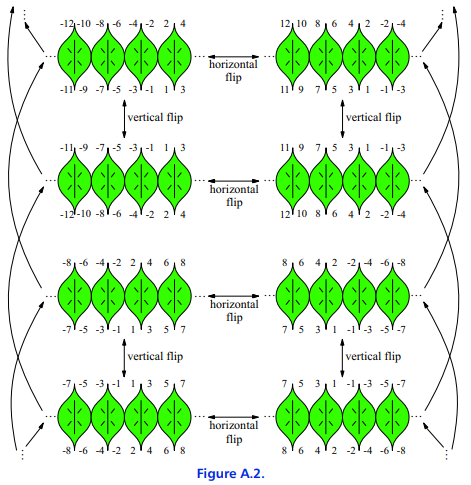
I was reading about frieze groups in Nathan Carter's Visual Group Theory. On page 263, in the answer to Exercise 3.11, the author describes the frieze pattern $\mathrm{p2mm}$, with the corresponding figure $\mathrm{A2}$ given on the next page, as shown below:
enter image description here

Here, the unmarked arrows represent the 'translation to right by one unit' action. For the purposes of this post however, vertical reflectional symmetry is not required, so we will instead modify the diagram to represent a quotient group of $\mathrm{p2mm}$, namely, the $\mathrm{p1m1}$ frieze group:

enter image description here

It is evident from the diagram that the axis used by the author during the horizontal flip moves during translation (the axis is always between $-2$ and $2$). Thereby this creates a group structure that appears like:

enter image description here

Here the green arrows represent the horizontal flip action, and the black arrows represent translation to the right by one unit (Note: the green and black arrows are not "enough" as generators, since they can't combine to create an inverse for the black action.). It is evident from the Cayley diagram that this group is isomorphic to the product group $\mathbb{Z}\times\mathbb{Z}_2$

However there is another possible perspective. We could also have kept the reflection axis fixed during the translation action:

enter image description here

Here the yellow arrows represent the translation action and the blue arrows represent horizontal flip. Thereby, this creates a group structure which appears like:

enter image description here

This group appears to be isomorphic to the $\mathrm{Dih}_\infty$ group.


Summing up

The symmetry group of the frieze pattern $\mathrm{p2mm}$ produces the quotient frieze group $\mathrm{p1m1}$. If we use the representation of $\mathrm{p2mm}$ as shown in the book (reflection axis moves during translation), then $\mathrm{p1m1}$ is isomorphic to the abelian group $\mathbb{Z}\times\mathbb{Z}_2$. However, if the reflection axis is kept stationary over translations, then $\mathrm{p1m1}$ can instead be shown isomorphic to the non-abelian $\mathrm{Dih}_\infty$ (the infinite dihedral group).


Question

Based on whether the reflection axis moves during translation, we can create two different symmetry groups for the same object (the $\mathrm{p1m1}$ frieze pattern). Wikipedia tells us that $\mathrm{Dih}_\infty$ is the accepted one, which doesn’t match with the book. Why is one symmetry group preferred over another? Is it possible for an object to have two different (non-isomorphic) symmetry groups, or am I getting something wrong?

Soham Saha
  • 2,356
  • Interestingly, I study now at a German university and one of the hardest exam questions was stuff like this; you're given a figure and have to find the symmetry group of it. This threw a lot of people off since the script for the course had no such examples afaik. – Clemens Bartholdy Jul 31 '24 at 06:32
  • @CatharticEncephalopathy I was trying to find a good visual intuition for abstract algebra. Came across this and this. Cayley diagrams are really pretty useful, and the book is full of visual explanations. – Soham Saha Jul 31 '24 at 06:39
  • 1
    https://mathoverflow.net/questions/31879/are-there-other-nice-math-books-close-to-the-style-of-tristan-needham – Clemens Bartholdy Jul 31 '24 at 06:41
  • @CatharticEncephalopathy Thanks for the link! The books there seem to be wonderful. – Soham Saha Jul 31 '24 at 06:47
  • Would the downvoter care to comment? – Soham Saha Aug 01 '24 at 05:43

1 Answers1

2

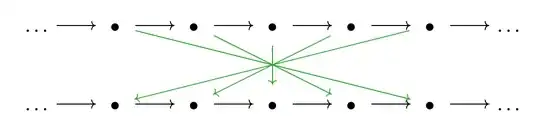
It is not possible for an object to have two different (that is, non-isomorphic) symmetry groups. The problem in your question is quite a subtle one: the "horizontal flip" arrows in your second picture do not all correspond to the same group element, because they are flipping relative to different axes, as you noticed. Thus, your first Cayley diagram is not accurate, as it implies that all the green arrows represent the same group element.

The symmetry group of $\mathbf{p1m1}$ is the infinite dihedral group, which is not isomorphic to the direct product $\mathbb{Z} \times \mathbb{Z}_2$, but rather to the semidirect product $\mathbb{Z} \rtimes \mathbb{Z}_2$ where $\mathbb{Z}_2$ acts on $\mathbb{Z}$ by negation.

If you were to correct the green arrows in your first Cayley diagram, it would look like this:

Cayley diagram

"Straightening" the green arrows by flipping the bottom axis yields your second Cayley diagram.

  • To be the ‘same’ action in every possible case, it is not necessary for the action to have its reflection axis at the same location (wrt ambient space). Defining it as reflection between -2 and 2, we can see that all green actions are same wrt this definition. – Soham Saha Jul 30 '24 at 15:17
  • 1
    Keep in mind that the numbers in your first two diagrams aren't actually there; they are just showing what the symmetry is doing. You can't define a symmetry of the frieze that flips 2 and -2, because the numbers are not part of the frieze (and if they were, it wouldn't be a symmetry!). – Naïm Camille Favier Jul 30 '24 at 15:22
  • 1
    I think we should continue in the chat to avoid cluttering the thread here. – Soham Saha Jul 30 '24 at 15:33