Restatement of the Question to Make Reference Easier
Find the coefficient of $x^{21}$ in $(1+x+x^2+\dots+x^{10})^4$
Solution Steps for the Specific Coefficient and Also Full Convolution
For the coefficient of $x^{21}$, we need to sum all combinations that result in their total product being $x^{21}$
$$(1+x+x^2+\dots+x^{10})*(1+x+x^2+\dots+x^{10})*(1+x+x^2+\dots+x^{10})
*(1+x+x^2+\dots+x^{10})$$
Convolution by Hand is Not Difficult
Let $$A=\left(10^{0}+10^{1}+10^{2}+10^{3}+10^{4}+10^{5}+10^{6} + 10^{7}+10^{8}+10^{9}+10^{10} \right)$$
Then, with:
$$C=(1+x+x^2+\dots+x^{10})*(1+x+x^2+\dots+x^{10})*(1+x+x^2+\dots+x^{10})
*(1+x+x^2+\dots+x^{10})$$
And:
$$B=A*A=(1+x+x^2+\dots+x^{10})*(1+x+x^2+\dots+x^{10})
\\ \text{And }C=B*B$$
Then, the convolution needed to solve for $B$ from $A$ (where $B_i$ is the coefficient for the element of $B$ that multiplies $10^i$) is a simple addition of $1 \textit{ elements}$. And there is only one coefficient of $C=B*B$ that needs to be solved for, namely $C_{21}$ that is the coefficient of $10^{21}$ for $C$. Start by solving for $B$ that ranges from $10^0$ to $10^{20}$ (21 coefficients from $B_0$ to $B_{20}$ in all):
$$B=1*10^0+2*10^1+3*10^2+4*10^3+5*10^4+6*10^5+7*10^6+8*10^7+9*10^8
+10*10^9+11*10^{10}+10*10^{11}+9*10^{12}+8*10^{13}+7*10^{14}+ 6*10^{15}+5*10^{16}+4*10^{17}+3*10^{18}+2*10^{19}+1*10^{20}$$
Now the convolution of $B$ and $B$ is needed, namely $C=B*B$. However, by hand, it is not necessary to calculate all coefficients of $C_k*10^{k}$. The calculation is needed only for $C_{21}*10^{21}$.
There are references on digital Linear Convolution of sequences, but the concept is simple enough that it can be figured out here. Say there is a contributing factor on the left term of the convolution $B_i*10^i$ and on the right term $B_j*10^j$. The requirement for all contributing products is that $i+j=21$, so that $B_i*10^i*B_j*10^j=B_i*B_j*10^{21}$ which is by inspection correct.
On the left, $B_0$ makes zero contribution, since there is no nonzero term $B_{\left({21}-0\right)}=B_{21}=0$, and the same with $B_0$ on the right, a zero contribution. So the calculation can proceed, starting with $B_1$ on the left and finishing with $B_1$ on the right:
$$
C_{21}=B_1*B_{20}+B_2*B_{19}+B_3*B_{18}+B_4*B_{17}+B_5*B_{16}
+B_6*B_{15}+B_7*B_{14}+B_8*B_{13}+B_9*B_{12}+B_{10}*B_{11}
+B_{11}*B_{10}+B_{12}*B_9+B_{13}*B_8+B_{14}*B_7+B_{15}*B_6
+B_{16}*B_5+B_{17}*B_4+B_{18}*B_3+B_{19}*B_2+B_{20}*B_1
$$
This final calculation can be done by hand or with a hand calculator (here the Unix Bash shell \$(()) Command Shell Calculator so that the calculation is entirely visible):
echo $((2*1+3*2+4*3+5*4+6*5+7*6+8*7+9*8+10*9+11*10+10*11+9*10+8*9+7*8+6*7+5*6+4*5+3*4+2*3+1*2))
880
$$
\boxed{\text{The coefficient of }10^{21}\text{ is: }
\text{Result of how many }10^{21}{ is: }880}$$
Performing Digital Convolution
Hint: The coefficients (all each 1, needing summing) are from the terms of
$x^{21}$ can be found by identifying the
$22^{nd}$ term of the convolution of (since the first term is for the
$x^0$ coefficient):
$$
\begin{align*}
[1\text{ }1\text{ }1\text{ }1\text{ }1\text{ }1\text{ }1\text{ }1\text{ }1\text{ }1\text{ }1]*
[1\text{ }1\text{ }1\text{ }1\text{ }1\text{ }1\text{ }1\text{ }1\text{ }1\text{ }1\text{ }1]*
[1\text{ }1\text{ }1\text{ }1\text{ }1\text{ }1\text{ }1\text{ }1\text{ }1\text{ }1\text{ }1]*
[1\text{ }1\text{ }1\text{ }1\text{ }1\text{ }1\text{ }1\text{ }1\text{ }1\text{ }1\text{ }1]
\end{align*}
$$
The full convolution results in 41 elements, with element 0 corresponding to the coefficient of $x^0$ and element 41 corresponding to $x^{40}$. Because of this, the coefficient of $x^{21}$ is actually the $22^{nd}$ entry in the convolution which results in the coefficient value of $880$:
$$
\left[ \text{ }1\text{ }\text{ }4\text{ }\text{ }10\text{ }\text{ }20\text{ }\text{ }35\text{ }\text{ }56\text{ }\text{ }84\text{ }\text{ }120\text{ }\text{ }165\text{ }\text{ }220\text{ }\text{ }286\text{ }\text{ }360\text{ }\text{ }439\text{ }\text{ }520\text{ }\text{ }600\text{ }\text{ }676\text{ }\text{ }745\text{ }\text{ }804\text{ }\text{ }850\text{ }\text{ }880\text{ }...\\
...\text{ }891\text{ }\textbf{ 880}\text{ }\text{ }850\text{ }\text{ }804\text{ }\text{ }745\text{ }\text{ }676\text{ }\text{ }600\text{ }\text{ }520\text{ }\text{ }439\text{ }\text{ }360\text{ }\text{ }286\text{ }\text{ }220\text{ }\text{ }165\text{ }\text{ }120\text{ }\text{ }84\text{ }\text{ }56\text{ }\text{ }35\text{ }\text{ }20\text{ }\text{ }10\text{ }\text{ }4\text{ }\text{ }1\text{ }\right]
$$
Thus:
$$
\boxed{\text{The coefficient of }10^{21}\text{ is: }
\text{Result of how many }10^{21}{ is: }880}$$
Procedure for Taking the Necessary Sum By Indexing the Contributing Terms from the Four Power Terms $(1+x...+x^{10})$
Below are the Tables Showing the Term Contributions, starting from 1 to 200, next from 201 to 400, next from 401 to 600, next from 601 to 800, and next from 801 to 880. Following the procedure in the table, the coefficients for the result of $880*10^{21}$ can be counted out by hand. And the hand calculations can be shortened by noticing patterns in the below tables.
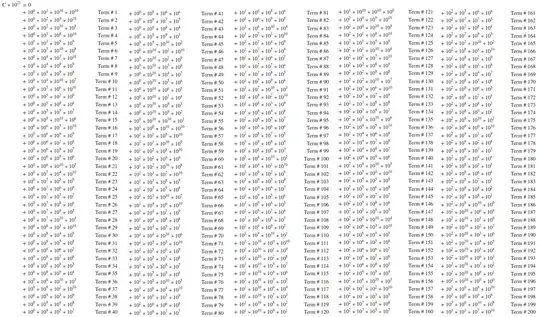

...
The remaining term contributions are available in MathJax form from the section below, *"Calculation of the MathJax Table of All Terms Contributing to
$C$ where
$C*10^{21}$ is the Term Being Sought"*. I hope to update the tables here time permitting. But the method of determining the coefficients should be clear from the already existing table references.
Direct Calculation of the Result for the $21^{st}$ Power Resulting in a Coefficient of 880
The result was calculated on the online C compiler as follows:
// Basic Ountline From:  https://www.programiz.com/c-programming/online-compiler/
// Online C compiler to run C program online
#include <stdio.h>
int i; //Power in first term
int j; //Power in second term
int k; //Power in third term
int l; //Power in fourth term
int itotal; //Number of terms that has 21 total powers
int isubtotal; //sum of i, j, k, and l
int main() {
itotal=0;
for (i=0; i<=10; i++)
  for (j=0; j<=10; j++)
   for (k=0; k<=10; k++)
       for (l=0; l<=10; l++)
       {
       isubtotal=i+j+k+l;
         if (isubtotal ==(int) 21)
            {
            itotal++;
            }
//       printf("isubtotal = %d \n", isubtotal);
       }
printf("Result of how many 10^21 is: %d \n",itotal);

return 0;
}
Calculation of the Convolution Result for All Powers
// Basice Ountline From:  https://www.programiz.com/c-programming/online-compiler/
// Online C compiler to run C program online
#include <stdio.h>
int i; //Power in first term
int j; //Power in second term
int k; //Power in third term
int l; //Power in fourth term
int m; //Which coefficient being sought
int itotal; //Number of terms that has m total powers
int isubtotal; //sum of i, j, k, and l
int main() {
printf("$$ \n \left[ ");
for (m=0; m<41; m++)
    {
    for (itotal=0, i=0; i<=10; i++)
        for (j=0; j<=10; j++)
            for (k=0; k<=10; k++)
                for (l=0; l<=10; l++)
                    {
                    isubtotal=i+j+k+l;
                     if (isubtotal == m)
                        {
                        itotal++;
                        }
                    }
    printf("\text{ }%d\text{ }", itotal);
    }
printf("\right] \n $$\n");

return 0;
}
Calculation of the MathJax Table of All Terms Contributing to $C$ where $C*10^{21}$ is the Term Being Sought
// Basic Outline From:  https://www.programiz.com/c-programming/online-compiler/
// Online C compiler to run C program online.  Or it is also possible to compile with programs such as gcc.
#include <stdio.h>
int i; //Power in first term
int j; //Power in second term
int k; //Power in third term
int l; //Power in fourth term
int itotal; //Number of terms that has 21 total powers
int isubtotal; //sum of i, j, k, and l
int main() {
printf("$$\n \begin{aligned} C10^{21}&=0 \text{          } &\text{      }\\ \n");
itotal=0;
for (i=0; i<=10; i++)
  for (j=0; j<=10; j++)
   for (k=0; k<=10; k++)
       for (l=0; l<=10; l++)
       {
       isubtotal=i+j+k+l;
         if (isubtotal ==(int) 21)
            {
            itotal++;
            printf("&+10^{%d}10^{%d}10^{%d}10^{%d} \text{          } & \text{Term # }%d \\ \n",i,j,k,l,itotal);
            }
       }
printf("\\ \n \\ \n \boxed{\text{Result of how many 10^{21} is }C\text{ is: }C=%d} \n \end{aligned}$$",itotal);

return 0;
}


