5

The question I need help with is line $D: x = {y-2\over -1} = z$
line $D': {x-2\over2} = {y-3\over1} = {z+5\over-1}$
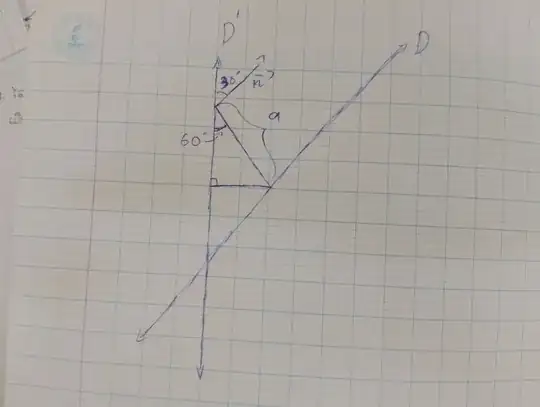
Find plane $(α)$ for $(α)$ containing $D$ and the angle between $(α)$ and $D' $ is 60 degrees.

This is what I did let $v,v'$ be the vector for line $D,D'$ respectively. I got $v = ( 1, -1, 1)$ ; $v' = ( 2, 1, -1)$, which is perpendicular (got from their dot product) meaning $D$ and $D'$ is perpendicular.

I calculated that $D$ and $D'$ do not intersect.

1

Ricky
  • 3,194
  • 1
    Note that your fractions can be simplified. $\frac{1}{-1} = -1$ and $\frac 1 1 = 1$; and thus $\frac{y-2}{-1} = 2-y$ and $\frac{y-3}{1} = y-3$. – Stef Oct 04 '23 at 06:55
  • 1
    @Stef The OP is of course aware of that, but chose a usual way to present a line:$$\frac{x-x_0}a=\frac{y-y_0}b=\frac{z-z_0}c.$$ – Anne Bauval Oct 04 '23 at 09:00

3 Answers3

6

A unit normal vector $n=(a,b,c)$ to that plane $(\alpha)$ must be orthogonal to $v$ and make an angle $30^\circ$ with $v'.$ The solutions of $$a^2+b^2+c^2=1,\quad a-b+c=0,\quad|2a+b-c|=\|v'\|\cos(30^\circ)$$ are $$n_1=\pm\frac1{\sqrt2}(1,1,0)\quad\text{and}\quad n_2=\pm\frac1{\sqrt2}(1,0,-1).$$ Using that $(0,2,0)\in D\subset(\alpha),$ we find two planes satisfying the constraints:

$$(\alpha_1):\quad x+y-2=0$$ and $$(\alpha_2):\quad x-z=0.$$

Anne Bauval
  • 49,005
5

The solutions given by Anne Bauval and Hosam H are very good.

I would like here to take a different approach (a little longer !) based on a general form of the planes passing through line $D$ (equation (2) below).

  1. One can write the equations of $D'$ $${x-2\over2} = {y-3\over1} = {z+5\over-1}=\color{red}{t}$$ under the parametric form :

$$D' : \begin{cases}x&=&2\color{red}{t}+2\\y&=&\color{red}{t}+3\\z&=&-\color{red}{t}-5\end{cases}\tag{1}$$

  1. Let us now find two points on line $D$, for example $\pmatrix{0\\2\\0}$ and $\pmatrix{2\\0\\2}$. Then, the general equation of planes passing through line $D$ and intersecting $D'$ is, under its determinantal form (see here) :

$$\left|\begin{matrix}0&2&\ \ 2t+2&x\\2&0&\ \ t+3&y\\0&2&-t-5&z\\1&1&1&1\end{matrix}\right|=0$$

Expanding, we obtain :

$$-4x+(-3t-7)y+(-3-3t)z+(6t+14)=0\tag{2}$$

with the alternative form ("pencil of planes") :

$$(-4x-7y-3z+14)+t(-3y-3z+6)=0\tag{2'}$$

From (3), we get a normal vector $N=\pmatrix{-4\\(-3t-7)\\(-3-3t)}$ which has to make a $90°-60°=30°$ angle with $N'=\pmatrix{2\\1\\-1}$, directing vector of line D'.

  1. The $30°$ constraint can be transformed into an equation, by using the two ways one can express a dot product :

$$(N.N')^2=\|N\|^2\|N'\|^2 (\cos 30°)^2$$

$$144=(16+(-3t-7)^2+(3+3t)^2) \times 6 \times \frac34$$

giving a quadratic equation whose solutions are

$$t=-1 \ \ \text{and} \ \ t=-7/3.$$

"Plugging" into (1) these values of $t$ gives the equation of the two $(\alpha)$ planes :

$$x-z=0 \ \ \ \text{and} \ \ \ x+y-2=0\tag{3}$$

A remarkable fact is that these planes make a $60°$ between themselves (underlined in the solution by Hosam H). A comparison can be made with the following situation : a book is placed vertically on a table, opened with a 60° angle between its front and back cover (its binding features line $D$); now consider a line on the table (featuring line $D'$) completing an equilateral triangle with the bottom of the book. The line and the two planes are exactly in the same configuration as in the problem.

enter image description here

Fig. 1 : Line $D$ with points $(0,2,0)$ and $(2,0,2)$ (dark green) ; line $D'$ with points corresponding to parameters $t=-1,-7/3$ (yellow) : see equations (1) ; planes (blue and red) given by equations (2) and intermediate plane (grey) corresponding to intermediate value $t=-5/3$, these three planes belonging to the pencil of planes (2') "rotating" around line $D$.

Jean Marie
  • 88,997
2

A plane $\pi$ containing line $D$ has its normal vector perpendicular to $D$.

The unit direction vector of $D$ is $\omega =\dfrac{1}{\sqrt{3}}(1, -1, 1) $. Two unit vectors that are perpendicular to $\omega$ are

$ u_1 = \dfrac{1}{\sqrt{2}} (1, 1, 0) $

and

$ u_2 = \omega \times u_1 = \dfrac{1}{\sqrt{6}} (-1, 1, 2) $

So now the unit normal vector $n$ of any plane containing line $D$, can be parameterized by $\theta \in \mathbb{R} $ as follows

$ n = \cos \theta u_1 + \sin \theta u_2 $

Since it is required that line $D'$ makes an angle of $60^\circ$ with the plane, then this means that $D'$ makes an angle of $30^\circ$ with $n$.

The unit direction vector along $D'$ is $\mu = \dfrac{1}{\sqrt{6}}( 2, 1, -1) $

Therefore, it is required that

$ \cos 30^\circ = \mu \cdot n $

Substituting $\mu$ and $n$ and evaluating the dot product we get

$ \cos \dfrac{\pi}{6} = \dfrac{\sqrt{3}}{2} \cos \theta - \dfrac{1}{2} \sin \theta $

The right hand side is just $\cos( \theta + \dfrac{\pi}{6} )$

So by inspection, the solutions are $\theta = 0 $ and $\theta = - \dfrac{\pi}{3} $

Substituting these two values gives the two possible planes with the desired properties.

The two planes pass through $P_0 = (0,2,0)$ which is on line $D$.

The first normal is

$ n_1 = u_1 = \dfrac{1}{\sqrt{2}}( 1, 1, 0) $

and the second normal is

$n_2 = \dfrac{1}{2 \sqrt{2}} (2, 0, -2) $

Hence the two possible planes are

$ x + y - 2 = 0 $

and

$ x - z = 0 $