Take the list of primes, $$2, 3, 5, 7, 11, 13, 17, 19, 23, 29, 31, 37, 41, 43, 47, 53, 59, 61, 67, 71, \ldots$$ and create ordered $(x,y)$ pairs by grouping in sequence, $$(2, 3), (5, 7), (11, 13), (17, 19), (23, 29), (31, 37), (41, 43), (47, 53), (59, 61), (67, 71), \ldots$$ and now plot these points:
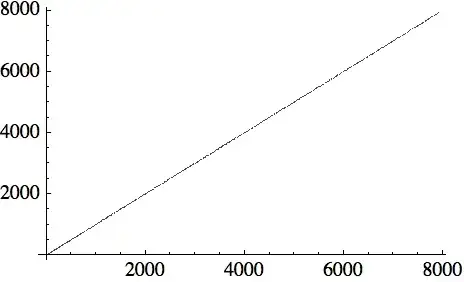
The best-fit slope for the first $10^3$ primes (shown) is $1.00046$;
for the first $10^5$ primes, the slope is $1.0000024$.
Why such rapid and close approach to a slope of $1$?
I (naively) expected more variation/spread...
What property of an increasing list of numbers would ensure this pairing will closely approach a slope of $1$?