6

While reading Walter Rudin's Principles of Mathematical Analysis, I ran into the following theorem and proof:

Theorem 2.12. Let $\left\{E_n\right\}$, $n=1,2,\dots$, be a sequence of countable sets, and put

$$ S=\bigcup_{n=1}^\infty E_n. $$

Then $S$ is countable.

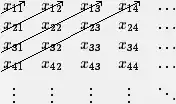
Proof. Let every set $E_n$ be arranged in a sequence $\left\{X_{nk}\right\}$, $k=1,2,3,\dots$, and consider the infinite array

                                                            enter image description here

in which the elements of $E_n$ form the $n$th row. The array contains all elements of $S$. As indicated by the arrows, these elements can be arranged in a sequence

$$ x_{11};x_{21},x_{12};x_{31},x_{22},x_{13};x_{41},x_{32},x_{23},x_{14};\dots\tag{*} $$

If any two of the sets $E_n$ have elements in common, these will appear more than once in $(*)$. Hence there is a subset $T$ of the set of all positive integers such that $S\sim T$, which shows that $S$ is at most countable. Since $E_1\subset S$, and $E_1$ is infinite, $S$ is infinite, and thus countable. $\blacksquare$
How does the bolded sentence follow from all previous? In fact, I do not know how the matrix and $(*)$ come into play.

wjmolina
  • 6,360
  • 7
  • 47
  • 97

2 Answers2

7

Look at the sequence *

$x_{11};x_{21},x_{12};x_{31},x_{22},x_{13};x_{41},x_{32},x_{23},x_{14};…$

Within each ;; add the suffixes.

1+1 =2

2+1 = 1+2 = 3

1+3 = 2+2 = 3+1 = 4

and so on.

So for any positive integer you shall get a countable (finite) number of such combination and in each case you shall get elements of $S$. If you remove duplicate items then you shall get a set $S$. This set will be bijective with the set of natural numbers as for each natural number you shall get only a finite number of elements.

I hope it is clear now. The bold sequence is constructed by taking arrows in the matrix. In the matrix the elements of the set $E_i$ are written in arrow.

user36339
  • 615
  • 1
  • 8
  • 24
Supriyo
  • 6,329
  • 7
  • 33
  • 64
  • But N is set of all positive integers. So to which term of the sequence does 1 correspond to? I mean the least sum is 2 so our sequence starts from x2 instead of x1. – Caratheodory_Enthusiast Oct 13 '19 at 14:56
  • @MayankJha Guess that's why in the original text Rudin says "Hence there is a subset $T$ of the set of all positive integers such that $S\sim T$" – C_Arietta_C Jul 14 '23 at 06:44
0

This does not address your specific question, but mapping injectively into powers of primes is a cute trick I always enjoy sharing.

Let $x_{ij}$ be the $i$th element of the $j$th set (the same indexing scheme you are using). The function defined by $f(x_{ij}) = 2^i3^j$ is an injection into the natural numbers, so there are countably-many $x$'s in total.

Austin Mohr
  • 26,272