Now, I can visualize how $a/b \times a/d=ab/cd$ for partial fractions, but I can't for the life of me visualize how they can work for multiplying an improper fraction anywhere (i.e. either multiplying a partial fraction with an improper one or two improper fractions).
Let's say, $1/5\times 2/3. $
Let's visualize it to get a good idea of what I'm talking about.
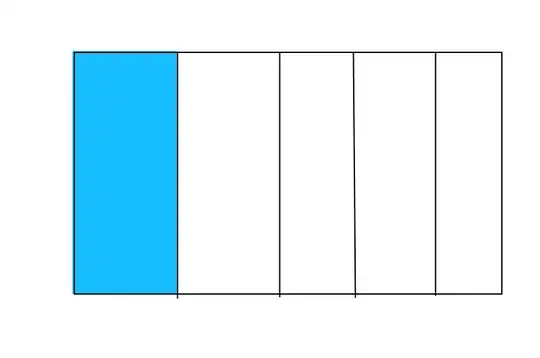 Now, let's "overlay" the denominator 3, by cutting that 5 up into 3 parts, making it $5\times3. $
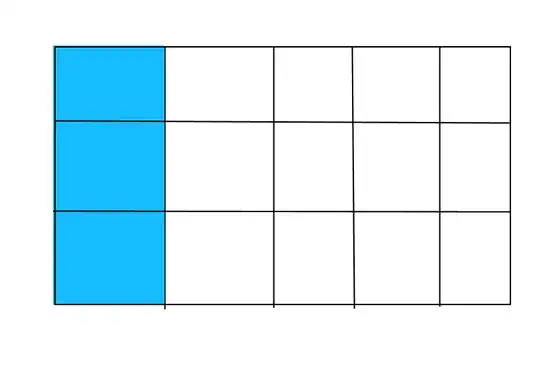 And now, let's get 2/3 of 1/5.

Now, as you can see, the shaded in "overlaid" part is $2/3 \times 1/5,$ or $2/15.$ However, I want to know how this could apply to both multiplying partial fractions with improper fractions (e.g. $1/3\times 4/3$) and also two improper fractions. I feel like both have a different way of how they work. Thank you.


