14

Suppose that we have a convex polyhedron $P$, such that the symmetry group of $P$ acts transitively on its vertices, edges, and faces (that is, it is isogonal, isotoxal, and isohedral). It then follows that $P$ is one of the Platonic solids, which have a number of equivalent definitions but usually includes some stipulation that the faces are regular. (Once you have regular faces plus these symmetry conditions, most other properties follow easily.)

This can be shown via a rather gross casework argument on the number of sides at each face. By face-transitivity, all faces are congruent (in fact, we only need that the polyhedron be monohedral for this). By edge-transitivity, said faces are equilateral polygons. Then we break into cases by the number of sides of the polygons:

  • If the faces are triangles, being equilateral implies being regular.

  • If the faces are non-regular equilateral quadrilaterals, they are rhombi. Then, at every vertex there must be an equal number of "skinny" and "wide" angles meeting, and there must be at least 3 faces meeting at a vertex. But then there are at least two skinny and two wide angles (since we assume the angles are different), so the angles at each vertex add up to at least 360 degrees, which is not possible in a convex polyhedron.

  • If the faces are non-regular equilateral pentagons, then they have angles which are not all the same; however, each vertex must have the same angles around it, so each vertex has a proportional fraction of the angles of the pentagons. But for any distribution other than the uniform one, the only way to have a proportional amount of every angle is to have some $n$ copies of every angle with multiplicity, since $5$ is prime. (E.g. if there are $2$ angles of one size and $3$ of another, we can't get a $2:3$ ratio without having at least $5$ angles at every vertex.) But the angles of a pentagon add to more than $360^\circ$, so we can't have them all at once.

  • If the faces are hexagons or higher, they cannot form a topological sphere by Euler's formula.

However, I don't like this proof very much; I walk away from it with no understanding of why this behavior occurs, and it certainly doesn't suggest any generalizations to other dimensions (where I believe the analogous statement - that transitivity on every degree of cell in a convex polytope implies regularity - is true, though I would appreciate a reference for this fact).

Is there a natural or more elegant proof of this statement?

One thing to note is that any proof must somehow use the fact that we are working on the sphere. In the case of planar tilings, the corresponding implication is false: being transitive on faces, vertices, and edges does not imply that one is looking at a tiling of regular polygons! As a counterexample, consider a rhombic tiling like this one:

                                  enter image description here

As another aside, relaxing any one of these conditions allows for polyhedra whose faces are not congruent regular polygons: the rhombic dodecahedron is face-transitive and edge-transitive, an isosceles tetrahedron is face-transitive and vertex-transitive, and the cuboctahedron is edge-transitive and vertex-transitive.

  • 1
    As one possible lead, it appears that every polyhedron which is edge-transitive and vertex-transitive has regular polygonal faces, though they are not necessarily congruent to one another. Perhaps this fact can be directly shown? If so, the desired statement would follow immediately. I would be somewhat surprised if this had a nice proof, though. – RavenclawPrefect Dec 30 '20 at 19:38
  • I've added a totally different type of proof which uses group properties more directly. –  Feb 17 '21 at 01:35
  • @RavenclawPrefect There is a rather short argument for this: if your polyhedron is vertex- and edge-transitive, then it is inscribed and all its edges are of the same length. The same then holds for its faces, which must then be regular polygons. – M. Winter Feb 18 '21 at 14:45
  • @M.Winter Sounds interesting - can you link to such an argument? – RavenclawPrefect Feb 18 '21 at 14:59
  • @RavenclawPrefect There is not much of a reference to give, this is rather elementary. But I elaborated this in an answer. Let me know if some part is unclear. – M. Winter Feb 18 '21 at 15:38
  • @RavenclawPrefect In fact, I consider this argument the standard argument for problems like this, because it has nothign to do with symmetry. Every inscribed polytope (of any dimension) in which all edges are of the same length has all its 2-dimensional faces regular. – M. Winter Feb 18 '21 at 18:07
  • in fact this given argument works both in spherical and hyperbolic geometries, it just happens to break down for the flat euclidean case, where the above counterexample becomes possible. – Dr. Richard Klitzing Sep 14 '21 at 16:20

3 Answers3

5

This is a more elaborate version of my comment below the question.

The first two observations are:

  • if $P$ is edge-transitive, then all its edges are of the same length.
  • if $P$ is vertex-transitive, then $P$ is inscribed, that is, all its vertices are one a common sphere.

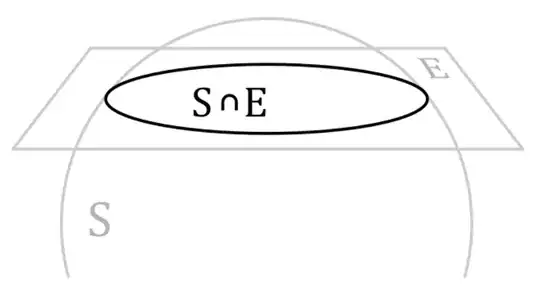
The next observation is the following: if $P$ has both properties, then also all its faces must have both properties. This is obvious for the edge lengths. For being inscribed consider the following image:

All vertices of $P$ are on a sphere $S$. If $f$ is a face of $P$ and $E$ is the plane that contains $f$, then $S\cap E$ is a circle that contains all the vertices of $f$. In other words, $f$ is inscribed as well.

So all faces of $P$ are inscribed and have all edges of the same length. The final observation is that the faces must then be regular polygons. This is easiest seen via an explicit construction:

enter image description here

If the radius of the circle and the edge lengths are fixed, then placing a single edge in the circle inductively determines all other edges as shown in the figure. That is, the inscribed polygon with this edge length is uniquely determined. But a regular polygon has this property, and so the face must be this regular polygon.

M. Winter
  • 30,828
3

Let a vertex have degree $\rho$ and a face have $s$ edges and note that $$\rho V=2E=sF\tag 1$$

Let $G$ be the group of symmetries. Let $G_v,G_e\text { and }G_f$ be the stabiliser of a vertex $v$, edge $e$ and face $f$, respectively. Then $$|G|=|G_v||V|=|G_e||E|=|G_f||F|\tag 2$$ If $G_e$ has a non-identity symmetry then it is a rotation of $180^o$ about the mid-point of the edge. Comparing (1) and (2) we then have $|G_f|=s$ and the face is regular.

Otherwise $|g_e|=1$. Again comparing (1) and (2) we have $|G_v|=\frac{\rho}{2} \text { and } |G_f|=\frac{s}{2}$. Therefore $\rho\ge 4$ and $s\ge 4$ and then Euler's formula gives $$\frac{E}{2}+\frac{E}{2}\ge E+2.$$

If $G$ includes reflections

The only 'extra' case is $|G_v|=\rho, |G_e|=2, |G_f|=s$, where both $G_v$ and $G_f$ contain reflections. However, the orders of the two groups, $\rho$ and $s$, are then both even and we still have $\rho\ge 4$ and $s\ge 4$.

  • Ah, nice! (Just to elaborate on why this is impossible, since it took me a second: if $\rho$ and $s$ are each even, then $V$ and $F$ are both multiples of $E$, so $E$ divides $2$, but obviously a polyhedron needs more than $2$ edges.) – RavenclawPrefect Feb 17 '21 at 02:09
  • V and F aren't multiples of E. The reason its impossible is that $\rho$ and s are both at least $4$ which contradicts Euler. –  Feb 17 '21 at 08:25
  • It would seem to me that this argument should extend and, even without Euler, places considerable limits on what is possible re. the symmetries. But my guess would be that in a higher dimension this argument will make the 'LHS ' of Euler too small. –  Feb 17 '21 at 08:57
  • Are the symmetries you are using in this proof restricted to rotations only? Cause otherwise $G_e$ could contain one or two reflections, and also $|G_f|=s$ would not by itself imply the faces are regular. I think you've shown that if you have all the transitivities using rotations only then it is platonic, but it does not seem to be a complete proof if reflections are included. – Jaap Scherphuis Feb 17 '21 at 10:13
  • 1
    Wolfram does not include reflections in its polyhedron groups and I tend to rely on Wolfram over Wikipedia. After all reflections are not physically possible. –  Feb 17 '21 at 10:30
  • 1
    One can ask the question ... if the extended symmetry group but not the polyhedron group has an action which is transitive then ... –  Feb 17 '21 at 10:32
  • I'm travelling today and unlikely to find time to type it out but I've gone through the argument in my head and I am sure that the same argument works. You might like to try it yourself. The only possibilities for $|G_e|$ are 1,2,4. An extra case which is a nuisance but each possibility allows us to determine variables in terms of $E$ etc. Euler is possible for the case 4 but then $|G_f|=2s$ and the face is regular. –  Feb 17 '21 at 10:55
  • The only case that might cause trouble is the $|G_e|=2$, $|G_f|=s$ case where the edge symmetry is reflection through a plane containing the edge, cause there it does not directly tell you more about the symmetry of the face itself. – Jaap Scherphuis Feb 17 '21 at 12:08
  • @Jaap Scherphuis. Yes this is the'new' case but we still have the same proof - I've included this in the answer. –  Feb 17 '21 at 16:19
0

I shall use Euler's polyhedron formula. (It does generalise to a higher dimension!) Let each face have $e$ edges and let $\rho$ edges meet at each vertex and then we have the standard result that $$\frac{1}{\rho}+ \frac{1}{e}>\frac{1}{2} \text { and therefore one of } e,\rho \text { is } 3.$$ If $e=3$ then we have triangular faces with edges of equal length and we are finished.

Therefore $\rho=3$. If the three angles at a vertex are not all equal the ratio of different sized angles is either $1:2$ or $1:1:1$. This ratio must be the same for the angles in a face and so $e$ is a multiple of $3$ and then $\frac{1}{\rho}+ \frac{1}{e}$ is too small.

  • I confess that this proof still feels pretty casework-y to me. Can you elaborate on the generalization to higher dimensions? I agree we have an analog of Euler's formula, but I don't see how it allows us to carry forward this sort of argument; certainly $1/p+1/e>1/2$ is not true in general, for instance in the $120$-cell. (And even if we can conclude the analogous result for polychora that either $e=6$ around a cell or $p=4$, the final conclusion doesn't seem to go through.) – RavenclawPrefect Feb 16 '21 at 22:31
  • This is a proof for 3D which offers the potential for extension since Euler's formula does extend i.e. it offers topological restrictions on the possibilities. If you don't like it then so be it - it looks simple and elegant to me! –  Feb 16 '21 at 22:48
  • I agree Euler's formula extends, I just think the argument will break down after that in higher dimensions because it relies on the primality of $\rho=3$, while in general $\rho$ will just be the dimension of our regular polyhedra. (I do like this proof better than the one in my original post, since it deals with two cases rather than four, but it still sort of feels "lucky" to me that the proof happens to work out, if that makes sense.) – RavenclawPrefect Feb 17 '21 at 02:17