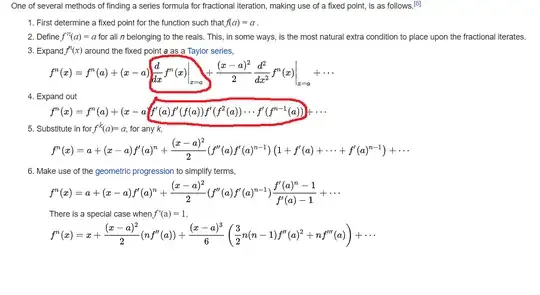
Here's a partial answer:
You might want to take a look at fractional calculus
The notation here is a bit confusing.
$f^n(x)$ is often used for the nth derivative of f (ie: $\frac{d^nf}{dx^n}$)
However here it is being used for repeated functional composition.
ie: $f(f(f(...))) $
One could consider an operator $H$ that when applied twice to a function gave the derivative.
$H(H(f(x))) = \frac{df}{dx} = D(F(x))$
$H$ could be thought of as the fractional derivative $D^\frac{1}{2}$.
Wikipedia gives an example of computing such an operator
$\frac{d^a}{dx^a} x^k = \frac{k!}{(k-a)!}x^{k-a}$
They replace the factorial with the gamma function to allow for non integer values.
I'm not sure if there's a proof of the uniqueness of such a solution.