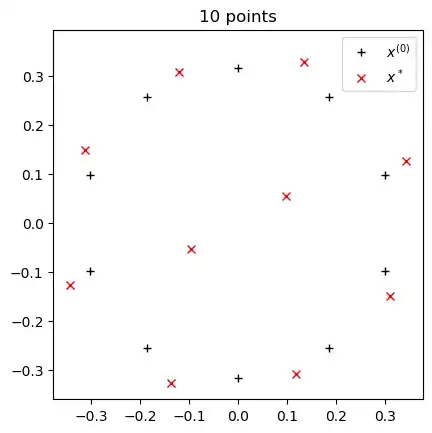
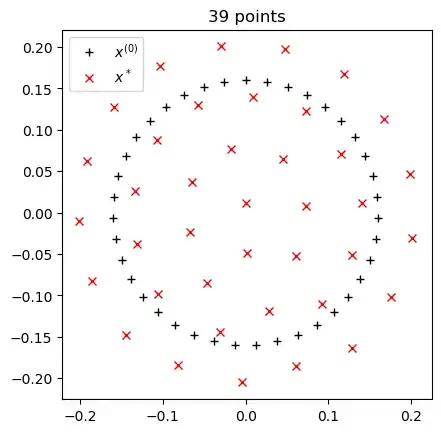
Consider an unconstrained matrix $Y\in{\mathbb R}^{2\times n}$ and with magnitude $\mu=\sqrt{\operatorname{tr}(Y^TY)}$.
Using a colon to denote the trace product, i.e. $\,A:B=\operatorname{tr}(A^TB),\,$ we can differentiate the magnitude as
$$\mu^2=Y:Y \implies\mu\,d\mu=Y:dY$$
Collect the $x_i$ vectors into the columns of a matrix, $X\in{\mathbb R}^{2\times n}$
Then the elements of the Grammian matrix $\,G=X^TX\,$ equal the dot products of the vectors and the main diagonal contains their squared lengths.
Thus the problem's constraint can be expressed as the trace of $G$
$$1 = \operatorname{tr}(G) = X:X$$
and $X$ can be construct from $Y$ such that this constraint is always satisfied
$$\eqalign{
X &= \mu^{-1}Y \quad\implies X:X = \mu^{-2}(Y:Y) = 1 \\
dX &= \mu^{-1}dY - \mu^{-3}Y(Y:dY) \\
}$$
Columnar distances can be calculated from $G$ and the all-ones vector ${\tt1}$
$$\eqalign{
G &= X^TX \;=\; \tfrac{Y^TY}{Y:Y} \\
g &= \operatorname{diag}(G) \\
A_{ij} &= \|x_i-x_j\| \quad\implies A= g{\tt1}^T + {\tt1}g^T - 2G \\
B &= A+I,\quad C= B^{\odot-3/2} \\
L &= \operatorname{Diag}(C{\tt1})-C \;=\; I\odot(C{\tt11}^T)-C \\
}$$
Adding the identity matrix gets rid of the zero elements on the main diagonal, and allows the calculation of the inverse Hadamard $(\odot)$ powers needed for the objective function and its derivative.
$$\eqalign{
f &= {\tt11}^T:B^{\odot-1/2} \;-\; {\tt11}^T:I \\
df &= -\tfrac{1}{2}C:dB \\
&= \tfrac{1}{2}C:(2\,dG - dg\,{\tt1}^T - {\tt1}\,dg^T) \\
&= C:dG - \tfrac{1}{2}(C{\tt1}:dg+{\tt1}^TC:dg^T) \\
&= C:dG - C{\tt1}:dg \\
&= \Big(C - \operatorname{Diag}(C{\tt1})\Big):dG \\
&= -L:dG \\
}$$
Pause here to note that $L$ is the Laplacian of $C$ and the matrices $(A,B,C,G,L)$ are all symmetric.
$$\eqalign{
df &= -L:(dX^TX+X^TdX) \\
&= -2L:X^TdX \\
&= -2XL:dX \\
&= -2\mu^{-1}YL:(\mu^{-1}dY - \mu^{-3}Y(Y:dY)) \\
&= 2\mu^{-2}\Big(\mu^{-2}(YL:Y)Y - YL\Big):dY \\
&= 2\mu^{-2}\Big((G:L)Y - YL\Big):dY \\
\frac{\partial f}{\partial Y}
&= 2\mu^{-2}\Big((G:L)Y - YL\Big) \\
}$$
Since $Y$ is unconstrained, setting the gradient to zero yields a first order conditon for optimality.
$$\eqalign{
YL &= (G:L)Y \;=\; \lambda Y \\
LY^T &= \lambda Y^T \\
}$$
This has the form of an eigenvalue problem, except that $L$ is a nonlinear function of $Y$.
However, the relationship does reveal that both rows of $Y$ must be eigenvectors of $L$ associated with some eigenvalue of multiplicity $>1$.
Since $L$ is a Laplacian, ${\tt1}$ is guaranteed to be an eigenvector of $L$ associated with $\lambda=0.$
If $\operatorname{rank}(L)\le(n-2)$ then there are additional vectors in the nullspace of $L$ which can be used in the second row. When plotted such a solution would appear as a vertical line, since the first component of each $x_i$ vector will be identical.
Summary
- The original constrained problem can be converted into an unconstrained
problem.
- All solutions must satisfy FOCs in the form of
a nonlinear EV problem.
- Despite their nonlinear nature, one eigenpair
$\big(\{\lambda,v\}=\{0,{\tt1}\}\big)$ is already known.
- Iff a second eigenpair $\{0,v\}$ exists, then points of the solution
$Y=\big[{\tt1}\;\;v\big]^T$ lie on a line.
- In any event, two $v_k$ with the same $\lambda$ are needed for
a solution $Y=\big[v_1\;\;v_2\big]^T$
- SOCs will need to be calculated and evaluated to determine if a
particular FOC solution represents a (local) minimum or maximum.
Another way to approach the problem is to treat each $x_i$ as a complex scalar rather than a real vector. Then instead of the matrix $X\in{\mathbb R}^{2\times n}$ the analysis would focus on the complex vector $z\in{\mathbb C}^{n}$.
It's a straightforward exercise to numerically verify that the vertices of a regular polygon $(Y_{poly})$ satisfy the nonlinear EV equation.
It's also easy to perturb $Y_{poly}$ and check for nearby $Y$'s with a smaller objective. This verifies that $Y_{poly}$ is a minimum without needing to find the SOCs.
#!/usr/bin/env  julia
using LinearAlgebra;
n = 5  # a pentagon
u,v = ones(n,1), 2*pi*collect(1:n)/n
c,s = cos.(v+u/n), sin.(v+u/n)  # add u/n to avoid 0-elements
Y = [c s]'; X = Y/norm(Y); G = X'X; g = diag(G);
A = g*u' + u*g' - 2*G
B = A+I; C = B.^(-3/2); L = C - Diagonal(vec(C*u));

# verify that Y solves the EV equation (via element-wise quotient)
Q = (L*Y') ./ Y'
   -15.3884  -15.3884
   -15.3884  -15.3884
   -15.3884  -15.3884
   -15.3884  -15.3884
   -15.3884  -15.3884
# the eigenvalue is -15.3884
# now verify that the constraint is satisfied
tr(G)
  0.9999999999999998

# objective function
function f(Y)
  m,n = size(Y)
  X = Y/norm(Y); G = X'X; g,u = diag(G), ones(n,1)
  A = g*u' + u*g' - 2*G;  B = A + I
  return sum(B.^(-0.5)) - n
end

# evaluate at *lots* of nearby points
fY,h = f(Y), 1e-3  # "nearby" is defined by h
extrema( [f(Y+randn(size(Y))*h)-fY  for k=1:9999] )
  (2.056884355283728e-6, 0.00014463419313415216)
# no negative values  ==>  f(Y) is a minimum
#