6

Studying aspects of this problem I stumbled on this question.

Designating the golden ration by $\phi=\frac{1+\sqrt{5}}{2} \simeq 1.61803$ and letting

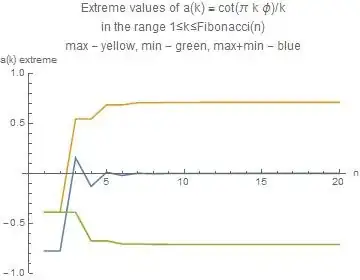
$$a(n) = \frac{1}{n} \cot(n \pi \phi)$$

(i) prove that $a(n)$ is bounded from above and from below

(ii) calculate $\max (a(n))$ and $\min (a(n))$ with $n =1,2,3,...$

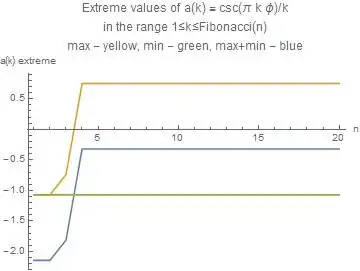
(iii) solve the similar problem when $\cot$ is replaced by $\csc$, i.e. consider

$$b(n) = \frac{1}{n \sin(\pi \phi n)}$$

In this case check the validity of my conjecture that $b(1)< b(n) < b(3)$ for $n\gt 3$

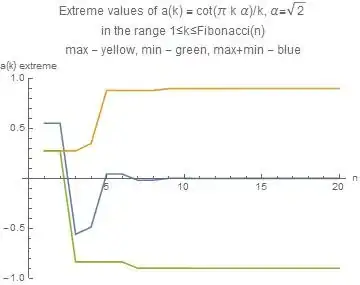
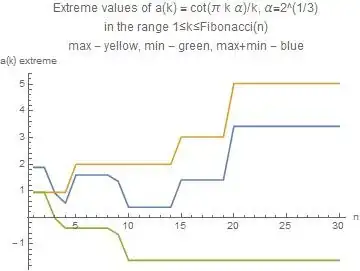
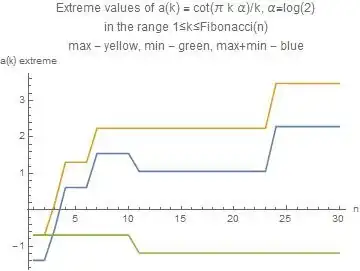
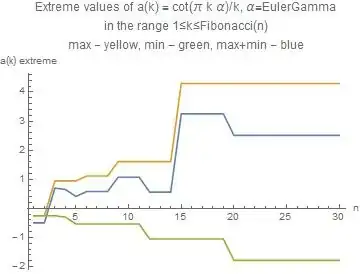
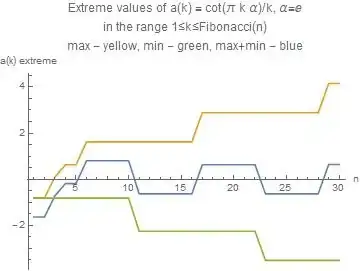
(iv) Extension: the same if $\phi$ is replaced by other irrational quantities like $\sqrt{2}$, $2^{\frac{1}{3}}$, $\log{2}$, $\gamma$, $\pi$, $e$. Here except for the case $\sqrt{2}$ I have no indication that the extremes exist at all, i.e. that $a(n)$ is bounded if $n \to \infty$.

What makes this question interesting (IMHO)?

One aspect is this:

The expression $b(n)$, when considered as a function of real $n\gt 0$ has simple poles at

$$n_{k} = k/ \phi, k=1,2,3,...$$

An integer $n$ can become very close to an $n_k$. I found it surprising that the rather modest damping factor $\frac{1}{n}$ is able to cancel the steep rise in the vicinity of the poles.

What have I done so far?

The modest part I did up to now is in the reference above. Addtionally here are graphs of the quantities in question. Remark: the choice of Fibonacci numbers as the upper limit of the range is made plausible in the quoted investigation.
Dr. Wolfgang Hintze
  • 13,265
  • 25
  • 49

1 Answers1

1

For an irrational number with bounded partial quotient, we have the following.

If $\theta$ is an irrational number with bounded partial quotients, i. e. the continued fraction expansion of $\theta=[a_0;a_1,a_2,\ldots]$ has $a_n\leq K, \ n\geq 1$ for some fixed $K>0$. Then for any integer $p, q$ with $q>0$, we have an absolute constant $c=c(\theta)>0$ such that $$ \left| \theta-\frac pq \right| \geq \frac 1{cq^2}. $$

Then we have $k\|k\theta\|\geq c$ for any positive integer $k$ where $\|x\|$ is the distance to the nearest integer to $x$. Since $| \cot k\theta | = \frac1{\pi\|k\theta\|} + O(1)$, and $|\csc k\theta|=\frac1{\pi \|k\theta\|}+O(1)$, we have

$|\cot k\theta|/k\leq 1/(c\pi)+O(1)$, and $|\csc k\theta|/k\leq 1/(c\pi)+ O(1)$ for any integer $k>0$.

This proves the boundedness of the two sequences in case $\theta = \phi$, $\sqrt 2$, since they are quadratic irrationals, which have bounded partial quotients.

For other numbers, there are insufficient information to conclude the boundedness. See also this post in MathOverflow: https://mathoverflow.net/questions/224340/is-there-any-pattern-to-the-continued-fraction-of-sqrt32

See also this post of mine which used the same technique. Does $\sum_{k=1}^n|\cot \sqrt2\pi k|$ tends to $An\ln n$ as $n\to\infty$?

Sungjin Kim
  • 20,850
  • @ i707107 Your solution and you quoted post filled in the missing gap I encountered when trying to use Roth's theorem in the form $\left| \theta-\frac pq \right| \geq \frac 1{cq^{2+\epsilon}}$. Because I couldn't see that $\epsilon = 0$ for the algeraic numbers in question. I have learned also that they belong to the class of "irrational numbers with bounded partial quotients" (a concept which was new to me).. – Dr. Wolfgang Hintze Apr 28 '19 at 10:45