9

Why is the radians implicitly cancelled? Somehow, the feet just trumps the numerator unit. For all other cases, you need to introduce the unit conversion fraction, and cancel explicitly. Is it because radians and angles have no relevance to linear speed (v), so they are simply discarded?
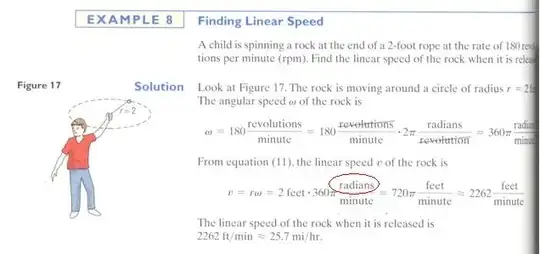
enter image description here

MJD
  • 67,568
  • 43
  • 308
  • 617
JackOfAll
  • 4,871

3 Answers3

10

Radians are dimensionless, i.e. there is nothing to cancel. This is because a radian is defined as a length over a length: $$\frac{\text{radius}}{\text{circumference}}$$

Zev Chonoles
  • 132,937
  • 1
    Makes sense. Almost. Since "radians" are dimensionless, why use it? It cancels. In the first equation, the rock rotates 180 times in a minute. So, it covers 360pi radians in a minute. In this equation, you must use radians to describe 360pi somethings per minute. In the 2nd equation, you are simply multiplying radius by this how much angle it sweeps per minute. Doesn't the same thing apply? 2 times 360pi somethings. No need to describe what there are 360pi's of? 360pi seems meaningless without the units to describe what you're counting (radians) – JackOfAll Feb 28 '13 at 00:57
  • @JackOfAll: A radian is dimensionless, yes, but that does not mean it is meaningless, or of arbitrary value. It is very specific--much in the same way (and strongly related to the fact) that the number $\pi$ is a very specific, meaningful, and dimensionless number. – Cameron Buie Feb 28 '13 at 07:18
  • Thank you Zev and Cameron. Let me sit in silence and ponder this. For now, I understand that once you introduce a radian measure into a linear measurement, the radians no longer apply, just the scalar value does. – JackOfAll Feb 28 '13 at 13:52
0

The units make better sense when you view a radius as distance per radian, i.e., the definition of a radian. Therefore, speed equals angular speed times radius because (distance / time) = (radians / time ) * ( distance / radian ).

Brad
  • 1
-1

So a radian is defined as

$1~\mathrm{radian} = \frac{\mathrm{radius}}{\mathrm{circumference}}$?

No, the radius over the circumference is a pure number equal to $1/(2\pi)$.

"One radian is the angle subtended at the center of a circle by an arc that is equal in length to the radius of the circle" is the more accurate definition. [1]

[1] http://en.wikipedia.org/wiki/Radian

  • Let's take an angle $\theta$. If angles were not dimensionless, a quantity like $\theta^2$ should never under any circumstances be added to a quantity like $\theta$ itself, right? How do you propose to make sense of $$\sin(\theta)=\theta-\frac{\theta^3}{3!}+\frac{\theta^5}{5!}-\cdots$$ – Zev Chonoles Jul 12 '13 at 19:32
  • The trig functions operate on ratios of arc-length-to-radius which is an alternative and dimensionless representation of an angle. Alternatively, we can think of the argument to the trig functions as being normalized to 1 radian of angle.

    We can also treat angles dimensionally if we explicitly call the trig functions with a normalization factor, for example,

    $\sin(\frac{\theta}{1~\mathrm{rad}})=\frac{\theta}{1~\mathrm{rad}}-\left ( \frac{\theta}{1~\mathrm{rad}} \right )^3 / 3! + ...$

    – Mitchell Jul 12 '13 at 20:59
  • I think Mitchell's point (which couldn't be left as a comment for reputation reasons) is the legitimate nit-pick that 'a radian' is not radius/circumference; rather, that is $1/2\pi$ radians (or better, circumference/radius is $2\pi radians$). – Steven Stadnicki Jul 12 '13 at 21:03
  • @StevenStadnicki Thanks, Steven. I would drop the radians from your last statement though. The circumference divided by the radius is simply $2\pi$. It's not an angle, just a ratio. – Mitchell Jul 12 '13 at 21:08
  • @Mitchell: What do you mean by "alternative representation"? Units are units; there's no alternative representation of a length, time, etc. that makes it a pure number. – Zev Chonoles Jul 12 '13 at 21:14
  • @Steven: I don't think that's Mitchell's point - Mitchell does not think that angles are unitless. As for my answer, I agree it could perhaps be better phrased as "one radian" instead of "a radian", but it is still the correct answer in terms of angles being unitless. – Zev Chonoles Jul 12 '13 at 21:16
  • @ZevChonoles Any angle can be described by a ratio of arc length to radius, just like any distance can be described as the time it takes light to go that distance. It doesn't mean that angle and distance can't be treated as dimensions in their own right. The trig functions expect their argument in radians, so we take the angle we'd like to insert, divide it by 1 radian, and pass it along. We just usually omit the division by 1 radian. I guess I should add that angles can be treated as dimensionless quantities, I just don't think they are required to be. – Mitchell Jul 12 '13 at 21:17
  • @StevenStadnicki I posted a long rant earlier about this that ZevChonoles must have seen. http://math.stackexchange.com/questions/103897/why-is-an-angle-dimensionless – Mitchell Jul 12 '13 at 21:21
  • @Mitchell: That's not an apt comparison, since light's speed (in a vacuum) being constant is a contingent property of the universe, whereas angles being unitless is not (it's a consequence of the human-chosen definitions). Your comparison also does not give an example of a quantity with units being "alternatively represented" as one without units; you just have different units. – Zev Chonoles Jul 12 '13 at 21:22
  • @ZevChonoles Well, in the case of replacing distance by time, I am just substituting one dimension for another. In the case of the angle, I am adding a dimension. http://physics.stackexchange.com/questions/52976/how-can-the-speed-of-light-be-a-dimensionless-constant http://en.wikipedia.org/wiki/Natural_units#Planck_units – Mitchell Jul 12 '13 at 21:29