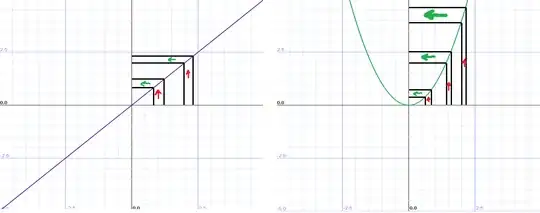
I'm told that a function defined on an interval $[a,b]$ or $(a,b)$ is uniformly continuous if for each $\epsilon\gt 0$ there exists a $\delta\gt 0$ such that $|x-t|\lt \delta$ implies that $|f(x)-f(t)|\lt \epsilon$. Then it gives a little note saying that $\delta$ cannot depend on $x$, it can only depend on $\epsilon$.
With ordinary continuity, the $\delta$ can depend on both $x$ and $\epsilon$. I'm just a little lost on why $|x-t|\lt \delta$ implies $|f(x)-f(t)|\lt \epsilon$, and how $\delta$ can't depend on $x$ but only $\epsilon$.